Ch. 8 - Delocalized Electrons: Their Effect on Stability, pKa, and the Products of a Reaction • Aromaticity and Electronic Effects: An Introduction to the Reactions of Benzene
Bruice - Organic Chemistry 8th Edition
Bruice8th EditionOrganic ChemistryISBN: 9780135213711당신이 사용하는 게 아니라요?교과서 변경
8장, 문제 20d,e,f

For each of the following substituents, indicate whether it withdraws electrons inductively, donates electrons by hyperconjugation, withdraws electrons by resonance, or donates electrons by resonance.
d. NHCH3
e. OCH3
f. +N(CH3)3

검증된 단계별 안내
1
Step 1: Understand the four electronic effects mentioned in the problem: (1) Inductive electron withdrawal occurs when a substituent pulls electron density through sigma bonds due to its electronegativity. (2) Hyperconjugation involves the donation of electron density through overlap of sigma bonds with an adjacent empty or partially filled orbital. (3) Resonance electron withdrawal happens when a substituent withdraws electron density through delocalization of electrons via pi bonds. (4) Resonance electron donation occurs when a substituent donates electron density through delocalization of lone pairs or pi electrons into the conjugated system.
Step 2: Analyze the substituent in part (d). Determine if the substituent has electronegative atoms or groups that can withdraw electrons inductively, lone pairs that can participate in resonance donation, or pi systems that can withdraw electrons by resonance.
Step 3: Analyze the substituent in part (e). Follow the same process as in Step 2, identifying whether the substituent exhibits inductive withdrawal, hyperconjugation donation, resonance withdrawal, or resonance donation based on its structure and electronic properties.
Step 4: Analyze the substituent in part (f). Again, evaluate the substituent's ability to withdraw or donate electrons through inductive effects, hyperconjugation, or resonance mechanisms. Pay attention to the presence of electronegative atoms, lone pairs, or conjugated systems.
Step 5: Summarize the findings for each substituent (d, e, f) based on the analysis. Clearly indicate which electronic effect(s) each substituent exhibits, ensuring the reasoning aligns with the substituent's structure and electronic characteristics.

비슷한 문제에 대한 검증된 영상 답변:

이 영상 해법은 위 문제에 도움이 된다고 튜터들이 추천한 것입니다.
영상 길이:
2m

주요 개념

질문에 올바르게 답하기 위해 반드시 이해해야 하는 핵심 개념들은 다음과 같습니다.

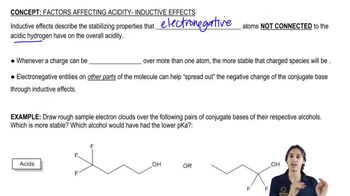
Inductive Effect

The inductive effect refers to the permanent polarization of a bond due to the electronegativity difference between atoms. Electronegative atoms or groups can withdraw electron density from adjacent atoms, leading to a decrease in electron density in the molecule. This effect diminishes with distance and is crucial for understanding how substituents influence the reactivity and stability of organic compounds.
추천 영상:
01:47
Understanding the Inductive Effect.

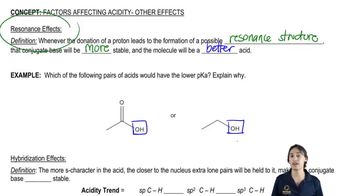
Resonance Effect

The resonance effect involves the delocalization of electrons across multiple atoms in a molecule, which can stabilize the structure. Electron-donating groups can provide electron density through resonance, while electron-withdrawing groups can pull electron density away. Understanding resonance is essential for predicting the behavior of substituents in reactions and their impact on molecular stability.
추천 영상:
03:32
Understanding Resonance Effects

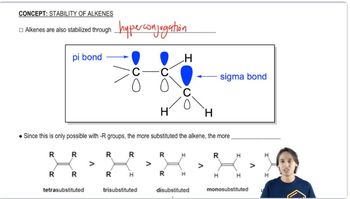
Hyperconjugation

Hyperconjugation is a stabilizing interaction that occurs when electron density from a filled orbital (usually a sigma bond) interacts with an adjacent empty orbital (like a pi bond or a carbocation). This effect can lead to increased stability in certain molecular structures, particularly in carbocations, and is important for understanding how alkyl groups can donate electron density to positively charged centers.
추천 영상:
04:28
Understanding trends of alkene stability.