Ch. 10 - Alkynes: Electrophilic Addition and Redox Reactions
Mullins - Organic Chemistry: A Learner Centered Approach 1st Edition
Mullins1st EditionOrganic Chemistry: A Learner Centered ApproachISBN: 9780137566471당신이 사용하는 게 아니라요?교과서 변경
9장, 문제 44c(vi)

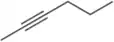
For the alkynes shows here, show the product(s) expected to form when treated under the following conditions: (vi) H2SO4, HgSO4, H2O. If you expect two products, show both.
(c) Chemical structure of alkynes illustrating expected products from oxymercuration with H2SO4, HgSO4, and H2O.

검증된 단계별 안내
1
Identify the alkyne structure provided in the problem. Determine whether it is a terminal alkyne (triple bond at the end of the chain) or an internal alkyne (triple bond within the chain). This distinction is important for predicting the product.
Understand the reaction conditions: H₂SO₄ (sulfuric acid), HgSO₄ (mercuric sulfate), and H₂O (water). These conditions promote the hydration of alkynes, leading to the formation of a ketone via the Markovnikov addition of water across the triple bond.
Apply the mechanism: The alkyne reacts with H₂O in the presence of H₂SO₄ and HgSO₄. First, the alkyne is protonated to form a carbocation intermediate. The Hg²⁺ ion stabilizes the carbocation, and water adds to the more substituted carbon (Markovnikov addition).
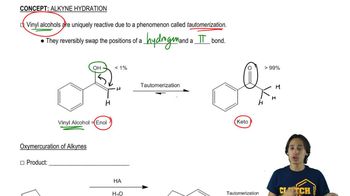
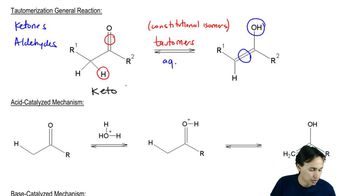
Recognize the enol intermediate: The addition of water forms an enol (a compound with a hydroxyl group attached to a carbon-carbon double bond). This enol is unstable and undergoes tautomerization to form a ketone. Tautomerization involves the migration of a proton and the rearrangement of the double bond.
If the alkyne is symmetrical, a single ketone product will form. If the alkyne is asymmetrical, two possible ketone products may form due to the different substituents on either side of the triple bond. Analyze the structure of the alkyne to determine whether one or two products are expected.

비슷한 문제에 대한 검증된 영상 답변:

이 영상 해법은 위 문제에 도움이 된다고 튜터들이 추천한 것입니다.
영상 길이:
5m

주요 개념

질문에 올바르게 답하기 위해 반드시 이해해야 하는 핵심 개념들은 다음과 같습니다.

Alkyne Hydration

Alkyne hydration is a chemical reaction where an alkyne reacts with water in the presence of an acid catalyst, typically sulfuric acid (H₂SO₄) and a mercury(II) salt (HgSO₄). This process leads to the formation of an enol, which can tautomerize to a more stable ketone. Understanding this reaction is crucial for predicting the products formed when alkynes are treated under these conditions.
추천 영상:
09:11
Alkyne Hydration

Markovnikov's Rule

Markovnikov's Rule states that in the addition of HX (where X is a halogen or OH) to an alkene or alkyne, the hydrogen atom will attach to the carbon with the greater number of hydrogen atoms already attached. This principle helps predict the regioselectivity of the reaction, guiding the formation of the major product when alkynes undergo hydration.
추천 영상:
03:54
The 18 and 16 Electron Rule

Tautomerization

Tautomerization is a chemical process where a compound exists in two interconvertible forms, typically involving the relocation of a proton and a shift of a double bond. In the context of alkyne hydration, the initial enol product can convert to a ketone through tautomerization, which is often the more stable and predominant form. Recognizing this process is essential for identifying all possible products of the reaction.
추천 영상:
05:11
Tautomerization Mechanisms