Ch. 10 - Alkynes: Electrophilic Addition and Redox Reactions
Mullins - Organic Chemistry: A Learner Centered Approach 1st Edition
Mullins1st EditionOrganic Chemistry: A Learner Centered ApproachISBN: 9780137566471당신이 사용하는 게 아니라요?교과서 변경
9장, 문제 61

An alternate method for the synthesis of alkynes relies on the double elimination of H―Br from a dihaloalkane under basic conditions. Suggest a mechanism for this reaction that we discuss in Chapter 12.
Chemical reaction diagram showing double elimination of H―Br from a dihaloalkane using sodium amide to form an alkyne.

검증된 단계별 안내
1
Step 1: Begin by identifying the starting material, which is a dihaloalkane. A dihaloalkane contains two halogen atoms (e.g., bromine) attached to adjacent carbon atoms in the molecule.
Step 2: Recognize that the reaction occurs under basic conditions. A strong base, such as NaNH₂ or KOH, is typically used to facilitate the elimination process. The base will abstract a proton (H⁺) from the molecule.
Step 3: In the first elimination step, the base abstracts a proton from a carbon atom adjacent to one of the halogen atoms. This leads to the formation of a carbanion intermediate. The halogen atom (e.g., Br) leaves as a halide ion (Br⁻), resulting in the formation of a double bond (alkene).
Step 4: In the second elimination step, the base abstracts another proton from the carbon atom adjacent to the remaining halogen atom. This leads to the formation of another carbanion intermediate. The second halogen atom leaves as a halide ion, resulting in the formation of a triple bond (alkyne).
Step 5: The final product is an alkyne, formed after the double elimination of H―Br from the dihaloalkane. The reaction mechanism involves two consecutive E2 elimination steps, where the base facilitates the removal of protons and halide ions to form the alkyne.

비슷한 문제에 대한 검증된 영상 답변:

이 영상 해법은 위 문제에 도움이 된다고 튜터들이 추천한 것입니다.
영상 길이:
1m

주요 개념

질문에 올바르게 답하기 위해 반드시 이해해야 하는 핵심 개념들은 다음과 같습니다.

Alkynes and Their Synthesis

Alkynes are hydrocarbons containing at least one carbon-carbon triple bond. They can be synthesized through various methods, including the double elimination of hydrogen halides from dihaloalkanes. Understanding the structure and reactivity of alkynes is crucial for predicting the outcomes of synthetic reactions.
추천 영상:
09:11
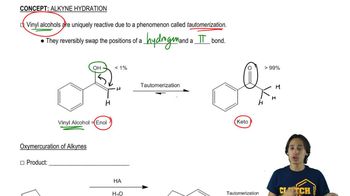
Alkyne Hydration

Dihaloalkanes

Dihaloalkanes are organic compounds that contain two halogen atoms attached to a carbon chain. Their reactivity is influenced by the nature of the halogens and the surrounding conditions. In the context of alkyne synthesis, the elimination of H-Br from a dihaloalkane is a key step that requires a strong base to facilitate the reaction.

Elimination Reactions

Elimination reactions involve the removal of atoms or groups from a molecule, resulting in the formation of a double or triple bond. In this case, the double elimination of H-Br from a dihaloalkane leads to the formation of an alkyne. Understanding the mechanism of elimination reactions, including the role of bases and the formation of intermediates, is essential for predicting reaction pathways.
추천 영상:
00:40
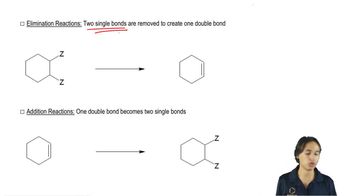
Recognizing Elimination Reactions.