Ch. 11 - Properties and Synthesis of Alkyl Halides: Radical Reactions
Mullins - Organic Chemistry: A Learner Centered Approach 1st Edition
Mullins1st EditionOrganic Chemistry: A Learner Centered ApproachISBN: 9780137566471당신이 사용하는 게 아니라요?교과서 변경
10장, 문제 19a

Using the bond-dissociation energies in Table 5.6,
(a) predict whether or not an iodine radical would be selective for forming a single radical propane.

검증된 단계별 안내
1
First, understand the concept of bond-dissociation energy (BDE). BDE is the energy required to break a bond in a molecule, resulting in the formation of radicals. It is a measure of bond strength.
Next, identify the relevant bond-dissociation energies from Table 5.6 for the bonds involved in the formation of a radical from propane. Typically, you would look at the C-H bond energies in propane.
Consider the iodine radical's reactivity. Iodine radicals are generally less reactive compared to other halogen radicals like chlorine or bromine. This is due to iodine's larger atomic size and lower electronegativity, which affects its ability to form strong bonds with hydrogen.
Compare the bond-dissociation energies of the C-H bonds in propane with the energy required to form an iodine-hydrogen bond. If the BDE of the C-H bond is higher than the energy required to form an I-H bond, the iodine radical may not be selective in forming a single radical from propane.
Finally, analyze the selectivity of iodine radicals. Due to their lower reactivity, iodine radicals are less selective and may not preferentially form a single radical from propane. This is in contrast to more reactive radicals, which can be more selective in their reactions.

비슷한 문제에 대한 검증된 영상 답변:

이 영상 해법은 위 문제에 도움이 된다고 튜터들이 추천한 것입니다.
영상 길이:
7m

주요 개념

질문에 올바르게 답하기 위해 반드시 이해해야 하는 핵심 개념들은 다음과 같습니다.

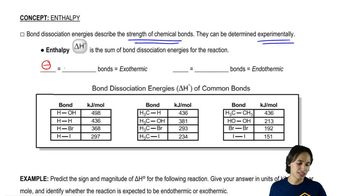
Bond-Dissociation Energy

Bond-dissociation energy (BDE) is the energy required to break a specific chemical bond in a molecule in the gas phase, resulting in the formation of radicals. It is a measure of bond strength; higher BDE indicates a stronger bond. Understanding BDE is crucial for predicting the stability of radicals formed during chemical reactions, as weaker bonds (lower BDE) are more likely to break, forming radicals.
추천 영상:
04:09
How to calculate enthalpy using bond dissociation energies.

Radical Stability

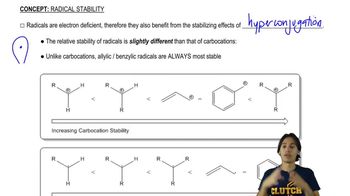
Radical stability refers to the relative stability of a radical species, which is influenced by factors such as the type of carbon atom the radical is on (primary, secondary, tertiary) and the presence of stabilizing groups or resonance. More stable radicals are less reactive and more likely to form. In the context of iodine radicals, understanding radical stability helps predict which radical species are more likely to form during a reaction.
추천 영상:
03:43
The radical stability trend.

Selectivity in Radical Reactions

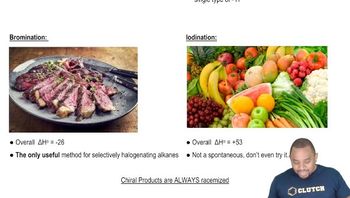
Selectivity in radical reactions refers to the preference of a radical to react with certain types of bonds over others, often influenced by the bond-dissociation energies and the stability of the resulting radicals. A selective radical will preferentially form the most stable radical product. In the case of iodine radicals, analyzing selectivity involves determining whether the iodine radical will preferentially abstract a hydrogen atom from a specific position in propane, leading to a single radical product.
추천 영상:
10:08
Radical selectivity: Food Analogy