Ch. 12 - Substitution and Elimination: Reactions of Haloalkanes
Mullins - Organic Chemistry: A Learner Centered Approach 1st Edition
Mullins1st EditionOrganic Chemistry: A Learner Centered ApproachISBN: 9780137566471당신이 사용하는 게 아니라요?교과서 변경
11장, 문제 12a

Practice your electron-pushing skills by drawing a mechanism for the following SN1 reactions.
(a) Chemical reaction diagram illustrating an SN1 reaction mechanism with reactants and products labeled.

검증된 단계별 안내
1
Step 1: Identify the substrate in the Sₙ1 reaction. The Sₙ1 mechanism typically involves a tertiary or secondary alkyl halide as the substrate, which can form a stable carbocation intermediate.
Step 2: Recognize the first step of the Sₙ1 mechanism, which is the loss of the leaving group. The leaving group departs, forming a carbocation intermediate. Represent this step using curved arrows to show the movement of electrons from the bond to the leaving group.
Step 3: Analyze the stability of the carbocation intermediate. If the carbocation can undergo rearrangement (e.g., hydride shift or alkyl shift) to form a more stable carbocation, include this step in the mechanism.
Step 4: Identify the nucleophile in the reaction. The nucleophile attacks the carbocation, forming a new bond. Use curved arrows to show the movement of electrons from the nucleophile to the carbocation.
Step 5: If necessary, include a proton transfer step to complete the reaction. For example, if the nucleophile is neutral, it may need to lose a proton to form the final product. Represent this step with curved arrows showing the movement of electrons.

비슷한 문제에 대한 검증된 영상 답변:

이 영상 해법은 위 문제에 도움이 된다고 튜터들이 추천한 것입니다.
영상 길이:
4m

주요 개념

질문에 올바르게 답하기 위해 반드시 이해해야 하는 핵심 개념들은 다음과 같습니다.

Sₙ1 Mechanism

The Sₙ1 (substitution nucleophilic unimolecular) mechanism involves a two-step process where the leaving group departs first, forming a carbocation intermediate. This is followed by the nucleophile attacking the carbocation. The rate of the reaction depends only on the concentration of the substrate, making it a unimolecular process. Understanding this mechanism is crucial for predicting the behavior of substrates in nucleophilic substitution reactions.
추천 영상:
04:32
General Mechanism

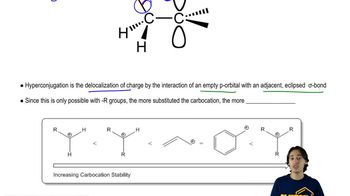
Carbocation Stability

Carbocations are positively charged species that play a central role in Sₙ1 reactions. Their stability is influenced by factors such as the degree of substitution (primary, secondary, tertiary) and resonance. Tertiary carbocations are the most stable due to hyperconjugation and inductive effects from surrounding alkyl groups. Recognizing the stability of carbocations helps in predicting the feasibility and rate of Sₙ1 reactions.
추천 영상:
05:58
Determining Carbocation Stability

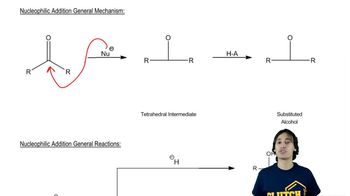
Nucleophiles

Nucleophiles are species that donate an electron pair to form a chemical bond in a reaction. In Sₙ1 reactions, the nucleophile attacks the carbocation after the leaving group has departed. The strength and nature of the nucleophile can significantly affect the reaction rate and outcome. Common nucleophiles include water, alcohols, and halides, and understanding their reactivity is essential for drawing accurate reaction mechanisms.
추천 영상:
08:27
Nucleophilic Addition