Ch. 14 - Structural Identification 1: Infrared Spectroscopy and Mass Spectrometry
Mullins - Organic Chemistry: A Learner Centered Approach 1st Edition
Mullins1st EditionOrganic Chemistry: A Learner Centered ApproachISBN: 9780137566471당신이 사용하는 게 아니라요?교과서 변경
13장, 문제 46e

Based on Hooke's law, choose the bond in each pair that you expect to vibrate at a higher wavenumber.
(e) C=N vs C≡N

검증된 단계별 안내
1
Understand Hooke's Law in the context of molecular vibrations: Hooke's Law relates the vibrational frequency of a bond to the force constant (k) and the reduced mass (μ) of the atoms involved. The formula is given by: v = 12π√kμ, where v is the vibrational frequency.
Identify the bonds in question: We have a C=N bond (a double bond) and a C≡N bond (a triple bond).
Consider the force constant (k): Triple bonds generally have a higher force constant than double bonds because they are stronger and stiffer. This means that the C≡N bond will have a higher force constant compared to the C=N bond.
Evaluate the reduced mass (μ): The reduced mass is calculated using the formula μ = m1m2m1+m2, where m1 and m2 are the masses of the atoms involved. Since both bonds involve the same atoms (carbon and nitrogen), the reduced mass will be the same for both bonds.
Determine which bond vibrates at a higher wavenumber: Since the C≡N bond has a higher force constant and the same reduced mass as the C=N bond, it will vibrate at a higher wavenumber according to Hooke's Law.

비슷한 문제에 대한 검증된 영상 답변:

이 영상 해법은 위 문제에 도움이 된다고 튜터들이 추천한 것입니다.
영상 길이:
3m

주요 개념

질문에 올바르게 답하기 위해 반드시 이해해야 하는 핵심 개념들은 다음과 같습니다.

Hooke's Law in Vibrational Spectroscopy

Hooke's Law relates the vibrational frequency of a bond to the bond strength and the masses of the atoms involved. In vibrational spectroscopy, stronger bonds and lighter atoms result in higher vibrational frequencies, which correspond to higher wavenumbers in IR spectra.
추천 영상:
가이드 코스
1:39
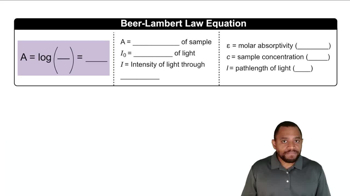
The Beer-Lambert Law Concept 2

Bond Order and Strength

Bond order refers to the number of chemical bonds between a pair of atoms. A higher bond order typically indicates a stronger bond. For example, a triple bond (C≡N) is stronger than a double bond (C=N), leading to higher vibrational frequencies and wavenumbers.
추천 영상:
06:00
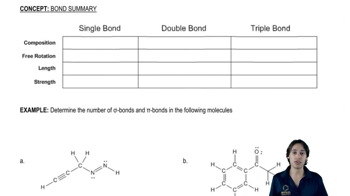
Single bonds, double bonds, and triple bonds.

Wavenumber in IR Spectroscopy

Wavenumber is a measure of frequency used in infrared spectroscopy, expressed in reciprocal centimeters (cm⁻¹). It indicates the energy of molecular vibrations; higher wavenumbers correspond to higher energy vibrations, often seen in stronger bonds like triple bonds compared to double bonds.
추천 영상:
16:04
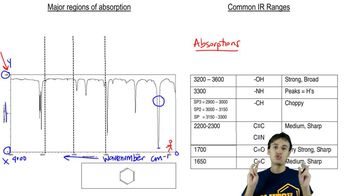
General Features of IR Spect