Ch. 16 - Metals in Organic Chemistry
Mullins - Organic Chemistry: A Learner Centered Approach 1st Edition
Mullins1st EditionOrganic Chemistry: A Learner Centered ApproachISBN: 9780137566471당신이 사용하는 게 아니라요?교과서 변경
15장, 문제 18a

Cyclopropanation using any of the reagents discussed here is stereospecific.
(a) What does this say about the mechanism?

검증된 단계별 안내
1
Understand the term 'stereospecific': A stereospecific reaction is one in which the stereochemistry of the reactant determines the stereochemistry of the product in a specific way. This means that the reaction mechanism must preserve or control the spatial arrangement of atoms or groups in the molecule.
Recall the general mechanism of cyclopropanation: Cyclopropanation typically involves the addition of a carbene or a carbenoid to an alkene, forming a three-membered cyclopropane ring. The reaction occurs in a single concerted step, meaning all bond-making and bond-breaking events happen simultaneously.
Analyze the stereospecificity: Since the reaction is stereospecific, the stereochemistry of the starting alkene (cis or trans) is directly reflected in the stereochemistry of the cyclopropane product. For example, a cis-alkene will yield a cis-cyclopropane, and a trans-alkene will yield a trans-cyclopropane.
Relate stereospecificity to the mechanism: The stereospecificity suggests that the reaction proceeds through a concerted mechanism, where the carbene or carbenoid interacts with both π-bonded carbons of the alkene simultaneously. This concerted nature ensures that the relative spatial arrangement of substituents on the alkene is preserved in the product.
Conclude the implication for the mechanism: The stereospecificity of cyclopropanation indicates that the reaction does not involve intermediates that could allow for free rotation or rearrangement of substituents. Instead, it supports a concerted, single-step mechanism that maintains the stereochemical integrity of the reactant.

비슷한 문제에 대한 검증된 영상 답변:

이 영상 해법은 위 문제에 도움이 된다고 튜터들이 추천한 것입니다.
영상 길이:
5m

주요 개념

질문에 올바르게 답하기 위해 반드시 이해해야 하는 핵심 개념들은 다음과 같습니다.

Stereospecificity

Stereospecificity refers to a reaction where the configuration of the reactant determines the configuration of the product. In the context of cyclopropanation, this means that the addition of reagents leads to a specific stereochemical outcome, indicating that the mechanism involves a direct interaction between the reagent and the substrate that preserves the spatial arrangement of atoms.
추천 영상:
15:39
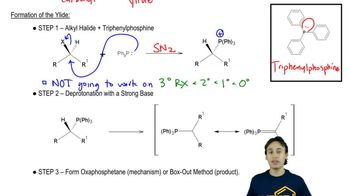
Box-Out Method and Full-Mechanism

Mechanism of Cyclopropanation

The mechanism of cyclopropanation typically involves the formation of a three-membered ring through the concerted addition of a reagent, such as a carbene or a metal-carbene complex, to a double bond. This process is stereospecific because the transition state is influenced by the orientation of the double bond, leading to a specific stereochemical configuration in the product.
추천 영상:
01:49
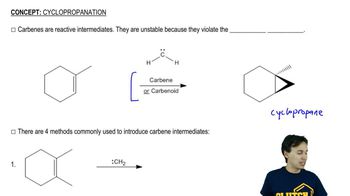
General properties of cyclopropanation.

Transition State Theory

Transition state theory posits that during a chemical reaction, reactants pass through a high-energy transition state before forming products. In stereospecific reactions like cyclopropanation, the transition state is crucial as it dictates the stereochemical outcome, ensuring that the spatial arrangement of substituents is retained in the final product, thus confirming the stereospecific nature of the mechanism.
추천 영상:
06:55
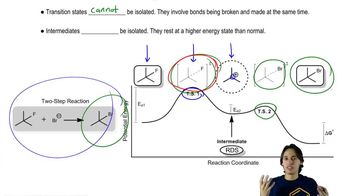
Intermediates vs. Transition States