Ch. 16 - Metals in Organic Chemistry
Mullins - Organic Chemistry: A Learner Centered Approach 1st Edition
Mullins1st EditionOrganic Chemistry: A Learner Centered ApproachISBN: 9780137566471당신이 사용하는 게 아니라요?교과서 변경
15장, 문제 24b

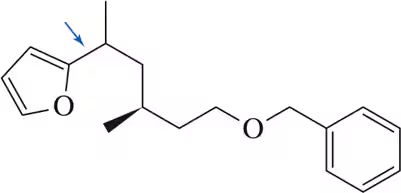
Work backward to an appropriate organozinc halide and organohalide to make the bonds indicated by the blue arrows. There may be two possibilities for each.
(b) Chemical structure diagram showing bonds indicated by blue arrows, with organozinc halide and organohalide components.

검증된 단계별 안내
1
Identify the bond indicated by the blue arrow. This bond is between the cyclopentyl group and the oxygen atom in the ether linkage.
To work backward, consider breaking the molecule at the indicated bond to form two fragments: a cyclopentyl group and an ether group.
The cyclopentyl group can be derived from a cyclopentyl organozinc halide. Consider the structure of cyclopentyl zinc bromide (C5H9ZnBr) as a potential organozinc halide.
The ether group can be derived from an organohalide. Consider the structure of 2-bromoethoxybenzene (C8H9BrO) as a potential organohalide.
Propose a reaction where the cyclopentyl zinc bromide reacts with 2-bromoethoxybenzene to form the desired ether linkage, using a coupling reaction such as the Negishi coupling.

비슷한 문제에 대한 검증된 영상 답변:

이 영상 해법은 위 문제에 도움이 된다고 튜터들이 추천한 것입니다.
영상 길이:
4m

주요 개념

질문에 올바르게 답하기 위해 반드시 이해해야 하는 핵심 개념들은 다음과 같습니다.

Organozinc Reagents

Organozinc reagents, typically represented as RZnX, are organometallic compounds where a zinc atom is bonded to an organic group (R) and a halide (X). They are highly reactive and serve as nucleophiles in organic synthesis, allowing for the formation of carbon-carbon bonds through reactions with electrophiles. Understanding their reactivity and how they can be synthesized from organohalides is crucial for constructing complex organic molecules.
추천 영상:
01:52
Reagents

Organohalides

Organohalides, or haloalkanes, are organic compounds containing at least one halogen atom (F, Cl, Br, I) bonded to a carbon atom. They are important intermediates in organic synthesis, as they can undergo various reactions, including nucleophilic substitution and elimination. Recognizing the structure and reactivity of organohalides is essential for determining how to create the desired organozinc halide for bond formation.

Nucleophilic Substitution Reactions

Nucleophilic substitution reactions involve the replacement of a leaving group (often a halide) in a molecule with a nucleophile. These reactions can occur via two main mechanisms: SN1 (unimolecular) and SN2 (bimolecular), each with distinct kinetics and stereochemical outcomes. Understanding these mechanisms is vital for predicting the products of reactions involving organozinc and organohalide compounds, especially when constructing new carbon-carbon bonds.
추천 영상:
01:47
Nucleophiles and Electrophiles can react in Substitution Reactions.