Ch. 18 - Nucleophilic Acyl Substitution 1: Carboxylic Acids
Mullins - Organic Chemistry: A Learner Centered Approach 1st Edition
Mullins1st EditionOrganic Chemistry: A Learner Centered ApproachISBN: 9780137566471당신이 사용하는 게 아니라요?교과서 변경
17장, 문제 5c

Calculate the oxidation numbers for the indicated atoms.
(c) Chemical structure of a benzene ring with a blue arrow pointing to a magnesium bromide (MgBr) group attached.

검증된 단계별 안내
1
Identify the structure: The compound shown is a Grignard reagent, specifically phenylmagnesium bromide, where the phenyl group (C6H5) is bonded to a magnesium bromide (MgBr). The arrow points to the carbon atom in the phenyl group that is directly bonded to the magnesium.
Understand the Grignard reagent: In Grignard reagents, the carbon atom bonded to the magnesium is considered to have a partial negative charge due to the polar covalent bond between carbon and magnesium. This is because magnesium is less electronegative than carbon.
Assign oxidation numbers: In organic compounds, carbon typically has an oxidation number of -4 to +4. For the carbon in the Grignard reagent, it is more electronegative than magnesium, so it 'takes' the electrons from the Mg-C bond, giving it an oxidation number of -1.
Consider the aromatic ring: The carbon atom in the phenyl group is part of an aromatic ring, which does not affect the oxidation number of the carbon directly bonded to magnesium. The aromaticity is maintained, and the oxidation number calculation focuses on the direct bond with magnesium.
Summarize the oxidation number: The oxidation number of the carbon atom indicated by the arrow in the Grignard reagent is -1, due to its bond with the less electronegative magnesium.

비슷한 문제에 대한 검증된 영상 답변:

이 영상 해법은 위 문제에 도움이 된다고 튜터들이 추천한 것입니다.

주요 개념

질문에 올바르게 답하기 위해 반드시 이해해야 하는 핵심 개념들은 다음과 같습니다.

Oxidation Number

The oxidation number is a theoretical charge assigned to an atom in a molecule, representing the number of electrons lost or gained by the atom. It helps in determining the electron distribution in compounds and is crucial for redox reactions. In organic chemistry, it aids in understanding the electron flow in reactions involving organometallic compounds like Grignard reagents.
추천 영상:
03:40
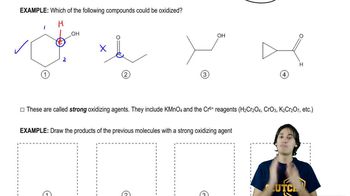
Strong oxidizing agents

Grignard Reagent

Grignard reagents are organomagnesium compounds typically represented as R-MgX, where R is an organic group and X is a halogen. They are highly reactive and used in forming carbon-carbon bonds. The magnesium atom in Grignard reagents often has a positive oxidation state, which is essential for understanding its reactivity and interaction with other molecules.
추천 영상:
02:12
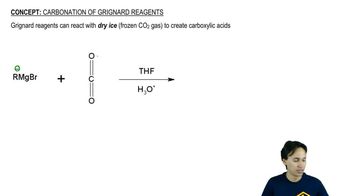
Carbonation of Grignard Reagents

Electronegativity

Electronegativity is the tendency of an atom to attract electrons towards itself in a chemical bond. It influences the oxidation number by affecting electron distribution in a molecule. In the context of the image, understanding the electronegativity difference between magnesium and bromine helps determine the oxidation state of magnesium in the MgBr group attached to the benzene ring.
추천 영상:
1:47
Electronegativity