Ch. 20 - Enolates: Carbonyl Addition and Substitution
Mullins - Organic Chemistry: A Learner Centered Approach 1st Edition
Mullins1st EditionOrganic Chemistry: A Learner Centered ApproachISBN: 9780137566471당신이 사용하는 게 아니라요?교과서 변경
19장, 문제 8

Rationalize the difference in Kₑq for the following reactions. Be sure to account for both ∆S and ∆H.
Two chemical reactions with water; first has Kₑq < 1, second has Kₑq > 1. Analyze ∆S and ∆H differences.

검증된 단계별 안내
1
Begin by understanding the concept of equilibrium constant (Kₑq). It is a measure of the extent of a chemical reaction at equilibrium, and it is influenced by the changes in enthalpy (∆H) and entropy (∆S) of the reaction.
Recall the Gibbs free energy equation: ΔG=ΔH-TΔS. This equation relates the change in Gibbs free energy (∆G) to the changes in enthalpy (∆H) and entropy (∆S), where T is the temperature in Kelvin.
Understand that the equilibrium constant Kₑq is related to Gibbs free energy by the equation: K=e-ΔG/RT, where R is the universal gas constant. This shows that Kₑq is exponentially dependent on ∆G.
Analyze how ∆H and ∆S affect ∆G. A negative ∆H (exothermic reaction) tends to favor product formation, increasing Kₑq, while a positive ∆S (increase in disorder) also favors product formation, increasing Kₑq. Conversely, a positive ∆H or negative ∆S would decrease Kₑq.
Compare the reactions by evaluating their ∆H and ∆S values. Consider how these values influence ∆G and subsequently Kₑq. A reaction with a more negative ∆G will have a larger Kₑq, indicating a greater extent of reaction towards products at equilibrium.

비슷한 문제에 대한 검증된 영상 답변:

이 영상 해법은 위 문제에 도움이 된다고 튜터들이 추천한 것입니다.
영상 길이:
9m

주요 개념

질문에 올바르게 답하기 위해 반드시 이해해야 하는 핵심 개념들은 다음과 같습니다.

Equilibrium Constant (Kₑq)

The equilibrium constant, Kₑq, is a measure of the ratio of the concentrations of products to reactants at equilibrium for a given reaction. It reflects the extent to which a reaction proceeds and is influenced by temperature and the nature of the reactants and products. A higher Kₑq indicates a greater concentration of products relative to reactants at equilibrium.
추천 영상:
02:19
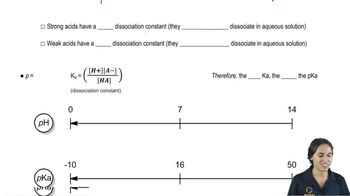
The relationship between equilibrium constant and pKa.

Enthalpy Change (∆H)

Enthalpy change, ∆H, represents the heat absorbed or released during a chemical reaction at constant pressure. It is a key factor in determining the favorability of a reaction; exothermic reactions (negative ∆H) tend to be more favorable as they release energy, while endothermic reactions (positive ∆H) require energy input. ∆H influences the equilibrium position by affecting the energy balance of the reaction.
추천 영상:
04:38
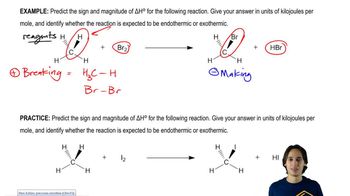
Calculating Enthalpies

Entropy Change (∆S)

Entropy change, ∆S, measures the change in disorder or randomness in a system during a chemical reaction. A positive ∆S indicates an increase in disorder, which can favor the spontaneity of a reaction. Entropy is a crucial component of the Gibbs free energy equation, which determines the spontaneity of a reaction. ∆S, along with ∆H, affects the equilibrium constant by influencing the overall energy dynamics of the reaction.
추천 영상:
02:46
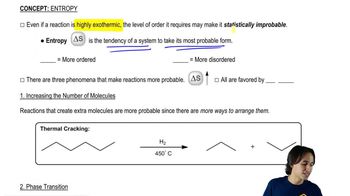
Explaining what entropy is.