Ch. 21 - Conjugated Systems 1: Stability and Addition Reactions
Mullins - Organic Chemistry: A Learner Centered Approach 1st Edition
Mullins1st EditionOrganic Chemistry: A Learner Centered ApproachISBN: 9780137566471당신이 사용하는 게 아니라요?교과서 변경
20장, 문제 21

Would you expect the following nucleophiles to do 1,2- or 1,4-addition? d. e. f.

검증된 단계별 안내
1
insert step 1: Understand the difference between 1,2-addition and 1,4-addition. In 1,2-addition, the nucleophile adds to the carbonyl carbon, while in 1,4-addition, the nucleophile adds to the beta carbon of an α,β-unsaturated carbonyl compound.
insert step 2: Identify the type of nucleophile. Strong nucleophiles, such as Grignard reagents or organolithium compounds, typically favor 1,2-addition due to their high reactivity. Weaker nucleophiles, like enolates or amines, may favor 1,4-addition.
insert step 3: Consider the stability of the resulting product. 1,4-addition often leads to more stable products due to the formation of a conjugated system, which can be a driving factor for the reaction pathway.
insert step 4: Evaluate the reaction conditions. Solvent, temperature, and the presence of catalysts can influence whether 1,2- or 1,4-addition is favored.
insert step 5: Apply these considerations to the specific nucleophiles in parts d, e, and f to predict whether they will undergo 1,2- or 1,4-addition.

비슷한 문제에 대한 검증된 영상 답변:

이 영상 해법은 위 문제에 도움이 된다고 튜터들이 추천한 것입니다.
영상 길이:
8m

주요 개념

질문에 올바르게 답하기 위해 반드시 이해해야 하는 핵심 개념들은 다음과 같습니다.

Nucleophilicity

Nucleophilicity refers to the ability of a nucleophile to donate an electron pair to an electrophile during a chemical reaction. Stronger nucleophiles are more likely to participate in reactions, influencing whether they will favor 1,2- or 1,4-addition. Factors affecting nucleophilicity include charge, electronegativity, and solvent effects.
추천 영상:
08:27
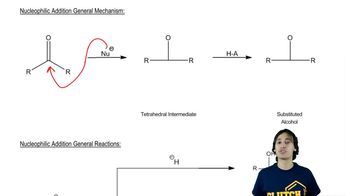
Nucleophilic Addition

1,2- and 1,4-Addition Mechanisms

1,2- and 1,4-addition mechanisms describe how nucleophiles add to conjugated systems, such as α,β-unsaturated carbonyl compounds. In 1,2-addition, the nucleophile attacks the carbonyl carbon, while in 1,4-addition, it attacks the β-carbon. The preference for one mechanism over the other can depend on the stability of intermediates and the nature of the nucleophile.
추천 영상:
05:39
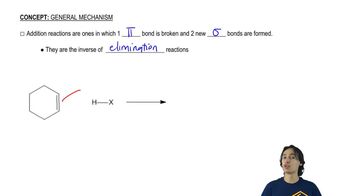
Features of Addition Mechanisms.

Stability of Intermediates

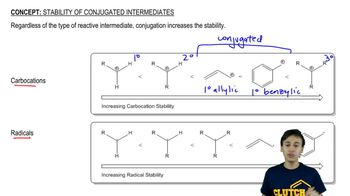
The stability of reaction intermediates plays a crucial role in determining the pathway of nucleophilic addition. More stable intermediates, such as resonance-stabilized carbocations, favor certain addition modes. Understanding the stability of these intermediates helps predict whether a nucleophile will lead to 1,2- or 1,4-addition in a given reaction.
추천 영상:
04:31
Stability of Conjugated Intermediates