뒤로
뒤로
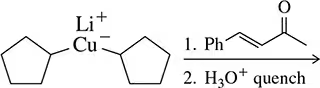
문제 43a
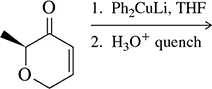
Predict the product of the following reactions.
(a)
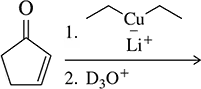
문제 43b
Predict the product of the following reactions.
(b)
문제 44
Show how the following molecule might be synthesized using the Robinson annulation.
문제 45a
Predict the product of the following reactions.
(a)
문제 45b
Predict the product of the following reactions.
(b)
문제 45c
Predict the product of the following reactions.
(c)
문제 46a
Suggest a reagent and a reactant that could be used to form the following molecules by conjugate addition of a cuprate. There can be multiple possibilities.
(a)
문제 46b
Suggest a reagent and a reactant that could be used to form the following molecules by conjugate addition of a cuprate. There can be multiple possibilities.
(b)
문제 46c
Suggest a reagent and a reactant that could be used to form the following molecules by conjugate addition of a cuprate. There can be multiple possibilities.
(c)
문제 47
To this point, we have seen four reactions that can be done by Gilman reagents. What are they? What do they have in common?
문제 48
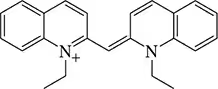
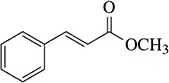
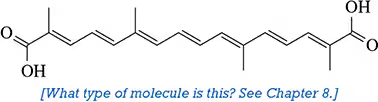
Would you expect the following molecules to absorb in the UV–visible region of the electromagnetic spectrum?
(a)
(b)
(c)
(d)
(e)
문제 50
On a per alkene basis, which would have the more negative heat of hydrogenation?
문제 51a
How many 𝝅 electrons are involved in the conjugated system for each of the following molecules?
(a)
문제 53
Draw the molecular orbital picture of octa-1,3,5,7-tetraene, indicating which is the HOMO and which is the LUMO.
문제 54b
Which of the following reactions would you expect to be faster/more favorable in each pair? Why?
(b)
문제 54c
Which of the following reactions would you expect to be faster/more favorable in each pair? Why?
(c)
문제 56
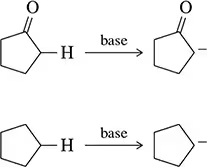
The dye alizarin normally forms an orange solution when dissolved. However, if KOEt is added to the solution, it turns blue very rapidly. Rationalize this result.
문제 57d
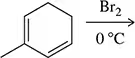
Predict the product of the following reactions.
(d)
문제 57i
Predict the product of the following reactions.
(i)
문제 57j
Predict the product of the following reactions.
(j)
문제 58
In Chapter 9, electron-rich alkenes were oxidized under acidic conditions with mCPBA. Conjugated alkenes can be oxidized using the same reagent, but under basic conditions. Suggest a mechanism for this reaction. [Think about what is electron-rich and what is electron-poor in the reaction. Also, identify the bonds formed and broken.]
문제 60a
The reactivity of cyclopropanes often mimics that of alkenes.
(a) On the basis of this, suggest a mechanism for the following reaction.
문제 60b
The reactivity of cyclopropanes often mimics that of alkenes.
(b) Besides opening the three-membered ring, what is the driving force for this reaction?
문제 68
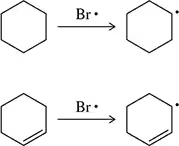
The following transformation was found to occur in areas with large NO₂ emissions. Suggest a mechanism for the reaction (J. Phys. Chem. 2013, 117, 14132–14140). [Hint: Use the fishhook arrows associated with radical reactions.]
문제 72
The following reaction was used in the synthesis of aculeatin A, a natural product that is active against KB cell lines. Although it only worked under acidic conditions, a mechanism can be drawn where the reaction might proceed under basic conditions. Suggest this mechanism (J. Org. Chem. 2014, 79, 1498–1504). [The most acidic proton is indicated . . . and number your carbons!]
문제 73
The following covalent inhibitor blocks function in a protease found in the porcine epidemic diarrhea virus by reacting with a cysteine amino acid residue (shown below) in the active site. Draw the expected complex that forms between the inhibitor and the enzyme active site (J. Med. Chem. 2017, 60, 3212–3216.) [Assume the presence of active site bases if you need them.]
<IMAGE>