Ch. 24 - Benzene 2: Reactions Influenced by the Aromatic Ring
Mullins - Organic Chemistry: A Learner Centered Approach 1st Edition
Mullins1st EditionOrganic Chemistry: A Learner Centered ApproachISBN: 9780137566471당신이 사용하는 게 아니라요?교과서 변경
23장, 문제 24.47a

FROM THE LITERATURE The following steps were used in the synthesis of the antimalarial thiaplakortone A. Identify the missing reagents, (a) and (b), 
<IMAGE>

검증된 단계별 안내
1
Examine the structure of thiaplakortone A and identify the functional groups present. This will help in understanding the transformations needed in the synthesis.
Analyze the given synthetic pathway and identify the transformations that occur between each step. Look for changes in functional groups, connectivity, or stereochemistry.
Determine the type of reaction that could facilitate each transformation. Common reactions include oxidation, reduction, substitution, addition, and elimination.
Consider the reagents typically used for the identified reactions. For example, if a hydroxyl group is introduced, a reagent like NaBH4 or LiAlH4 might be used for reduction.
Match the identified reagents to the missing steps in the synthesis pathway, ensuring that they are compatible with the functional groups and conditions required for the transformation.

주요 개념

질문에 올바르게 답하기 위해 반드시 이해해야 하는 핵심 개념들은 다음과 같습니다.

Reagent Identification

In organic synthesis, identifying the correct reagents is crucial for successful reactions. Reagents are substances that participate in a chemical reaction, and their selection can significantly influence the yield and purity of the desired product. Understanding the functional groups involved and the type of reaction (e.g., substitution, addition) helps in determining the appropriate reagents needed for each step.
추천 영상:
01:52
Reagents

Reaction Mechanisms

A reaction mechanism describes the step-by-step process by which reactants transform into products. It includes the breaking and forming of bonds, the intermediates formed, and the energy changes involved. Familiarity with common mechanisms, such as nucleophilic substitution or electrophilic addition, is essential for predicting the outcomes of reactions and for identifying missing reagents in a synthesis pathway.
추천 영상:
02:16
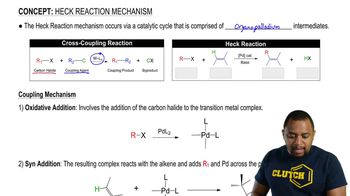
Heck Reaction Mechanism

Functional Group Transformations

Functional groups are specific groups of atoms within molecules that determine their chemical reactivity. Understanding how different functional groups can be transformed into one another through various reactions is key in organic synthesis. This knowledge allows chemists to plan synthetic routes effectively, ensuring that the necessary transformations occur to produce the target compound, such as thiaplakortone A.
추천 영상:
02:36
Identifying Functional Groups