Ch. 26 - Amino Acids, Proteins, and Peptide Synthesis
Mullins - Organic Chemistry: A Learner Centered Approach 1st Edition
Mullins1st EditionOrganic Chemistry: A Learner Centered ApproachISBN: 9780137566471당신이 사용하는 게 아니라요?교과서 변경
25장, 문제 18b

Provide a synthesis of the following amino acids using a combination of the HVZ and amination reactions.
b. Leu

검증된 단계별 안내
1
Identify the starting material: Begin with a carboxylic acid that has a similar carbon skeleton to leucine. For leucine, you can start with isovaleric acid (3-methylbutanoic acid).
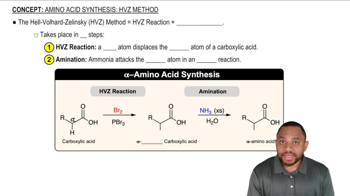
Apply the Hell-Volhard-Zelinsky (HVZ) reaction: Treat the isovaleric acid with bromine (Br2) and phosphorus tribromide (PBr3) to brominate the alpha position of the carboxylic acid, forming an alpha-bromo acid.
Prepare for amination: Convert the alpha-bromo acid into an alpha-amino acid by treating it with ammonia (NH3). This step involves a nucleophilic substitution where the bromine atom is replaced by an amino group.
Ensure stereochemistry: If necessary, use a chiral auxiliary or a chiral catalyst to ensure the correct stereochemistry of the amino acid, as leucine is chiral.
Finalize the synthesis: Purify the product to obtain leucine, ensuring that the amino acid is in its correct L-configuration, which is the naturally occurring form in proteins.

비슷한 문제에 대한 검증된 영상 답변:

이 영상 해법은 위 문제에 도움이 된다고 튜터들이 추천한 것입니다.
영상 길이:
5m

주요 개념

질문에 올바르게 답하기 위해 반드시 이해해야 하는 핵심 개념들은 다음과 같습니다.

HVZ Reaction

The Hell-Volhard-Zelinsky (HVZ) reaction is a halogenation process used to introduce a halogen atom, typically bromine, at the alpha position of a carboxylic acid. This reaction involves the use of phosphorus tribromide (PBr3) and bromine (Br2) to convert the carboxylic acid into an alpha-bromo acid, which is a key intermediate for further transformations.
추천 영상:
가이드 코스
1:24
Amino Acid Synthesis: HVZ Method Concept 1

Amination Reaction

Amination is a chemical process that introduces an amino group (-NH2) into a molecule. In the context of synthesizing amino acids, amination typically involves the conversion of an alpha-bromo acid into an amino acid by replacing the bromine atom with an amino group, often using ammonia or an amine as the nucleophile.
추천 영상:
03:46
Buchwald-Hartwig Amination Reaction

Synthesis of Leucine

Leucine synthesis involves creating the specific structure of this branched-chain amino acid. Starting with a suitable precursor, such as isovaleric acid, the HVZ reaction introduces a bromine atom at the alpha position. Subsequent amination replaces the bromine with an amino group, yielding leucine, which is characterized by its isobutyl side chain.
추천 영상:
가이드 코스
1:16
Synthesis of Amino Acids: Strecker Synthesis Example 1