Ch. 4 - Acids and Bases/Electron Flow
Mullins - Organic Chemistry: A Learner Centered Approach 1st Edition
Mullins1st EditionOrganic Chemistry: A Learner Centered ApproachISBN: 9780137566471당신이 사용하는 게 아니라요?교과서 변경
3장, 문제 73d

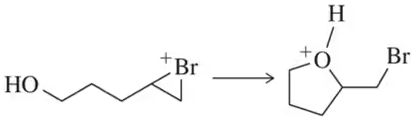
Suggest an arrow-pushing mechanism for each of the following acid–base reactions.
(d) [an intramolecular reaction]

검증된 단계별 안내
1
Identify the functional groups involved in the reaction. The molecule contains a hydroxyl group (-OH) and a positively charged bromonium ion (+Br) attached to a cyclopropane ring.
Recognize that this is an intramolecular reaction, meaning the nucleophile (the hydroxyl group) and the electrophile (the bromonium ion) are part of the same molecule.
Determine the nucleophilic attack. The lone pair of electrons on the oxygen atom in the hydroxyl group will attack the electrophilic carbon in the bromonium ion, leading to the opening of the strained cyclopropane ring.
Show the arrow-pushing mechanism. Draw an arrow from the lone pair on the oxygen atom to the electrophilic carbon of the bromonium ion. Simultaneously, draw an arrow showing the breaking of the bond between the electrophilic carbon and the bromonium ion, resulting in the ring opening.
Account for the final structure. The attack forms a new bond between the oxygen and the carbon, creating a cyclic ether (a five-membered ring with oxygen). The bromonium ion is now attached to the other carbon atom in the ring.

비슷한 문제에 대한 검증된 영상 답변:

이 영상 해법은 위 문제에 도움이 된다고 튜터들이 추천한 것입니다.
영상 길이:
2m

주요 개념

질문에 올바르게 답하기 위해 반드시 이해해야 하는 핵심 개념들은 다음과 같습니다.

Acid-Base Reactions

Acid-base reactions involve the transfer of protons (H+) between reactants. In these reactions, acids donate protons while bases accept them. Understanding the strength of acids and bases, as well as their conjugate pairs, is crucial for predicting the direction of the reaction and the stability of the resulting species.
추천 영상:
02:49
The Lewis definition of acids and bases.

Arrow-Pushing Mechanism

Arrow-pushing mechanisms are a way to illustrate the movement of electrons during chemical reactions. Curved arrows represent the flow of electron pairs, indicating bond formation and breaking. This visual representation helps in understanding the stepwise progression of reactions, particularly in complex mechanisms like those involving intramolecular interactions.
추천 영상:
04:32
General Mechanism

Intramolecular vs. Intermolecular Reactions

Intramolecular reactions occur within a single molecule, often leading to the formation of cyclic structures or rearrangements. In contrast, intermolecular reactions involve different molecules. Recognizing the distinction is essential for predicting the products and understanding the spatial orientation of reactants in acid-base reactions, especially in complex organic systems.
추천 영상:
가이드 코스
2:29
Rates of Intramolecular Reactions Concept 1