Ch. 5 - Chemical Reaction Analysis: Thermodynamics and Kinetics
Mullins - Organic Chemistry: A Learner Centered Approach 1st Edition
Mullins1st EditionOrganic Chemistry: A Learner Centered ApproachISBN: 9780137566471당신이 사용하는 게 아니라요?교과서 변경
4장, 문제 37b

Calculate ∆H° for the following reactions.
(b) CH3Br + HCl → CH3Cl + HBr

검증된 단계별 안내
1
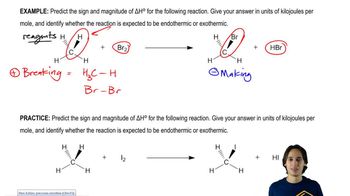
Identify the bonds broken and formed in the reaction. In this case, the bonds broken are the C-Br bond in CH3Br and the H-Cl bond in HCl. The bonds formed are the C-Cl bond in CH3Cl and the H-Br bond in HBr.
Look up the bond dissociation energies (BDEs) for each bond involved in the reaction. These values are typically given in units of kJ/mol and can be found in a table of bond energies. For example, approximate values might be: C-Br = 276 kJ/mol, H-Cl = 431 kJ/mol, C-Cl = 338 kJ/mol, and H-Br = 366 kJ/mol.
Calculate the total energy required to break the bonds. This is the sum of the bond dissociation energies for the bonds broken: \( \text{Energy for bonds broken} = \text{BDE}_{\text{C-Br}} + \text{BDE}_{\text{H-Cl}} \).
Calculate the total energy released when the new bonds are formed. This is the sum of the bond dissociation energies for the bonds formed: \( \text{Energy for bonds formed} = \text{BDE}_{\text{C-Cl}} + \text{BDE}_{\text{H-Br}} \).
Determine \( \Delta H^\circ \) for the reaction by subtracting the energy of the bonds formed from the energy of the bonds broken: \( \Delta H^\circ = \text{Energy for bonds broken} - \text{Energy for bonds formed} \). This value will indicate whether the reaction is exothermic (negative \( \Delta H^\circ \)) or endothermic (positive \( \Delta H^\circ \)).

비슷한 문제에 대한 검증된 영상 답변:

이 영상 해법은 위 문제에 도움이 된다고 튜터들이 추천한 것입니다.

주요 개념

질문에 올바르게 답하기 위해 반드시 이해해야 하는 핵심 개념들은 다음과 같습니다.

Enthalpy Change (∆H°)

Enthalpy change (∆H°) refers to the heat content change of a system at constant pressure during a chemical reaction. It indicates whether a reaction is exothermic (releases heat, ∆H° < 0) or endothermic (absorbs heat, ∆H° > 0). Calculating ∆H° involves considering the bond energies of the reactants and products, allowing chemists to predict the energy changes associated with reactions.
추천 영상:
04:38
Calculating Enthalpies

Bond Energies

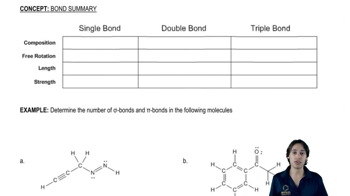
Bond energies are the amounts of energy required to break specific chemical bonds in a molecule. Each type of bond (e.g., C-H, C-Br, C-Cl) has a characteristic bond energy value. By summing the bond energies of the reactants and subtracting the sum of the bond energies of the products, one can calculate the overall enthalpy change for a reaction, providing insight into its energy dynamics.
추천 영상:
06:00
Single bonds, double bonds, and triple bonds.

Reaction Mechanism

A reaction mechanism describes the step-by-step sequence of elementary reactions that lead to the overall transformation of reactants into products. Understanding the mechanism helps in predicting the rate of reaction and the energy changes involved. In the case of the reaction CH3Br + HCl → CH3Cl + HBr, knowing the mechanism can clarify how bonds are broken and formed, influencing the calculation of ∆H°.
추천 영상:
02:16
Heck Reaction Mechanism