Ch. 5 - Chemical Reaction Analysis: Thermodynamics and Kinetics
Mullins - Organic Chemistry: A Learner Centered Approach 1st Edition
Mullins1st EditionOrganic Chemistry: A Learner Centered ApproachISBN: 9780137566471당신이 사용하는 게 아니라요?교과서 변경
4장, 문제 37c

Calculate ∆H° for the following reactions.
(c) CH3CH3 + HOOH → CH3CH2OH + H2O

검증된 단계별 안내
1
Step 1: Understand the problem. The goal is to calculate the enthalpy change (∆H°) for the given reaction. This involves using bond dissociation energies (BDEs) to determine the energy required to break bonds in the reactants and the energy released when bonds are formed in the products.
Step 2: Write out the bonds involved in the reactants and products. In the reactants, CH3CH3 contains C-H and C-C bonds, and HOOH contains O-H and O-O bonds. In the products, CH3CH2OH contains C-H, C-C, C-O, and O-H bonds, and H2O contains O-H bonds.
Step 3: Use a table of bond dissociation energies to find the BDE values for each bond type. For example, the BDE for a C-H bond is approximately 412 kJ/mol, for a C-C bond is 348 kJ/mol, for an O-H bond is 463 kJ/mol, and for an O-O bond is 146 kJ/mol. Ensure you have accurate values for all bonds involved.
Step 4: Calculate the total energy required to break all bonds in the reactants. Multiply the BDE of each bond by the number of such bonds in the reactants and sum them up. For example, if CH3CH3 has 6 C-H bonds and 1 C-C bond, calculate the energy for breaking all these bonds.
Step 5: Calculate the total energy released when bonds are formed in the products. Multiply the BDE of each bond by the number of such bonds in the products and sum them up. Subtract the energy released from the energy required to break bonds to find ∆H° for the reaction.

비슷한 문제에 대한 검증된 영상 답변:

이 영상 해법은 위 문제에 도움이 된다고 튜터들이 추천한 것입니다.

주요 개념

질문에 올바르게 답하기 위해 반드시 이해해야 하는 핵심 개념들은 다음과 같습니다.

Enthalpy Change (∆H°)

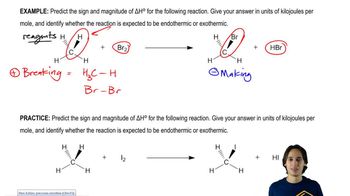
Enthalpy change (∆H°) refers to the heat content change of a system at constant pressure during a chemical reaction. It indicates whether a reaction is exothermic (releases heat, ∆H° < 0) or endothermic (absorbs heat, ∆H° > 0). Understanding how to calculate ∆H° is crucial for predicting the energy changes associated with chemical reactions.
추천 영상:
04:38
Calculating Enthalpies

Hess's Law

Hess's Law states that the total enthalpy change for a reaction is the sum of the enthalpy changes for the individual steps of the reaction, regardless of the pathway taken. This principle allows chemists to calculate ∆H° for reactions that may be difficult to measure directly by using known enthalpy changes of related reactions.
추천 영상:
가이드 코스
1:39
The Beer-Lambert Law Concept 2

Standard State Conditions

Standard state conditions refer to the specific set of conditions (usually 1 atm pressure and 25°C) under which the enthalpy values are measured. It is essential to use standard state values when calculating ∆H° to ensure consistency and comparability of thermodynamic data across different reactions.
추천 영상:
03:08
Ground vs. Excited States