Ch. 5 - Chemical Reaction Analysis: Thermodynamics and Kinetics
Mullins - Organic Chemistry: A Learner Centered Approach 1st Edition
Mullins1st EditionOrganic Chemistry: A Learner Centered ApproachISBN: 9780137566471당신이 사용하는 게 아니라요?교과서 변경
4장, 문제 73

For rotation around a bond, the rate constant is equal to the reaction rate. Why?

검증된 단계별 안내
1
Understand the context: In organic chemistry, bond rotation refers to the movement around a single bond (sigma bond) in a molecule. This is a dynamic process that can be described using reaction kinetics, where the rate constant (k) is a measure of how quickly the rotation occurs.
Recognize the relationship: The rate constant (k) is directly related to the reaction rate (v) through the equation: v = k[A], where [A] is the concentration of the reactant. For bond rotation, the 'reactant' is the molecule in its initial conformation.
Simplify the scenario: In the case of bond rotation, the concentration of the molecule undergoing rotation does not change because the process is intramolecular (occurs within the same molecule). Therefore, [A] is constant, and the reaction rate (v) becomes directly proportional to the rate constant (k).
Interpret the equality: Since the concentration [A] is constant and does not affect the proportionality, the rate constant (k) effectively represents the reaction rate (v) for bond rotation. This is why the rate constant is equal to the reaction rate in this specific context.
Conclude the reasoning: The equality between the rate constant and the reaction rate is unique to processes like bond rotation, where the 'reactant' concentration remains unchanged, and the process is governed solely by the intrinsic rate of rotation.

비슷한 문제에 대한 검증된 영상 답변:

이 영상 해법은 위 문제에 도움이 된다고 튜터들이 추천한 것입니다.

주요 개념

질문에 올바르게 답하기 위해 반드시 이해해야 하는 핵심 개념들은 다음과 같습니다.

Bond Rotation

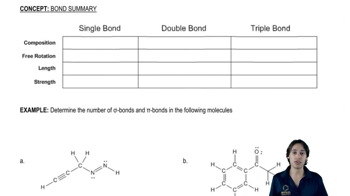
Bond rotation refers to the ability of atoms connected by a single bond to rotate around that bond axis. This rotation can influence the spatial arrangement of atoms in a molecule, affecting its conformation and, consequently, its reactivity. Understanding how and why certain bonds rotate is crucial for grasping the dynamics of molecular interactions.
추천 영상:
06:00
Single bonds, double bonds, and triple bonds.

Rate Constant

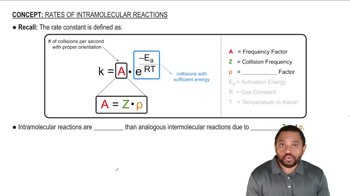
The rate constant is a proportionality factor in the rate equation of a chemical reaction, indicating the speed at which a reaction occurs. It is influenced by factors such as temperature and the nature of the reactants. In the context of bond rotation, the rate constant reflects how quickly the rotation can occur, which is directly related to the reaction rate.
추천 영상:
가이드 코스
2:29
Rates of Intramolecular Reactions Concept 1

Reaction Rate

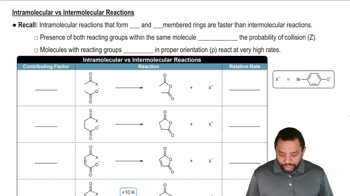
The reaction rate is the speed at which reactants are converted into products in a chemical reaction. It can be affected by various factors, including concentration, temperature, and the presence of catalysts. In the case of bond rotation, the reaction rate being equal to the rate constant suggests that the rotation is a fundamental step in the reaction mechanism, directly influencing the overall kinetics.
추천 영상:
가이드 코스
5:07
Rates of Intramolecular Reactions Concept 2