Ch. 6 - Stereoisomerism: Arrangement of Atoms in Space
Mullins - Organic Chemistry: A Learner Centered Approach 1st Edition
Mullins1st EditionOrganic Chemistry: A Learner Centered ApproachISBN: 9780137566471당신이 사용하는 게 아니라요?교과서 변경
5장, 문제 9c

For each of the following molecules, draw a 3-D representation.
(c) CHBr3

검증된 단계별 안내
1
Step 1: Recognize the molecular formula CHBr₃ as a derivative of methane (CH₄), where three hydrogen atoms are replaced by bromine atoms. This molecule is called bromoform.
Step 2: Identify the central atom in the molecule. Carbon (C) is the central atom because it forms four bonds and is surrounded by hydrogen (H) and bromine (Br) atoms.
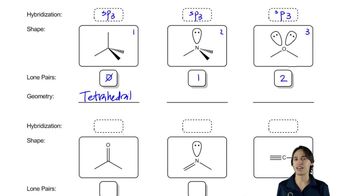
Step 3: Determine the molecular geometry using VSEPR theory. Since carbon has four single bonds (one to hydrogen and three to bromine), the electron pairs around the carbon atom will arrange themselves to minimize repulsion. This results in a tetrahedral geometry.
Step 4: Place the atoms in a 3-D tetrahedral arrangement. Carbon is at the center, with one bond pointing straight up (to hydrogen) and the other three bonds pointing downward and outward (to bromine atoms). The bond angles are approximately 109.5°.
Step 5: Represent the 3-D structure using wedge-and-dash notation. Use a solid wedge to show a bond coming out of the plane, a dashed wedge for a bond going behind the plane, and straight lines for bonds in the plane. Assign the bromine atoms to the positions with larger spatial demand due to their size compared to hydrogen.

비슷한 문제에 대한 검증된 영상 답변:

이 영상 해법은 위 문제에 도움이 된다고 튜터들이 추천한 것입니다.

주요 개념

질문에 올바르게 답하기 위해 반드시 이해해야 하는 핵심 개념들은 다음과 같습니다.

Molecular Geometry

Molecular geometry refers to the three-dimensional arrangement of atoms within a molecule. It is determined by the number of bonding pairs and lone pairs of electrons around the central atom, which influences the shape of the molecule. Understanding molecular geometry is crucial for visualizing how molecules interact and react with one another.
추천 영상:
07:44
Molecular Geometry Explained.

VSEPR Theory

Valence Shell Electron Pair Repulsion (VSEPR) theory is a model used to predict the geometry of individual molecules based on the repulsion between electron pairs in the valence shell of the central atom. According to VSEPR, electron pairs will arrange themselves to minimize repulsion, leading to specific molecular shapes. This theory is essential for accurately drawing 3-D representations of molecules like CHBr₃.
추천 영상:
10:48
Equipment and Theory

Stereochemistry

Stereochemistry is the study of the spatial arrangement of atoms in molecules and how this affects their chemical behavior. It includes concepts such as chirality and geometric isomerism, which are important for understanding the 3-D structure of molecules. In the case of CHBr₃, recognizing the stereochemical aspects helps in accurately depicting its three-dimensional conformation.
추천 영상:
가이드 코스
1:38
Polymer Stereochemistry Concept 1