Ch. 8 - Alkenes 1: Properties and Electrophilic Additions
Mullins - Organic Chemistry: A Learner Centered Approach 1st Edition
Mullins1st EditionOrganic Chemistry: A Learner Centered ApproachISBN: 9780137566471당신이 사용하는 게 아니라요?교과서 변경
7장, 문제 2

(a) Rank the following carbocations from least stable to most stable. (b) Which would you expect to form first? (c) Which would you expect to react most quickly with a bromide ion (Br⁻) ? [Carbocations, like radicals, are electron deficient.]
Four carbocation structures are shown, each marked with a positive charge, illustrating varying stability.

검증된 단계별 안내
1
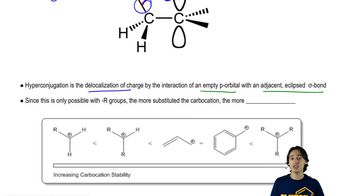
Step 1: Understand the stability of carbocations. Carbocation stability is influenced by factors such as the number of alkyl groups attached to the positively charged carbon (hyperconjugation), resonance stabilization, and inductive effects. Generally, tertiary carbocations are more stable than secondary, which are more stable than primary, and methyl carbocations are the least stable.
Step 2: Analyze the given carbocations and rank them based on their stability. Look for features such as the degree of substitution (primary, secondary, tertiary), resonance stabilization (if the positive charge is delocalized), and inductive effects from nearby electronegative atoms or groups.
Step 3: Determine which carbocation would form first. The formation of a carbocation depends on the energy required to generate it. The most stable carbocation typically forms first because it requires less energy to stabilize the positive charge.
Step 4: Predict which carbocation would react most quickly with a bromide ion (Br⁻). The reactivity of a carbocation with a nucleophile like Br⁻ is influenced by its stability. Less stable carbocations are more reactive because they are more eager to stabilize their positive charge by bonding with a nucleophile.
Step 5: Summarize the reasoning for each part of the problem. (a) Rank the carbocations based on stability using substitution, resonance, and inductive effects. (b) Identify the carbocation that forms first based on stability. (c) Determine the reactivity with Br⁻ based on the carbocation's eagerness to stabilize its charge.

비슷한 문제에 대한 검증된 영상 답변:

이 영상 해법은 위 문제에 도움이 된다고 튜터들이 추천한 것입니다.
영상 길이:
3m

주요 개념

질문에 올바르게 답하기 위해 반드시 이해해야 하는 핵심 개념들은 다음과 같습니다.

Carbocation Stability

Carbocation stability is influenced by the degree of alkyl substitution. Tertiary carbocations, which have three alkyl groups attached, are more stable than secondary and primary carbocations due to hyperconjugation and inductive effects. The presence of electron-donating groups helps to stabilize the positive charge, making tertiary carbocations the most stable.
추천 영상:
05:58
Determining Carbocation Stability

Reaction Mechanism

Understanding the reaction mechanism is crucial for predicting the order of formation and reactivity of carbocations. The formation of a carbocation typically occurs through the loss of a leaving group or protonation of an alkene. The more stable the carbocation, the faster it will form and react, as it is lower in energy and more favorable.
추천 영상:
02:16
Heck Reaction Mechanism

Nucleophilic Attack

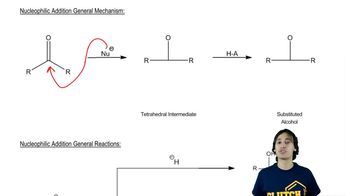
Nucleophilic attack refers to the reaction of a nucleophile, such as bromide ion (Br⁻), with an electrophile, like a carbocation. The stability of the carbocation affects the rate of this reaction; more stable carbocations are more reactive towards nucleophiles. Thus, the carbocation that forms first and is most stable will react most quickly with Br⁻.
추천 영상:
08:27
Nucleophilic Addition