Ch.10 - Structure and Synthesis of Alcohols
Wade - Organic Chemistry 9th Edition
Wade9th EditionOrganic ChemistryISBN: 9780135213728당신이 사용하는 게 아니라요?교과서 변경
10장, 문제 22d,e

Predict the products of the following reactions.
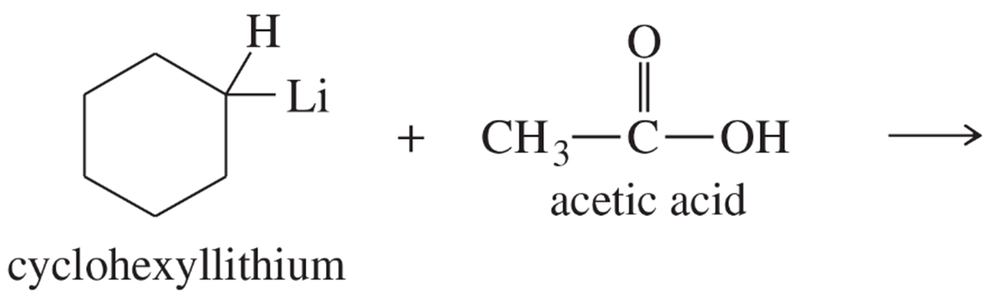
(d)
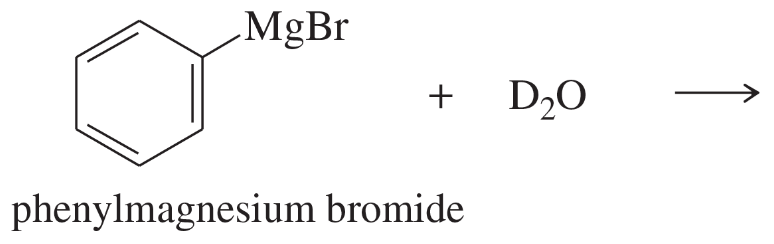
(e)

검증된 단계별 안내
1
Step 1: Analyze the first reaction involving cyclohexyl lithium and acetic acid. Cyclohexyl lithium (C6H11Li) is an organolithium compound, which acts as a strong base and nucleophile. Acetic acid (CH3COOH) is a carboxylic acid and can donate a proton (H⁺).
Step 2: In the first reaction, cyclohexyl lithium will abstract the acidic proton from acetic acid. This results in the formation of cyclohexane (C6H12) and lithium acetate (CH3COOLi). The reaction mechanism involves proton transfer.
Step 3: Analyze the second reaction involving phenylmagnesium bromide (C6H5MgBr) and deuterium oxide (D2O). Phenylmagnesium bromide is a Grignard reagent, which is highly reactive and acts as a nucleophile. D2O is heavy water, and the deuterium atom (D) can act as a proton donor.
Step 4: In the second reaction, the phenyl group (C6H5-) from phenylmagnesium bromide will abstract the deuterium atom from D2O. This results in the formation of benzene-d1 (C6H5D) and magnesium bromide hydroxide (MgBrOD). The reaction mechanism involves proton (or deuterium) transfer.
Step 5: Summarize the products: For the first reaction, the products are cyclohexane and lithium acetate. For the second reaction, the products are benzene-d1 and magnesium bromide hydroxide. These reactions demonstrate acid-base chemistry and the reactivity of organometallic compounds.

비슷한 문제에 대한 검증된 영상 답변:

이 영상 해법은 위 문제에 도움이 된다고 튜터들이 추천한 것입니다.
영상 길이:
5m

주요 개념

질문에 올바르게 답하기 위해 반드시 이해해야 하는 핵심 개념들은 다음과 같습니다.

Reaction Mechanisms

Understanding reaction mechanisms is crucial in organic chemistry as they describe the step-by-step process by which reactants transform into products. This includes identifying intermediates, transition states, and the movement of electrons. Familiarity with mechanisms helps predict the outcome of reactions and the stability of products formed.
추천 영상:
02:16
Heck Reaction Mechanism

Functional Groups

Functional groups are specific groups of atoms within molecules that are responsible for the characteristic chemical reactions of those molecules. Recognizing functional groups allows chemists to predict reactivity patterns and the types of reactions that can occur, which is essential for determining the products of a given reaction.
추천 영상:
02:36
Identifying Functional Groups

Stereochemistry

Stereochemistry involves the study of the spatial arrangement of atoms in molecules and how this affects their chemical behavior. It is important for predicting the products of reactions, especially in cases where chirality or geometric isomerism plays a role. Understanding stereochemical outcomes can influence the selectivity and yield of desired products.
추천 영상:
가이드 코스
1:38
Polymer Stereochemistry Concept 1