Ch.10 - Structure and Synthesis of Alcohols
Wade - Organic Chemistry 9th Edition
Wade9th EditionOrganic ChemistryISBN: 9780135213728당신이 사용하는 게 아니라요?교과서 변경
10장, 문제 21c

Show how you would synthesize the following compound from alkyl halides, vinyl halides, and aryl halides containing no more than six carbon atoms.
(c) trans-oct-3-ene

검증된 단계별 안내
1
Step 1: Identify the target molecule, trans-oct-3-ene. This is an alkene with a trans configuration, meaning the two substituents on the double bond are on opposite sides. The double bond is located between carbons 3 and 4 in an 8-carbon chain.
Step 2: Plan the retrosynthesis. Break the molecule into smaller components that can be synthesized from the allowed starting materials (alkyl halides, vinyl halides, and aryl halides with no more than six carbons). A logical disconnection is at the double bond, suggesting a coupling reaction such as the Wittig reaction or a cross-coupling reaction like the Heck reaction.
Step 3: Choose a suitable reaction. For this synthesis, the Heck reaction is a good choice. The Heck reaction involves the coupling of a vinyl halide with an alkyl halide in the presence of a palladium catalyst to form a substituted alkene. Ensure that the starting materials are trans-configured to maintain the stereochemistry of the product.
Step 4: Select the starting materials. Use a vinyl halide such as 1-bromo-1-hexene (C6H11Br) and an alkyl halide such as ethyl bromide (C2H5Br). These compounds meet the requirement of having no more than six carbons.
Step 5: Perform the Heck reaction. Combine the vinyl halide and alkyl halide in the presence of a palladium catalyst (e.g., Pd(PPh3)4) and a base (e.g., triethylamine) under appropriate reaction conditions. This will yield trans-oct-3-ene as the product.

비슷한 문제에 대한 검증된 영상 답변:

이 영상 해법은 위 문제에 도움이 된다고 튜터들이 추천한 것입니다.
영상 길이:
6m

주요 개념

질문에 올바르게 답하기 위해 반드시 이해해야 하는 핵심 개념들은 다음과 같습니다.

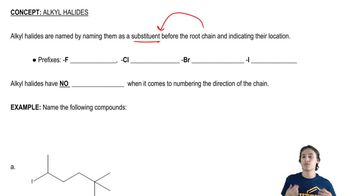
Alkyl Halides

Alkyl halides are organic compounds derived from alkanes that contain one or more halogen atoms (F, Cl, Br, I) attached to a carbon atom. They are key intermediates in organic synthesis, often undergoing nucleophilic substitution or elimination reactions to form alkenes or other functional groups. Understanding their reactivity is essential for synthesizing compounds like trans-oct-3-ene.
추천 영상:
01:52
How to name alkyl halides

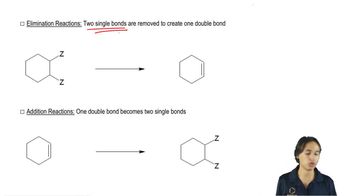
Elimination Reactions

Elimination reactions involve the removal of a small molecule (often HX) from a larger molecule, resulting in the formation of a double bond. In the context of synthesizing alkenes, such as trans-oct-3-ene, elimination can be achieved through dehydrohalogenation of alkyl halides. The stereochemistry of the elimination reaction is crucial for obtaining the desired trans isomer.
추천 영상:
00:40
Recognizing Elimination Reactions.

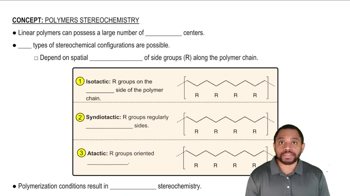
Stereochemistry

Stereochemistry refers to the spatial arrangement of atoms in molecules and how this affects their chemical properties and reactions. For trans-oct-3-ene, the specific arrangement of substituents around the double bond is important for its identity and reactivity. Understanding stereochemical principles helps in predicting the outcomes of reactions and ensuring the correct isomer is synthesized.
추천 영상:
가이드 코스
1:38
Polymer Stereochemistry Concept 1