

The following reaction involves a starting material with a double bond and a hydroxy group, yet its mechanism resembles a pinacol rearrangement. Propose a mechanism, and point out the part of your mechanism that resembles a pinacol rearrangement.
Ch.11 - Reactions of Alcohols
11장, 문제 30c,d
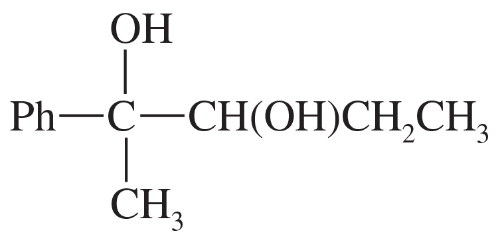
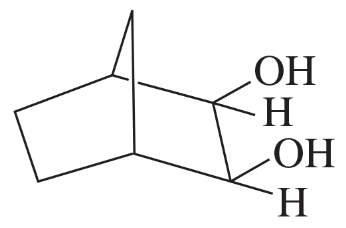
Predict the products formed by periodic acid cleavage of the following diols.
(c) 
(d) 
검증된 단계별 안내1
Periodic acid (HIO₄) cleaves vicinal diols (diols with hydroxyl groups on adjacent carbons) into carbonyl compounds (aldehydes or ketones). This reaction occurs via oxidative cleavage of the C-C bond between the hydroxyl-bearing carbons.
For structure (c): Identify the vicinal diol. The hydroxyl groups are on adjacent carbons (C1 and C2). The cleavage will break the bond between these two carbons, forming two carbonyl compounds. Analyze the substituents on each carbon to determine whether aldehydes or ketones are formed.
For structure (c): The carbon attached to the phenyl group (Ph) and a methyl group (CH₃) will form a ketone because it is a tertiary carbon. The adjacent carbon (C2), which is part of the ethyl group (CH₂CH₃), will form an aldehyde because it is a primary carbon.
For structure (d): Identify the vicinal diols. The hydroxyl groups are on adjacent carbons in the bicyclic structure. Cleavage will occur at the C-C bond between these carbons, resulting in two carbonyl compounds. Consider the steric and structural arrangement to determine the products.
For structure (d): The cleavage of the diol in the bicyclic system will yield two carbonyl compounds. Depending on the specific arrangement of the substituents, the products will likely include ketones or aldehydes. Carefully analyze the connectivity of the carbons to predict the exact products.

비슷한 문제에 대한 검증된 영상 답변:
이 영상 해법은 위 문제에 도움이 된다고 튜터들이 추천한 것입니다.
영상 길이:
6m주요 개념
질문에 올바르게 답하기 위해 반드시 이해해야 하는 핵심 개념들은 다음과 같습니다.
Periodic Acid Cleavage
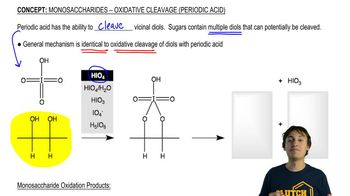
Periodic acid (H5IO6) is a strong oxidizing agent that cleaves vicinal diols (1,2-diols) into carbonyl compounds. This reaction involves the formation of a cyclic periodate intermediate, which subsequently breaks down to yield aldehydes or ketones, depending on the structure of the diol. Understanding this mechanism is crucial for predicting the products of the reaction.
추천 영상:
Monosaccharides - Oxidative Cleavage
Vicinal Diols
Vicinal diols, also known as glycols, are organic compounds that contain two hydroxyl (-OH) groups attached to adjacent carbon atoms. Their structure is essential for periodic acid cleavage, as the reaction specifically targets these diols. Recognizing the configuration and positioning of the hydroxyl groups helps in determining the expected cleavage products.
추천 영상:
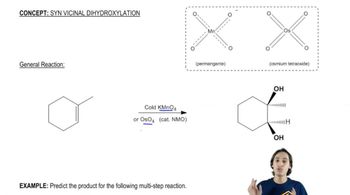
General properties of syn vicinal dihydroxylation.
Oxidation States and Functional Groups
In organic chemistry, understanding oxidation states is vital for predicting the outcome of reactions. During periodic acid cleavage, the oxidation state of the carbon atoms changes as hydroxyl groups are converted into carbonyl groups. Familiarity with functional groups, such as aldehydes and ketones, allows for accurate identification of the products formed from the cleavage of diols.
추천 영상:
Identifying Functional Groups
관련 실천
교과서 질문
867
views
교과서 질문
Use resonance forms of the conjugate bases to explain why methanesulfonic acid (CH3SO3H, pKa = –2.6) is a much stronger acid than acetic acid (CH3COOH, pKa = 4.8).
1083
views
교과서 질문
A good Williamson synthesis of ethyl methyl ether would be
What is wrong with the following proposed synthesis of ethyl methyl ether? First, ethanol is treated with acid to protonate the hydroxy group (making it a good leaving group), and then sodium methoxide is added to displace water.
1376
views
1
rank
교과서 질문
Propose a mechanism for each reaction.
(a)
(b)
1106
views
교과서 질문
Show the alcohol and the acid chloride that combine to make the following esters.
(c)
(d)
725
views
교과서 질문
Predict the products formed by periodic acid cleavage of the following diols.
(a) CH3CH(OH)CH(OH)CH3
(b)
1682
views
