Ch. 15 - Conjugated Systems, Orbital Symmetry, and Ultraviolet Spectroscopy
Wade - Organic Chemistry 9th Edition
Wade9th EditionOrganic ChemistryISBN: 9780135213728당신이 사용하는 게 아니라요?교과서 변경
15장, 문제 1a

Rank each group of compounds in order of increasing heat of hydrogenation.
(a) hexa-1,2-diene; hexa-1,3,5-triene; hexa-1,3-diene; hexa-1,4-diene; hexa-1,5-diene; hexa-2,4-diene

검증된 단계별 안내
1
Step 1: Understand the concept of heat of hydrogenation. Heat of hydrogenation is the energy released when a molecule undergoes hydrogenation (addition of H₂ across double bonds). Molecules with more stable double bonds (due to conjugation or resonance) will have lower heats of hydrogenation.
Step 2: Analyze the structures provided. The compounds are hexa-1,2-diene, hexa-1,3,5-triene, hexa-1,3-diene, hexa-1,4-diene, hexa-1,5-diene, and hexa-2,4-diene. Note the number and arrangement of double bonds in each structure.
Step 3: Identify conjugation in the molecules. Conjugated double bonds (alternating single and double bonds) are more stable due to delocalization of π-electrons. For example, hexa-1,3,5-triene has fully conjugated double bonds, making it the most stable and thus having the lowest heat of hydrogenation.
Step 4: Rank the compounds based on stability. Molecules with isolated double bonds (e.g., hexa-1,2-diene) are less stable and will have higher heats of hydrogenation. Partially conjugated systems (e.g., hexa-1,3-diene, hexa-1,4-diene, hexa-1,5-diene, hexa-2,4-diene) will have intermediate heats of hydrogenation.
Step 5: Arrange the compounds in order of increasing heat of hydrogenation: hexa-1,3,5-triene (lowest heat of hydrogenation due to full conjugation), followed by partially conjugated systems (hexa-1,3-diene, hexa-1,4-diene, hexa-1,5-diene, hexa-2,4-diene), and finally hexa-1,2-diene (highest heat of hydrogenation due to isolated double bonds).

비슷한 문제에 대한 검증된 영상 답변:

이 영상 해법은 위 문제에 도움이 된다고 튜터들이 추천한 것입니다.
영상 길이:
9m

주요 개념

질문에 올바르게 답하기 위해 반드시 이해해야 하는 핵심 개념들은 다음과 같습니다.

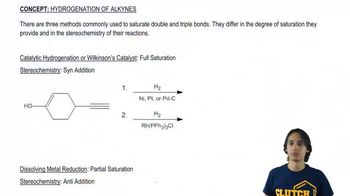
Heat of Hydrogenation

The heat of hydrogenation is the amount of energy released when an alkene is converted to an alkane through the addition of hydrogen. This value is indicative of the stability of the alkene; more stable alkenes release less heat upon hydrogenation. Thus, the heat of hydrogenation can be used to compare the relative stabilities of different alkenes, with less heat indicating greater stability.
추천 영상:
00:48
The definition of hydrogenation.

Alkene Stability and Substitution

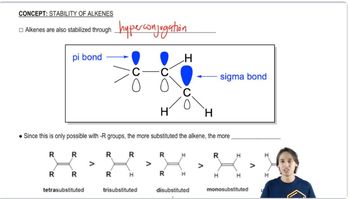
Alkene stability is influenced by the degree of substitution at the double bond. More substituted alkenes (those with more alkyl groups attached to the carbon atoms of the double bond) are generally more stable due to hyperconjugation and the inductive effect. This stability affects the heat of hydrogenation, where more substituted alkenes will have a lower heat of hydrogenation compared to less substituted ones.
추천 영상:
04:28
Understanding trends of alkene stability.

Conjugation and Resonance

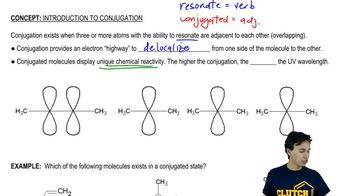
Conjugation occurs when double bonds are separated by a single bond, allowing for delocalization of π electrons across the molecule. This delocalization stabilizes the alkene, leading to lower heat of hydrogenation. Resonance structures can also contribute to the stability of certain alkenes, making them less reactive and thus requiring less energy to hydrogenate.
추천 영상:
05:29
Definition of Conjugation