Ch. 16 - Aromatic Compounds
Wade - Organic Chemistry 9th Edition
Wade9th EditionOrganic ChemistryISBN: 9780135213728당신이 사용하는 게 아니라요?교과서 변경
16장, 문제 2b

Using the information in Figure 16-2, calculate the values of ∆H° for the following reactions:
(b) Chemical reaction diagram showing benzene reacting with hydrogen in the presence of a catalyst to form cyclohexane.

검증된 단계별 안내
1
Step 1: Identify the reaction. The given reaction involves the hydrogenation of benzene (C₆H₆) with 2 moles of hydrogen gas (H₂) in the presence of a catalyst to form cyclohexene (C₆H₁₀).
Step 2: Refer to Figure 16-2 for the enthalpy values. Look for the standard enthalpy of formation (∆H°f) values for benzene (C₆H₆), hydrogen gas (H₂), and cyclohexene (C₆H₁₀). These values are typically provided in a table or graph in the figure.
Step 3: Write the equation for calculating ∆H° for the reaction. Use the formula: ∆H° = Σ∆H°f(products) - Σ∆H°f(reactants).
Step 4: Substitute the values into the equation. For the products, use the ∆H°f value of cyclohexene. For the reactants, sum the ∆H°f values of benzene and 2 moles of hydrogen gas (note that the ∆H°f of H₂ gas is usually 0).
Step 5: Perform the subtraction to determine the ∆H° for the reaction. Ensure that the units are consistent (typically kJ/mol) and interpret the sign of ∆H° (negative for exothermic reactions, positive for endothermic reactions).

비슷한 문제에 대한 검증된 영상 답변:

이 영상 해법은 위 문제에 도움이 된다고 튜터들이 추천한 것입니다.
영상 길이:
7m

주요 개념

질문에 올바르게 답하기 위해 반드시 이해해야 하는 핵심 개념들은 다음과 같습니다.

Enthalpy Change (∆H°)

Enthalpy change (∆H°) is a measure of the heat content of a system at constant pressure. It indicates whether a reaction is exothermic (releases heat, ∆H° < 0) or endothermic (absorbs heat, ∆H° > 0). Calculating ∆H° for a reaction involves using standard enthalpy values of formation for the reactants and products, allowing chemists to predict the energy changes associated with chemical reactions.
추천 영상:
04:38
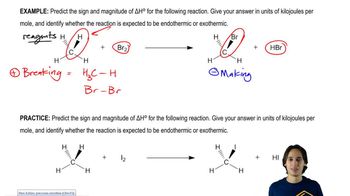
Calculating Enthalpies

Catalysis

Catalysis refers to the process of increasing the rate of a chemical reaction by adding a substance known as a catalyst. Catalysts work by providing an alternative reaction pathway with a lower activation energy, thus facilitating the conversion of reactants to products without being consumed in the process. In the given reaction, a catalyst is necessary to hydrogenate benzene into cyclohexane efficiently.
추천 영상:
가이드 코스
2:31
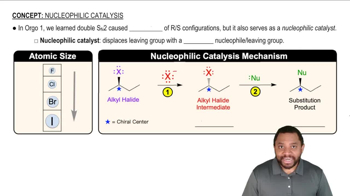
Nucleophilic Catalysis Concept 1

Hydrogenation of Aromatic Compounds

Hydrogenation of aromatic compounds involves the addition of hydrogen (H2) to the aromatic ring, converting it into a saturated compound. This reaction typically requires a catalyst, such as palladium or platinum, to proceed under mild conditions. In this case, benzene is being hydrogenated to form cyclohexane, which is a key transformation in organic synthesis and industrial applications.
추천 영상:
08:19
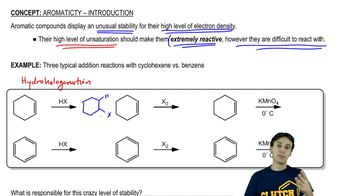
Intro to Aromaticity