Ch. 17 - Reactions of Aromatic Compounds
Wade - Organic Chemistry 9th Edition
Wade9th EditionOrganic ChemistryISBN: 9780135213728당신이 사용하는 게 아니라요?교과서 변경
17장, 문제 16d

For each reaction, show the generation of the electrophile and predict the products.
d. propan-2-ol + toluene + BF3

검증된 단계별 안내
1
Step 1: Understand the role of BF₃ in the reaction. Boron trifluoride (BF₃) is a Lewis acid, meaning it can accept electron pairs. In this reaction, BF₃ will likely interact with propan-2-ol to generate an electrophile.
Step 2: Analyze the interaction between BF₃ and propan-2-ol. Propan-2-ol contains a hydroxyl (-OH) group, which has lone pairs of electrons. BF₃ can coordinate with these lone pairs, leading to the formation of a complex that enhances the electrophilic character of the carbon atom attached to the hydroxyl group.
Step 3: Consider the role of toluene in the reaction. Toluene is an aromatic compound with a methyl group attached to a benzene ring. The aromatic ring can act as a nucleophile due to its π-electrons, which can interact with the electrophile generated in Step 2.
Step 4: Predict the product formation. The electrophile generated from propan-2-ol and BF₃ will likely undergo an electrophilic aromatic substitution reaction with toluene. This involves the aromatic ring attacking the electrophile, followed by the restoration of aromaticity.
Step 5: Summarize the reaction mechanism. The reaction proceeds as follows: (1) BF₃ interacts with propan-2-ol to generate an electrophile, (2) the electrophile reacts with the aromatic ring of toluene, and (3) a substituted aromatic product is formed, with the electrophile replacing a hydrogen atom on the benzene ring.

비슷한 문제에 대한 검증된 영상 답변:

이 영상 해법은 위 문제에 도움이 된다고 튜터들이 추천한 것입니다.
영상 길이:
2m

주요 개념

질문에 올바르게 답하기 위해 반드시 이해해야 하는 핵심 개념들은 다음과 같습니다.

Electrophiles

Electrophiles are species that accept electron pairs from nucleophiles during chemical reactions. They are typically positively charged or neutral molecules with an electron-deficient atom, making them reactive towards nucleophiles. In the given reaction, BF3 acts as a Lewis acid, generating an electrophile that can react with the nucleophilic propan-2-ol.
추천 영상:
03:
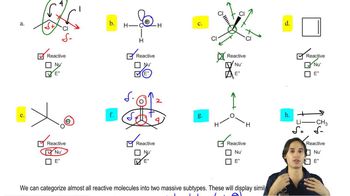
Nucleophile or Electrophile

Lewis Acids and Bases

Lewis acids are substances that can accept an electron pair, while Lewis bases donate an electron pair. In this reaction, BF3, a Lewis acid, interacts with propan-2-ol, a Lewis base, to form a complex. This interaction is crucial for understanding how the electrophile is generated and how the reaction proceeds.
추천 영상:
02:49
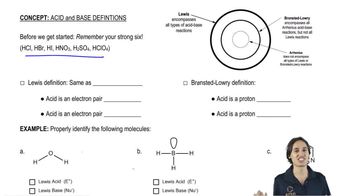
The Lewis definition of acids and bases.

Electrophilic Substitution Reactions

Electrophilic substitution reactions involve the replacement of a hydrogen atom in an aromatic compound with an electrophile. In this case, toluene undergoes electrophilic substitution after the generation of the electrophile from the interaction of propan-2-ol and BF3. Understanding this mechanism is essential for predicting the products of the reaction.
추천 영상:
01:47
Nucleophiles and Electrophiles can react in Substitution Reactions.