Ch. 17 - Reactions of Aromatic Compounds
Wade - Organic Chemistry 9th Edition
Wade9th EditionOrganic ChemistryISBN: 9780135213728당신이 사용하는 게 아니라요?교과서 변경
17장, 문제 57a,b

Give the structures of compounds A through B in the following series of reactions.
Chemical reaction diagram showing the transformation from a benzene ring to compound A, followed by nitration to compound B.

검증된 단계별 안내
1
Step 1: Analyze the first reaction. The starting material is benzene, and it reacts with an acyl chloride (CH3CH2COCl) in the presence of AlCl3. This is a Friedel-Crafts acylation reaction, which introduces an acyl group onto the benzene ring. The product (compound A) will be an aromatic ketone.
Step 2: Understand the mechanism of Friedel-Crafts acylation. AlCl3 acts as a Lewis acid, facilitating the generation of the acylium ion (CH3CH2CO+), which is the electrophile. This electrophile reacts with benzene to form compound A.
Step 3: Analyze the second reaction. Compound A undergoes nitration, which involves the reaction of HNO3 and H2SO4. This is an electrophilic aromatic substitution reaction where a nitro group (-NO2) is introduced onto the aromatic ring.
Step 4: Understand the regioselectivity of nitration. The acyl group on compound A is an electron-withdrawing group, which directs the incoming nitro group to the meta position relative to the acyl group.
Step 5: Combine the information from both reactions. Compound A is an aromatic ketone formed by Friedel-Crafts acylation, and compound B is the meta-nitro derivative of compound A formed by nitration.

비슷한 문제에 대한 검증된 영상 답변:

이 영상 해법은 위 문제에 도움이 된다고 튜터들이 추천한 것입니다.
영상 길이:
2m

주요 개념

질문에 올바르게 답하기 위해 반드시 이해해야 하는 핵심 개념들은 다음과 같습니다.

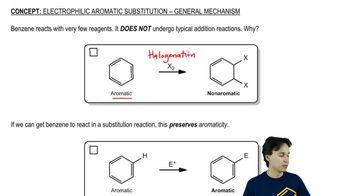
Electrophilic Aromatic Substitution

Electrophilic aromatic substitution (EAS) is a fundamental reaction in organic chemistry where an electrophile replaces a hydrogen atom on an aromatic ring. This process is crucial for understanding how compounds like benzene can be transformed into more complex structures, such as compound A in the given reaction. The stability of the aromatic system allows for the substitution to occur without disrupting the aromaticity.
추천 영상:
03:07
EAS Review

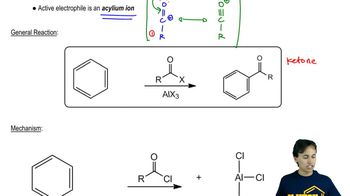
Friedel-Crafts Acylation

Friedel-Crafts acylation is a specific type of electrophilic aromatic substitution that introduces an acyl group into an aromatic ring. In the reaction shown, benzene reacts with an acyl chloride in the presence of a Lewis acid catalyst (AlCl3) to form compound A. This reaction is significant for synthesizing ketones and modifying aromatic compounds.
추천 영상:
05:20
Friedel-Crafts Acylation

Nitration of Aromatic Compounds

Nitration is a chemical process that introduces a nitro group (-NO2) into an aromatic compound, typically using a mixture of nitric acid (HNO3) and sulfuric acid (H2SO4). In the context of the question, compound A undergoes nitration to form compound B. This reaction is important for creating compounds that can participate in further chemical transformations and is a key step in the synthesis of various pharmaceuticals and explosives.
추천 영상:
08:19
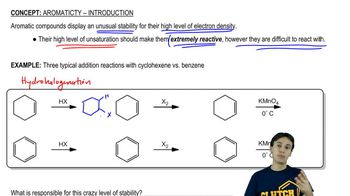
Intro to Aromaticity