Give the structures of compounds A through B in the following series of reactions.
Ch. 17 - Reactions of Aromatic Compounds
17장, 문제 58
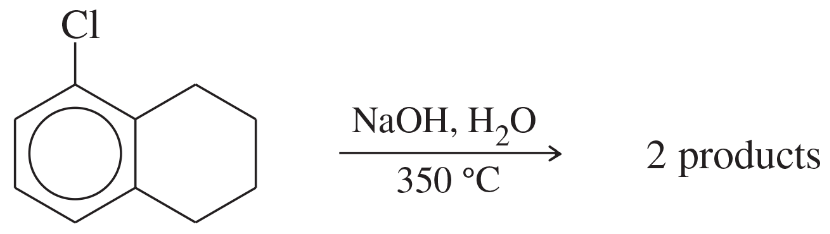
The following compound reacts with a hot, concentrated solution of NaOH (in a sealed tube) to give a mixture of two products. Propose structures for these products, and give a mechanism to account for their formation.

검증된 단계별 안내1
Step 1: Identify the functional groups in the given compound. Analyze the structure to determine reactive sites, such as halides, carbonyl groups, or aromatic rings, which may interact with NaOH under the given conditions.
Step 2: Understand the reaction conditions. Hot, concentrated NaOH in a sealed tube suggests a strong base and high temperature, which can promote elimination, substitution, or rearrangement reactions. Consider how these conditions might affect the functional groups in the compound.
Step 3: Propose the first product. Determine the most likely reaction pathway for one of the reactive sites. For example, if the compound contains a halide, a nucleophilic substitution (SN2 or SN1) or elimination (E2 or E1) reaction may occur. Use curved arrows to show the movement of electrons in the mechanism.
Step 4: Propose the second product. Consider alternative reaction pathways or secondary reactions that could occur under the same conditions. For example, if the compound contains an aromatic ring, hydroxide may act as a nucleophile to initiate an electrophilic aromatic substitution or addition reaction.
Step 5: Write the complete mechanism for the formation of both products. Use step-by-step electron-pushing diagrams to illustrate how the reactants transform into the products. Ensure that all intermediates and transition states are accounted for, and verify that the proposed products are consistent with the reaction conditions.

비슷한 문제에 대한 검증된 영상 답변:
이 영상 해법은 위 문제에 도움이 된다고 튜터들이 추천한 것입니다.
영상 길이:
9m주요 개념
질문에 올바르게 답하기 위해 반드시 이해해야 하는 핵심 개념들은 다음과 같습니다.
Nucleophilic Substitution
Nucleophilic substitution is a fundamental reaction in organic chemistry where a nucleophile replaces a leaving group in a molecule. In the context of the question, the concentrated NaOH acts as a strong nucleophile, attacking the electrophilic carbon atom of the compound, leading to the formation of new products. Understanding the mechanism of this reaction is crucial for predicting the structures of the products formed.
추천 영상:
Nucleophiles and Electrophiles can react in Substitution Reactions.
Elimination Reactions
Elimination reactions involve the removal of atoms or groups from a molecule, resulting in the formation of a double bond or a ring structure. In the presence of a strong base like NaOH, the reaction can lead to both substitution and elimination pathways. Recognizing the conditions that favor elimination, such as heat and concentrated reagents, is essential for determining the possible products in this scenario.
추천 영상:
Recognizing Elimination Reactions.
Reaction Mechanisms
A reaction mechanism describes the step-by-step process by which reactants transform into products, detailing the bond-breaking and bond-forming events. For the question at hand, proposing a mechanism involves illustrating how the nucleophile interacts with the substrate and the subsequent steps leading to product formation. Understanding mechanisms is vital for predicting the outcome of reactions and rationalizing the formation of multiple products.
추천 영상:
Heck Reaction Mechanism
관련 실천
교과서 질문
932
views
교과서 질문
Give the structures of compounds A through C in the following series of reactions.
795
views
교과서 질문
Give the structures of compounds C through D in the following series of reactions.
938
views
교과서 질문
α-Tetralone undergoes Birch reduction to give an excellent yield of a single product. Predict the structure of the product, and propose a mechanism for its formation.
1154
views
교과서 질문
Show the products you expect when each compound reacts with NBS with light shining on the reaction.
(d)
751
views
교과서 질문
Electrophilic aromatic substitution usually occurs at the 1-position of naphthalene, also called the a position. Predict the major products of the reactions of naphthalene with the following reagents.
(a) HNO3, H2SO4
(b) Br2, FeBr3
(c) CH3CH2COCl, AlCl3
1346
views