Ch. 18 - Ketones and Aldehydes
Wade - Organic Chemistry 9th Edition
Wade9th EditionOrganic ChemistryISBN: 9780135213728당신이 사용하는 게 아니라요?교과서 변경
18장, 문제 36a

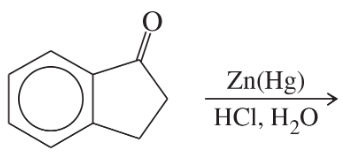
Predict the major products of the following reactions:
(a)

검증된 단계별 안내
1
Step 1: Recognize the reaction type. The reagents Zn(Hg), HCl, and H2O indicate a Clemmensen reduction, which is used to reduce ketones or aldehydes to alkanes.
Step 2: Identify the functional group in the starting material. The given compound contains a ketone group attached to a benzene ring and an ethyl chain.
Step 3: Understand the mechanism. In Clemmensen reduction, the ketone group is reduced to a methylene (-CH2-) group, effectively removing the oxygen atom and saturating the carbon with hydrogen atoms.
Step 4: Predict the structural change. The ketone group in the starting material will be replaced by a methylene group, resulting in a compound where the benzene ring is directly attached to the ethyl chain.
Step 5: Draw the major product. The final structure will consist of a benzene ring connected to an ethyl chain without the ketone group. Ensure the connectivity and saturation of the molecule are correct.

비슷한 문제에 대한 검증된 영상 답변:

이 영상 해법은 위 문제에 도움이 된다고 튜터들이 추천한 것입니다.
영상 길이:
2m

주요 개념

질문에 올바르게 답하기 위해 반드시 이해해야 하는 핵심 개념들은 다음과 같습니다.

Clemmensen Reduction

The Clemmensen reduction is a chemical reaction that reduces carbonyl compounds, such as aldehydes and ketones, to their corresponding alkanes using zinc amalgam (Zn(Hg)) in the presence of hydrochloric acid (HCl). This reaction is particularly useful for converting aromatic ketones into aliphatic hydrocarbons, effectively removing the carbonyl functional group.

Aromatic Compounds

Aromatic compounds are a class of cyclic compounds characterized by their stable ring structure and delocalized π-electrons, which follow Huckel's rule (4n + 2 π electrons). These compounds, such as benzene and its derivatives, exhibit unique reactivity patterns, including electrophilic substitution, which is crucial for understanding their behavior in various chemical reactions.

Electrophilic Substitution

Electrophilic substitution is a fundamental reaction mechanism in organic chemistry where an electrophile replaces a hydrogen atom in an aromatic ring. This process is essential for modifying aromatic compounds, allowing for the introduction of various functional groups while maintaining the aromaticity of the ring. Understanding this mechanism is key to predicting the products of reactions involving aromatic systems.