Ch. 18 - Ketones and Aldehydes
Wade - Organic Chemistry 9th Edition
Wade9th EditionOrganic ChemistryISBN: 9780135213728당신이 사용하는 게 아니라요?교과서 변경
18장, 문제 36b

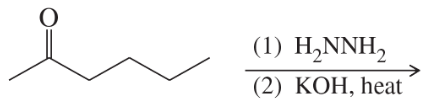
Predict the major products of the following reactions:
(b)

검증된 단계별 안내
1
Step 1: Recognize the reaction type. The reagents H₂NNH₂ (hydrazine) and KOH with heat indicate a Wolff-Kishner reduction. This reaction is used to reduce a carbonyl group (C=O) in aldehydes or ketones to a methylene group (-CH₂).
Step 2: Analyze the starting material. The given compound is a ketone with a carbonyl group attached to a secondary carbon. The rest of the molecule consists of alkyl groups branching off the main chain.
Step 3: Understand the mechanism. In the Wolff-Kishner reduction, hydrazine reacts with the carbonyl group to form a hydrazone intermediate. Under basic conditions and heat, the hydrazone undergoes decomposition, resulting in the removal of the oxygen atom and the formation of a methylene group (-CH₂).
Step 4: Predict the product. The carbonyl group in the ketone will be replaced by a methylene group (-CH₂), leaving the rest of the molecule unchanged. The major product will retain the same carbon skeleton as the starting material, but the carbonyl group will be reduced.
Step 5: Verify the structure. Ensure that the major product is consistent with the Wolff-Kishner reduction mechanism and that no other functional groups are affected during the reaction.

비슷한 문제에 대한 검증된 영상 답변:

이 영상 해법은 위 문제에 도움이 된다고 튜터들이 추천한 것입니다.
영상 길이:
10m

주요 개념

질문에 올바르게 답하기 위해 반드시 이해해야 하는 핵심 개념들은 다음과 같습니다.

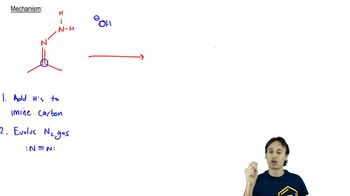
Wolff-Kishner Reduction

The Wolff-Kishner reduction is a chemical reaction used to convert carbonyl compounds, such as ketones and aldehydes, into alkanes. This process involves the use of hydrazine (H2NNH2) and a strong base, typically potassium hydroxide (KOH), under heating conditions. The reaction proceeds through the formation of a hydrazone intermediate, which is then deprotonated and subsequently decomposed to yield the corresponding alkane.
추천 영상:
04:57
Mechanism

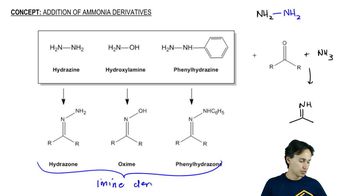
Hydrazine and its Role

Hydrazine (H2NNH2) is a key reagent in the Wolff-Kishner reduction, acting as a nucleophile that reacts with carbonyl compounds to form hydrazones. This intermediate is crucial for the subsequent steps of the reaction, where it undergoes deprotonation and elimination to produce the final alkane product. Understanding the reactivity of hydrazine and its derivatives is essential for predicting the outcomes of reactions involving carbonyl compounds.
추천 영상:
02:49
Ammonia Derivatives

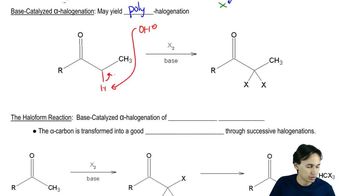
Base-Catalyzed Decomposition

In the Wolff-Kishner reduction, the strong base (KOH) plays a vital role in facilitating the decomposition of the hydrazone intermediate. The base deprotonates the hydrazone, leading to the formation of a carbanion that can eliminate nitrogen gas (N2) and yield the alkane product. This step is critical for the successful conversion of the carbonyl compound to an alkane, highlighting the importance of base strength and reaction conditions in organic synthesis.
추천 영상:
01:57
Base Catalyzed