Ch. 20 - Carboxylic Acids
Wade - Organic Chemistry 9th Edition
Wade9th EditionOrganic ChemistryISBN: 9780135213728당신이 사용하는 게 아니라요?교과서 변경
20장, 문제 30d,e

Predict the products (if any) of the following acid–base reactions.
(d) α-bromopropionic acid + sodium propionate
(e) benzoic acid + sodium phenoxide

검증된 단계별 안내
1
Step 1: Understand the nature of the reactants. In both reactions, you are dealing with acid-base chemistry. Acids donate protons (H⁺), while bases accept protons. Identify the acidic and basic components in each reaction. For (d), a-bromopropionic acid is the acid, and sodium propionate is the base. For (e), benzoic acid is the acid, and sodium phenoxide is the base.
Step 2: Write the chemical formulas for the reactants. For (d), a-bromopropionic acid is CH₂BrCH₂COOH, and sodium propionate is CH₃CH₂COONa. For (e), benzoic acid is C₆H₅COOH, and sodium phenoxide is C₆H₅ONa.
Step 3: Predict the proton transfer. In an acid-base reaction, the acid donates a proton to the base. For (d), CH₂BrCH₂COOH will donate its proton (H⁺) to CH₃CH₂COO⁻ (the conjugate base of sodium propionate). For (e), C₆H₅COOH will donate its proton to C₆H₅O⁻ (the conjugate base of sodium phenoxide).
Step 4: Write the products of the reaction. For (d), the products will be CH₂BrCH₂COO⁻ (the conjugate base of a-bromopropionic acid) and CH₃CH₂COOH (propionic acid). For (e), the products will be C₆H₅COO⁻ (the conjugate base of benzoic acid) and C₆H₅OH (phenol).
Step 5: Consider equilibrium and reactivity. Acid-base reactions often favor the formation of the weaker acid and base. Compare the pKa values of the acids involved (a-bromopropionic acid vs. propionic acid in (d), and benzoic acid vs. phenol in (e)) to determine the direction of equilibrium. This step helps confirm the likelihood of the reaction proceeding as written.

비슷한 문제에 대한 검증된 영상 답변:

이 영상 해법은 위 문제에 도움이 된다고 튜터들이 추천한 것입니다.
영상 길이:
6m

주요 개념

질문에 올바르게 답하기 위해 반드시 이해해야 하는 핵심 개념들은 다음과 같습니다.

Acid-Base Reactions

Acid-base reactions involve the transfer of protons (H+) between reactants. In these reactions, acids donate protons while bases accept them. Understanding the strength of the acids and bases involved is crucial, as it determines the direction of the reaction and the stability of the products formed.
추천 영상:
02:49
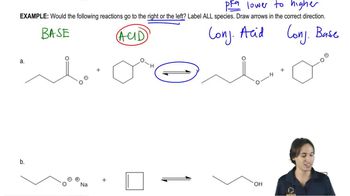
The Lewis definition of acids and bases.

Conjugate Acid-Base Pairs

In acid-base chemistry, every acid has a corresponding conjugate base, and every base has a corresponding conjugate acid. When an acid donates a proton, it becomes its conjugate base, and when a base accepts a proton, it becomes its conjugate acid. Recognizing these pairs helps predict the products of the reaction and their relative strengths.
추천 영상:
가이드 코스
2:56
Base Pairing Concept 1

Equilibrium in Acid-Base Reactions

Acid-base reactions often reach an equilibrium state where both reactants and products are present. The position of this equilibrium is influenced by the relative strengths of the acids and bases involved. Understanding Le Chatelier's principle can help predict how changes in concentration or conditions will affect the equilibrium and the products formed.
추천 영상:
04:00
Determining Acid/Base Equilibrium