Ch. 21 - Carboxylic Acid Derivatives
Wade - Organic Chemistry 9th Edition
Wade9th EditionOrganic ChemistryISBN: 9780135213728당신이 사용하는 게 아니라요?교과서 변경
21장, 문제 38a

Show how you would convert the following starting materials to the indicated nitriles:
(a) phenylacetic acid → phenylacetonitrile

검증된 단계별 안내
1
Identify the functional group in the starting material, phenylacetic acid. It contains a carboxylic acid group (-COOH) attached to a benzyl group (C6H5-CH2-). The goal is to replace the carboxylic acid group with a nitrile group (-CN).
Recall that carboxylic acids can be converted to nitriles through a two-step process: (1) conversion of the carboxylic acid to an amide intermediate, and (2) dehydration of the amide to form the nitrile.
In the first step, react phenylacetic acid with a reagent like thionyl chloride (SOCl2) to convert the carboxylic acid into an acid chloride (phenylacetyl chloride). This step activates the carboxylic acid for further reaction.
In the second step, react the acid chloride with ammonia (NH3) to form the corresponding amide, phenylacetamide. This occurs via nucleophilic substitution, where ammonia attacks the carbonyl carbon of the acid chloride.
Finally, dehydrate the amide using a dehydrating agent such as phosphorus pentoxide (P2O5) or thionyl chloride (SOCl2) to form phenylacetonitrile. This step removes water from the amide, resulting in the nitrile group (-CN).

비슷한 문제에 대한 검증된 영상 답변:

이 영상 해법은 위 문제에 도움이 된다고 튜터들이 추천한 것입니다.
영상 길이:
3m

주요 개념

질문에 올바르게 답하기 위해 반드시 이해해야 하는 핵심 개념들은 다음과 같습니다.

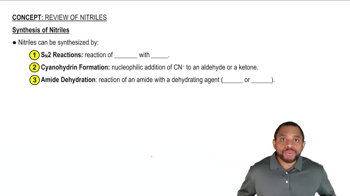
Nitrile Synthesis

Nitriles are organic compounds containing a cyano group (-C≡N). One common method to synthesize nitriles is through the conversion of carboxylic acids or their derivatives. In this case, phenylacetic acid can be converted to phenylacetonitrile via a dehydration reaction, often using reagents like thionyl chloride or phosphorus pentoxide to facilitate the transformation.
추천 영상:
가이드 코스
0:59
Review of Nitriles Concept 1

Carboxylic Acid Derivatives

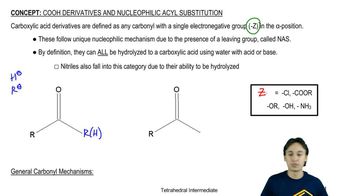
Carboxylic acids can be transformed into various derivatives, such as acid chlorides, esters, and amides, which can further react to form nitriles. Understanding these derivatives is crucial for predicting reaction pathways. For phenylacetic acid, converting it to an acid chloride is a key step before further reaction to yield the desired nitrile.
추천 영상:
03:50
Intro to Carboxylic Acid Derivatives

Reagents and Reaction Conditions

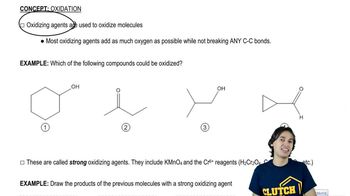
The choice of reagents and reaction conditions is vital in organic synthesis. For the conversion of phenylacetic acid to phenylacetonitrile, reagents like thionyl chloride (SOCl2) or phosphorus oxychloride (POCl3) are commonly used to create the acid chloride intermediate. The subsequent reaction with a suitable nucleophile, such as sodium cyanide, leads to the formation of the nitrile.
추천 영상:
01:52
Reagents