Ch. 21 - Carboxylic Acid Derivatives
Wade - Organic Chemistry 9th Edition
Wade9th EditionOrganic ChemistryISBN: 9780135213728당신이 사용하는 게 아니라요?교과서 변경
21장, 문제 7

Which of the following proposed reactions would take place quickly under mild conditions?
(a)
(b)
(c)
(d)
(e)

검증된 단계별 안내
1
Step 1: Analyze the reactivity of the functional groups in each reaction. Mild conditions typically favor reactions with highly reactive functional groups, such as acyl chlorides, which readily undergo nucleophilic substitution.
Step 2: Evaluate reaction (i). The reaction involves an amide and NaCl. Amides are relatively stable and do not react easily under mild conditions with NaCl, as this would require harsh conditions to break the C-N bond.
Step 3: Evaluate reaction (ii). The reaction involves an acyl chloride and methylamine (CH3NH2). Acyl chlorides are highly reactive and readily undergo nucleophilic substitution with amines under mild conditions, forming an amide and releasing HCl.
Step 4: Evaluate reaction (iii). The reaction involves an amide and ethanol (CH3CH2OH). Amides are stable and do not react easily with alcohols under mild conditions, as this would require strong acid or base catalysis.
Step 5: Evaluate reaction (iv) and (v). Reaction (iv) involves an acyl chloride and a carboxylic acid, which can react under mild conditions to form an anhydride. Reaction (v) involves an ester and ethylamine, which can react under mild conditions to form an amide and acetic acid. Both reactions are feasible under mild conditions.

비슷한 문제에 대한 검증된 영상 답변:

이 영상 해법은 위 문제에 도움이 된다고 튜터들이 추천한 것입니다.
영상 길이:
3m

주요 개념

질문에 올바르게 답하기 위해 반드시 이해해야 하는 핵심 개념들은 다음과 같습니다.

Nucleophilic Acyl Substitution

Nucleophilic acyl substitution is a fundamental reaction in organic chemistry where a nucleophile attacks the electrophilic carbon of a carbonyl group, leading to the replacement of a leaving group. This reaction is characteristic of carboxylic acid derivatives, such as esters, amides, and acyl chlorides. The rate of this reaction can be influenced by the nature of the nucleophile and the leaving group, as well as the reaction conditions.
추천 영상:
01:47
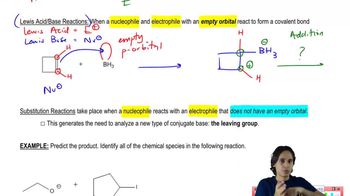
Nucleophiles and Electrophiles can react in Substitution Reactions.

Leaving Groups

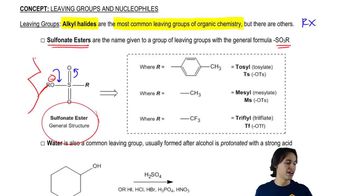
In nucleophilic acyl substitution reactions, the leaving group is the atom or group that departs with a pair of electrons, allowing the nucleophile to bond to the carbonyl carbon. Good leaving groups, such as halides (e.g., Cl, Br) or sulfonate esters, stabilize the transition state and facilitate the reaction. The ability of a leaving group to depart is crucial for determining the reaction's speed and feasibility under mild conditions.
추천 영상:
07:22
The 3 important leaving groups to know.

Reaction Conditions

Mild reaction conditions refer to the use of low temperatures, neutral pH, and non-aggressive solvents that do not promote side reactions or decomposition of reactants. These conditions are often preferred in organic synthesis to ensure selectivity and yield. Understanding how different conditions affect the reactivity of nucleophiles and electrophiles is essential for predicting which reactions will proceed quickly and efficiently.
추천 영상:
가이드 코스
1:18
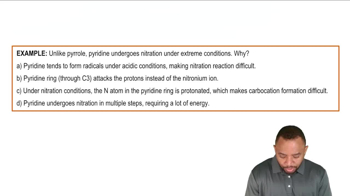
EAS Reactions of Pyridine Example 1