Ch.4 - The Study of Chemical Reactions
Wade - Organic Chemistry 9th Edition
Wade9th EditionOrganic ChemistryISBN: 9780135213728당신이 사용하는 게 아니라요?교과서 변경
4장, 문제 16d

The bromination of methane proceeds through the following steps:

d. Compute the overall value of ΔH° for the bromination

검증된 단계별 안내
1
Step 1: Understand the problem. The bromination of methane involves multiple steps, and the goal is to compute the overall ΔH° (change in enthalpy) for the reaction. This requires summing up the ΔH° values for each step provided in the problem.
Step 2: Identify the ΔH° values for each step. From the problem: Step 1 has ΔH° = +190 kJ, Step 2 has ΔH° = +73 kJ, and Step 3 has ΔH° = -112 kJ.
Step 3: Apply the principle of Hess's Law. Hess's Law states that the overall ΔH° for a reaction is the sum of the ΔH° values for each individual step. This means you need to add the ΔH° values from Step 1, Step 2, and Step 3.
Step 4: Write the mathematical expression for the overall ΔH°. Using MathML, the expression can be written as: ΔH°=(190)+(73)+(-112)
Step 5: Simplify the expression to find the overall ΔH°. Add the values together to compute the result. This will give you the overall enthalpy change for the bromination of methane.

비슷한 문제에 대한 검증된 영상 답변:

이 영상 해법은 위 문제에 도움이 된다고 튜터들이 추천한 것입니다.
영상 길이:
4m

주요 개념

질문에 올바르게 답하기 위해 반드시 이해해야 하는 핵심 개념들은 다음과 같습니다.

Enthalpy Change (ΔH°)

Enthalpy change (ΔH°) is a measure of the heat content of a system at constant pressure. It indicates whether a reaction is exothermic (releases heat, ΔH° < 0) or endothermic (absorbs heat, ΔH° > 0). In the context of the bromination of methane, calculating the overall ΔH° involves summing the enthalpy changes of each step in the reaction mechanism.
추천 영상:
04:38
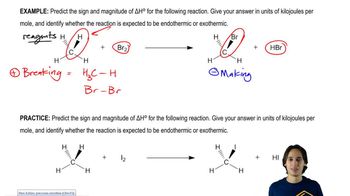
Calculating Enthalpies

Reaction Mechanism

A reaction mechanism describes the step-by-step sequence of elementary reactions by which a chemical change occurs. Understanding the mechanism of bromination of methane is crucial, as it involves radical intermediates and specific steps that contribute to the overall enthalpy change. Each step's ΔH° reflects the energy changes associated with bond breaking and forming.
추천 영상:
02:16
Heck Reaction Mechanism

Activation Energy (Ea)

Activation energy (Ea) is the minimum energy required for a reaction to occur. It is a critical factor in determining the rate of a reaction. In the bromination of methane, the Ea values for each step indicate how much energy must be supplied to initiate the reaction, influencing both the kinetics and thermodynamics of the overall process.
추천 영상:
가이드 코스
3:22
EAS Reactions of Pyridine Concept 3