
Ch.4 - The Study of Chemical Reactions
Wade - Organic Chemistry 9th Edition
Wade9th EditionOrganic ChemistryISBN: 9780135213728당신이 사용하는 게 아니라요?교과서 변경
4장, 문제 5b

The following reaction has a value of ΔG° = –2.1 kJ/mol (–0.50 kcal/mol).
CH3Br + H2S ⇌ CH3SH + HBr
b. Starting with a 1 M solution of CH3Br and H2S, calculate the final concentrations of all four species at equilibrium.

검증된 단계별 안내
1
Step 1: Write the equilibrium constant expression (K) for the reaction. The reaction is CH3Br + H2S ⇌ CH3SH + HBr. The equilibrium constant expression is: K = [CH3SH][HBr][CH3Br][H2S].
Step 2: Use the relationship between ΔG and K to calculate the equilibrium constant. The formula is: ΔG = -RTlnK, where ΔG is the Gibbs free energy change (-2.1 kJ/mol), R is the gas constant (8.314 J/mol·K), and T is the temperature in Kelvin (assume 298 K unless otherwise specified). Rearrange the equation to solve for K: K = eΔG-RT.
Step 3: Set up an ICE (Initial, Change, Equilibrium) table to track the concentrations of all species. Initially, [CH3Br] = 1 M, [H2S] = 1 M, and [CH3SH] = [HBr] = 0 M. Define the change in concentration of CH3Br and H2S as -x, and the change in concentration of CH3SH and HBr as +x.
Step 4: Express the equilibrium concentrations in terms of x. At equilibrium, [CH3Br] = 1 - x, [H2S] = 1 - x, [CH3SH] = x, and [HBr] = x. Substitute these expressions into the equilibrium constant expression: K = xx(1-x)(1-x).
Step 5: Solve for x using the value of K calculated in Step 2. This will involve substituting the value of K into the equation and solving the quadratic equation for x. Once x is determined, use it to calculate the equilibrium concentrations of all species: [CH3Br] = 1 - x, [H2S] = 1 - x, [CH3SH] = x, and [HBr] = x.

비슷한 문제에 대한 검증된 영상 답변:

이 영상 해법은 위 문제에 도움이 된다고 튜터들이 추천한 것입니다.
영상 길이:
11m

주요 개념

질문에 올바르게 답하기 위해 반드시 이해해야 하는 핵심 개념들은 다음과 같습니다.

Gibbs Free Energy (ΔG)

Gibbs Free Energy (ΔG) is a thermodynamic potential that indicates the spontaneity of a reaction. A negative ΔG value, such as -2.1 kJ/mol, suggests that the reaction is exergonic and will proceed spontaneously towards the products under standard conditions. Understanding ΔG helps predict the direction of the reaction and the extent to which reactants will convert to products at equilibrium.
추천 영상:
05:02
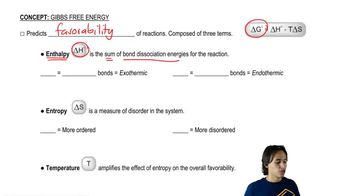
Breaking down the different terms of the Gibbs Free Energy equation.

Equilibrium Constant (K)

The equilibrium constant (K) quantifies the ratio of concentrations of products to reactants at equilibrium for a reversible reaction. It is derived from the Gibbs Free Energy change, where a negative ΔG corresponds to a K value greater than 1, indicating that products are favored. Calculating K is essential for determining the final concentrations of species in the reaction at equilibrium.
추천 영상:
02:19
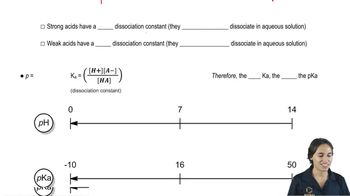
The relationship between equilibrium constant and pKa.

ICE Table (Initial, Change, Equilibrium)

An ICE table is a systematic way to track the concentrations of reactants and products during a chemical reaction as it progresses towards equilibrium. It includes initial concentrations, the changes in concentration as the reaction proceeds, and the equilibrium concentrations. Using an ICE table allows for the calculation of the final concentrations of all species involved in the reaction, based on the stoichiometry and equilibrium constant.
추천 영상:
01:46
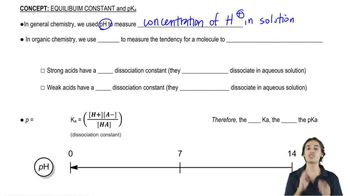
Why we use pKa instead of pH.
관련 실천
교과서 질문

Use the bond-dissociation enthalpies in Table 4-2 (page 167) to calculate the heats of reaction for the two possible first propagation steps in the chlorination of isobutane. Use this information to draw a reaction-energy diagram like Figure 4-8, comparing the activation energies for formation of the two radicals.

1047
views
교과서 질문

When ethene is mixed with hydrogen in the presence of a platinum catalyst, hydrogen adds across the double bond to form ethane. At room temperature, the reaction goes to completion. Predict the signs of ΔH° and ΔS° for this reaction. Explain these signs in terms of bonding and freedom of motion.

3051
views
교과서 질문

Under base-catalyzed conditions, two molecules of acetone can condense to form diacetone alcohol. At room temperature (25 °C), about 5% of the acetone is converted to diacetone alcohol. Determine the value of ΔG° for this reaction.

1269
views
교과서 질문

Free-radical chlorination of hexane gives very poor yields of 1-chlorohexane, while cyclohexane can be converted to chlorocyclohexane in good yield.

a. How do you account for this difference?

b. What ratio of reactants (cyclohexane and chlorine) would you use for the synthesis of chlorocyclohexane?

2423
views
교과서 질문

The following reaction has a value of ΔG° = –2.1 kJ/mol (–0.50 kcal/mol).

CH3Br + H2S ⇌ CH3SH + HBr

a. Calculate Keq at room temperature (25 °C) for this reaction as written.

1856
views
교과서 질문
The dehydrogenation of butane to trans-but-2-ene has ΔH° = +116 kJ/mol (+27.6 kcal/mol) and ΔS° = +117J/kelvin-mol (+28.0 cal/kelvin-mol). a. Compute the value of ΔG° for dehydrogenation at room temperature (25 °C or 298 °K). Is dehydrogenation favored or disfavored? HINT: When you are doing synthesis problems, avoid using these high-temperature industrial methods. They require specialized equipment, and they produce variable mixtures of products.
1066
views