Ch. 7 - Structure and Synthesis of Alkenes; Elimination
Wade - Organic Chemistry 9th Edition
Wade9th EditionOrganic ChemistryISBN: 9780135213728당신이 사용하는 게 아니라요?교과서 변경
7장, 문제 20b

Give the substitution and elimination products you would expect from the following reactions.
b. 1-iodo-1-phenylcyclopentane heated in ethanol

검증된 단계별 안내
1
Identify the type of reaction mechanism that can occur. In this case, the substrate (1-iodo-1-phenylcyclopentane) is a secondary alkyl halide, which can undergo both substitution (SN1 or SN2) and elimination (E1 or E2) reactions. The solvent, ethanol, is a polar protic solvent, favoring SN1 and E1 mechanisms.
Analyze the conditions. Heating the reaction mixture typically promotes elimination (E1) over substitution (SN1), as heat provides the energy required for the formation of the carbocation intermediate and subsequent elimination of a proton.
For the SN1 mechanism: The iodine atom leaves first, forming a carbocation intermediate. The phenyl group stabilizes the carbocation through resonance. Ethanol, acting as a nucleophile, can attack the carbocation to form the substitution product, which is an ether.
For the E1 mechanism: After the carbocation is formed, a beta-hydrogen (a hydrogen atom on a carbon adjacent to the carbocation) is removed by ethanol acting as a base. This results in the formation of a double bond, yielding an alkene as the elimination product. The major product will follow Zaitsev's rule, where the more substituted alkene is favored.
Consider stereochemistry and regioselectivity. For the elimination product, the trans (E) isomer is typically more stable and favored over the cis (Z) isomer due to reduced steric hindrance. For the substitution product, the stereochemistry depends on the attack of ethanol on the planar carbocation intermediate.

비슷한 문제에 대한 검증된 영상 답변:

이 영상 해법은 위 문제에 도움이 된다고 튜터들이 추천한 것입니다.
영상 길이:
4m

주요 개념

질문에 올바르게 답하기 위해 반드시 이해해야 하는 핵심 개념들은 다음과 같습니다.

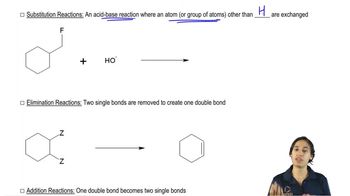
Substitution Reactions

Substitution reactions involve the replacement of one functional group in a molecule with another. In organic chemistry, this often occurs with alkyl halides, where a nucleophile attacks the carbon atom bonded to the halogen, leading to the formation of a new bond and the release of the halide ion. The type of substitution (SN1 or SN2) depends on factors like the structure of the substrate and the nature of the nucleophile.
추천 영상:
01:34
Recognizing Substitution Reactions.

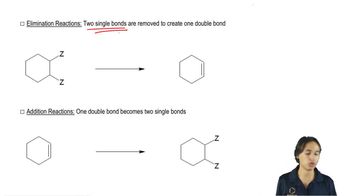
Elimination Reactions

Elimination reactions involve the removal of two atoms or groups from a molecule, resulting in the formation of a double bond or a ring structure. In the context of alkyl halides, elimination can occur via E1 or E2 mechanisms, where a base abstracts a proton, and the leaving group departs simultaneously or sequentially. The conditions, such as heat and solvent, can influence the pathway and products formed.
추천 영상:
00:40
Recognizing Elimination Reactions.

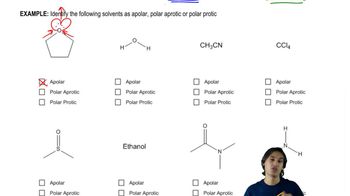
Solvent Effects

The choice of solvent can significantly influence the outcome of substitution and elimination reactions. Polar protic solvents, like ethanol, can stabilize ions and facilitate SN1 and E1 mechanisms, while polar aprotic solvents favor SN2 and E2 pathways. In the case of heating 1-iodo-1-phenylcyclopentane in ethanol, the solvent's properties will affect whether substitution or elimination products are favored.
추천 영상:
01:16
Identification of polarity in solvents
관련 실천
교과서 질문

Give the substitution and elimination products you would expect from the following reactions.

a. 3-bromo-3-ethylpentane heated in methanol

2145
views

교과서 질문

The solvolysis of 2-bromo-3-methylbutane potentially can give several products, ­including both E1 and products from both the unrearranged carbocation and the rearranged ­carbocation. Mechanisms 6-6 and 7-2 show the products from the rearranged carbocation. Summarize all the possible products, showing which carbocation they come from and whether they are the products of E1 or reactions.

<IMAGES>

1778
views
1
rank
교과서 질문

When (1-bromoethyl)cyclohexane is heated in methanol for an extended period of time, five products result: two ethers and three alkenes. Predict which of the three alkenes is the major elimination product.

1157
views
교과서 질문

Finish Solved Problem 7-3 by showing how the rearranged carbocations give the four products shown in the problem. Be careful when using curved arrows to show ­deprotonation and/or nucleophilic attack by the solvent. The curved arrows always show ­movement of electrons, not movement of protons or other species.

1071
views
교과서 질문

Give the substitution and elimination products you would expect from the following reactions.

c. 1-bromo-2-methylcyclohexane + silver nitrate in water (AgNO3 forces ionization)

844
views
교과서 질문

When (1-bromoethyl)cyclohexane is heated in methanol for an extended period of time, five products result: two ethers and three alkenes. Predict the products of this reaction, and propose mechanisms for their formation.

2800
views