Ch.8 - Reactions of Alkenes
Wade - Organic Chemistry 9th Edition
Wade9th EditionOrganic ChemistryISBN: 9780135213728당신이 사용하는 게 아니라요?교과서 변경
8장, 문제 48a,b

Give the products expected when the following compounds are ozonized and reduced.
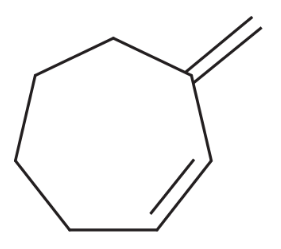
(a)
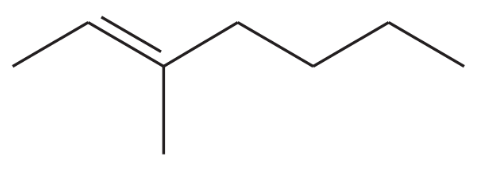
(b)

검증된 단계별 안내
1
Step 1: Understand the reaction mechanism. Ozonolysis involves the cleavage of double bonds in alkenes using ozone (O₃), followed by reduction. The reduction step can be performed using agents like zinc and water or dimethyl sulfide (DMS). This process results in the formation of carbonyl compounds (aldehydes or ketones).
Step 2: Analyze compound (a). The structure shows a cyclic compound with one double bond. During ozonolysis, the double bond will be cleaved, and the resulting fragments will form carbonyl groups. Identify the positions of the double bond and predict the cleavage products.
Step 3: Analyze compound (b). The structure shows a branched alkene with one double bond. Ozonolysis will cleave the double bond, and the resulting fragments will form carbonyl groups. Determine the cleavage points and predict the products based on the substituents attached to the double bond.
Step 4: Write the general reaction for ozonolysis. Represent the cleavage of the double bond in each compound using the chemical equation: R₁-CH=CH-R₂ + O₃ → R₁-CHO + R₂-CHO (for aldehydes) or R₁-CO-R₂ (for ketones).
Step 5: Predict the products for each compound. For compound (a), the cyclic structure will yield two carbonyl compounds upon cleavage. For compound (b), the branched structure will yield specific aldehydes or ketones based on the substituents. Ensure the products match the original structure and substituents.

비슷한 문제에 대한 검증된 영상 답변:

이 영상 해법은 위 문제에 도움이 된다고 튜터들이 추천한 것입니다.
영상 길이:
11m

주요 개념

질문에 올바르게 답하기 위해 반드시 이해해야 하는 핵심 개념들은 다음과 같습니다.

Ozonolysis

Ozonolysis is a reaction involving the cleavage of alkenes or alkynes using ozone (O3) to form carbonyl compounds. The process typically occurs in two steps: first, the formation of a molozonide intermediate, followed by rearrangement to yield ozonides, which can be further reduced to aldehydes or ketones. Understanding this reaction is crucial for predicting the products of ozonization.
추천 영상:
06:30
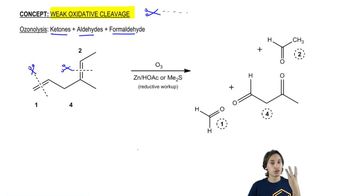
General properties of ozonolysis.

Reduction of Ozonides

After ozonolysis, the ozonides formed can be reduced using a reducing agent, commonly zinc (Zn) and acetic acid or dimethyl sulfide (DMS). This reduction step converts the ozonides into stable carbonyl compounds, such as aldehydes or ketones. Recognizing the reducing agents and their roles is essential for determining the final products of the reaction.
추천 영상:
07:12
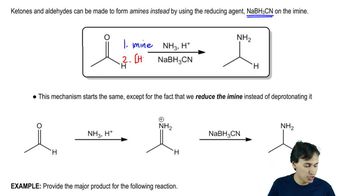
Reductive Amination

Functional Group Transformation

Functional group transformation refers to the conversion of one functional group into another during a chemical reaction. In ozonolysis, alkenes are transformed into carbonyl groups (aldehydes or ketones), which significantly alters the reactivity and properties of the original compound. Understanding these transformations is vital for predicting the outcomes of organic reactions.
추천 영상:
02:36
Identifying Functional Groups