Ch.6 - Alkyl Halides; Nucleophilic Substitution
Wade - Organic Chemistry 9th Edition
Wade9th EditionOrganic ChemistryISBN: 9780135213728당신이 사용하는 게 아니라요?교과서 변경
6장, 문제 16e,f

For each pair, predict the stronger nucleophile in the SN2 reaction (using an alcohol as the solvent). Explain your prediction.
e. (CH3)3N or (CH3)2O
f. CH3COO or CF3COO

검증된 단계별 안내
1
Step 1: Understand the concept of nucleophilicity in SN2 reactions. Nucleophilicity refers to the ability of a species to donate a pair of electrons to an electrophile. In SN2 reactions, nucleophilicity is influenced by factors such as charge, electronegativity, steric hindrance, and solvent effects.
Step 2: Analyze the pair (CH3)3N vs. (CH3)2O. (CH3)3N is a neutral amine, while (CH3)2O is a neutral ether. Amines are generally better nucleophiles than ethers because nitrogen is less electronegative than oxygen, making nitrogen more willing to donate its lone pair of electrons. Additionally, steric hindrance in (CH3)3N is moderate, but it is still less hindered compared to the oxygen in (CH3)2O.
Step 3: Consider the solvent effect. Alcohol solvents are protic, meaning they can form hydrogen bonds with nucleophiles. Protic solvents tend to stabilize nucleophiles through hydrogen bonding, which can reduce their nucleophilicity. However, the relative nucleophilicity of (CH3)3N vs. (CH3)2O remains consistent due to the inherent properties of nitrogen and oxygen.
Step 4: Analyze the pair CH3COO- vs. CF3COO-. Both are carboxylate anions, but their nucleophilicity is influenced by the electron-withdrawing effects of substituents. CF3COO- has three highly electronegative fluorine atoms attached to the carbon adjacent to the carboxylate group, which strongly withdraws electron density and stabilizes the negative charge on the oxygen. This stabilization reduces its nucleophilicity compared to CH3COO-, which has a less electron-withdrawing methyl group.
Step 5: Summarize the predictions. For pair (e), (CH3)3N is the stronger nucleophile due to nitrogen's lower electronegativity compared to oxygen. For pair (f), CH3COO- is the stronger nucleophile because it is less stabilized by electron-withdrawing groups compared to CF3COO-.

비슷한 문제에 대한 검증된 영상 답변:

이 영상 해법은 위 문제에 도움이 된다고 튜터들이 추천한 것입니다.
영상 길이:
7m

주요 개념

질문에 올바르게 답하기 위해 반드시 이해해야 하는 핵심 개념들은 다음과 같습니다.

Nucleophilicity

Nucleophilicity refers to the ability of a species to donate an electron pair to an electrophile during a chemical reaction. In SN2 reactions, stronger nucleophiles are typically negatively charged or have lone pairs that can readily participate in bond formation. Factors influencing nucleophilicity include charge, electronegativity, and steric hindrance.
추천 영상:
08:27
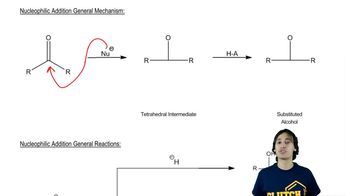
Nucleophilic Addition

Solvent Effects in SN2 Reactions

The choice of solvent can significantly impact the rate and outcome of SN2 reactions. Polar protic solvents, like alcohols, can stabilize nucleophiles through hydrogen bonding, which may reduce their reactivity. Conversely, polar aprotic solvents enhance nucleophilicity by solvation effects, allowing nucleophiles to remain more reactive.
추천 영상:
01:16
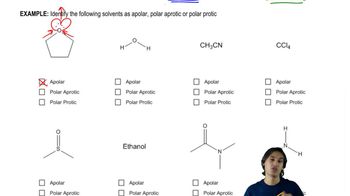
Identification of polarity in solvents

Steric Hindrance

Steric hindrance refers to the prevention of reactions due to the spatial arrangement of atoms within a molecule. In SN2 reactions, bulky groups around the nucleophile can hinder its approach to the electrophile, making it less effective. Therefore, less sterically hindered nucleophiles are generally stronger and more favorable in these reactions.
추천 영상:
02:53
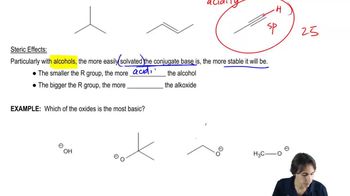
Understanding steric effects.