 뒤로
뒤로Forces and Newton’s Laws of Motion: Structured Study Notes
스터디 가이드 - 스마트 노트
 자료에 맞춘 맞춤형 노트, 핵심 정의, 예시, 맥락을 확장해 제공합니다.
Forces and Newton’s Laws of Motion
Newton’s First Law and the Nature of Forces
Newton’s First Law, also known as the law of inertia, states that an object will remain at rest or move in a straight line at constant speed unless acted upon by a net external force. This principle explains why motion changes only when a force is applied.
Inertia: The tendency of an object to resist changes in its state of motion.
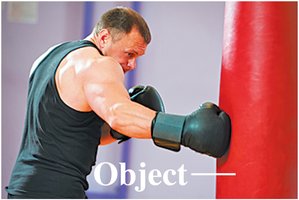
Force: A push or pull exerted on an object, capable of changing its velocity.
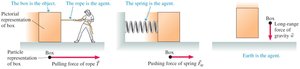
Agent: The source that exerts the force (e.g., a person, gravity, a rope).
Object: The entity on which the force acts.
Example: In a car crash, the car stops due to an external force, but a crash dummy continues moving until acted upon by another force (the dashboard).

What Is a Force?
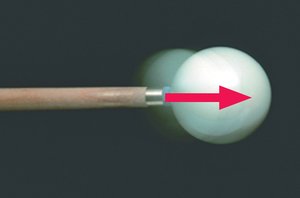
A force is defined as a push or pull acting upon an object as a result of its interaction with another object. Forces are vector quantities, meaning they have both magnitude and direction.
Contact Forces: Forces that act on an object by direct physical contact (e.g., friction, tension, normal force).
Long-Range Forces: Forces that act over a distance without physical contact (e.g., gravity, electric, and magnetic forces).
Notation: The general symbol for force is \( \vec{F} \), and its magnitude is denoted as F.


Force Vectors and Combining Forces
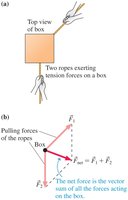
Forces are represented as vectors, and multiple forces acting on an object combine to form a net force, which is the vector sum of all individual forces.
Net Force (Resultant Force): The single vector that has the same effect as all the individual forces combined.
Vector Addition: Forces are added using vector addition rules.


Catalog of Common Forces
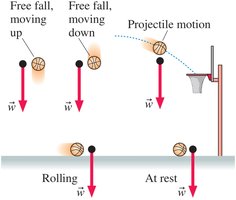
Weight (Gravitational Force)
The weight of an object is the gravitational pull exerted by the Earth. It always points vertically downward.
Formula:
Direction: Always toward the center of the Earth.
Spring Force
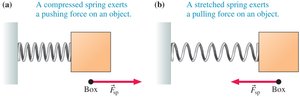
Springs exert a force when compressed or stretched, described by Hooke’s Law.
Formula: (where k is the spring constant and x is the displacement from equilibrium)
Tension Force
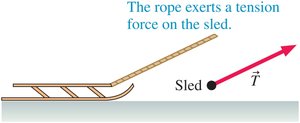
Tension is the pulling force transmitted by a string, rope, or cable when it is attached to an object and pulled taut.
Direction: Along the string, away from the object.
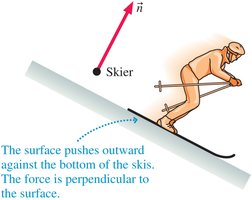
Normal Force
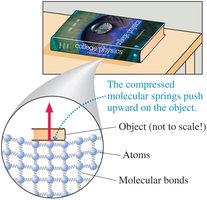
The normal force is the perpendicular contact force exerted by a surface on an object resting on it. It is responsible for the sensation of 'solidness' in solids.
Direction: Perpendicular to the surface.
Friction
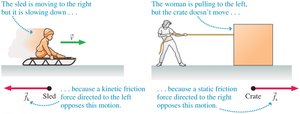
Friction is a force exerted by a surface that opposes the relative motion or attempted motion of an object across it.
Kinetic Friction (\( f_k \)): Acts when an object slides across a surface; always opposes motion.
Static Friction (\( f_s \)): Prevents an object from starting to move; points in the direction necessary to prevent motion.
Drag
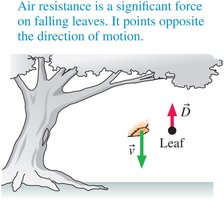
Drag is the resistive force of a fluid (such as air or water) on a moving object, always pointing opposite to the direction of motion.
Thrust
Thrust is a force produced by expelling mass (such as exhaust gases) in the opposite direction, commonly seen in rockets and jet engines.
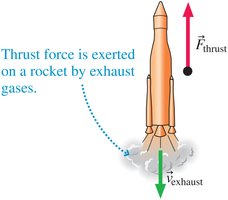
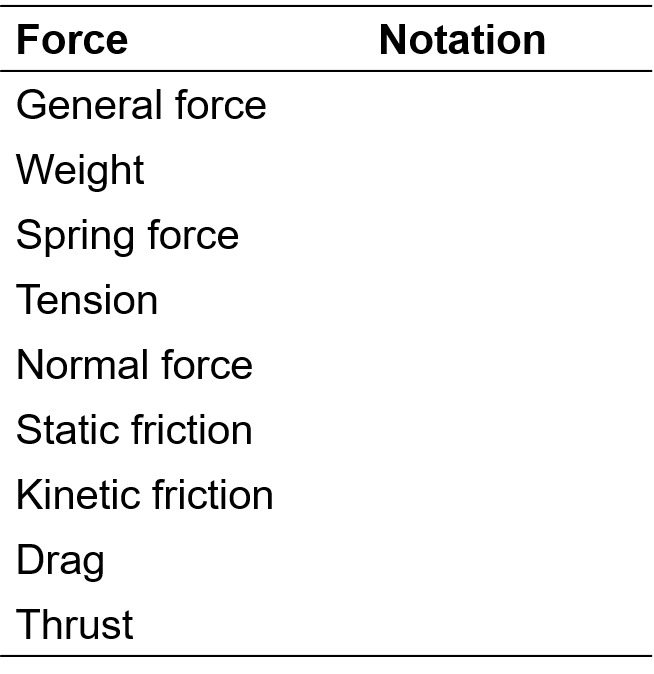
Table: Common Forces and Their Notation
Force | Notation |
|---|---|
General force | \( \vec{F} \) |
Weight | \( \vec{w} \) |
Spring force | \( \vec{F}_{\text{spring}} \) |
Tension | \( \vec{T} \) |
Normal force | \( \vec{n} \) |
Static friction | \( \vec{f}_s \) |
Kinetic friction | \( \vec{f}_k \) |
Drag | \( \vec{D} \) |
Thrust | \( \vec{F}_{\text{thrust}} \) |
Newton’s Second Law of Motion
Statement and Mathematical Formulation
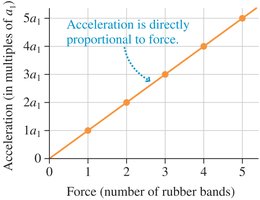
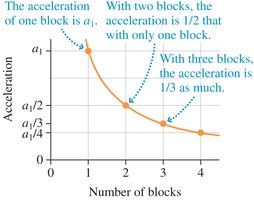
Newton’s Second Law states that the acceleration of an object is directly proportional to the net force acting on it and inversely proportional to its mass. The direction of the acceleration is the same as the direction of the net force.
Formula:
Alternate Form:
Units of Force
Newton (N): The SI unit of force. One newton is the force required to accelerate a 1 kg mass by 1 m/s².
Conversion: 1 pound (lb) = 4.45 N
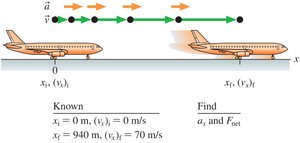
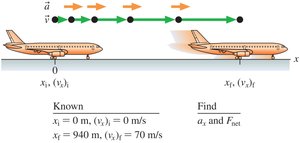
Example: Racing Down the Runway
A Boeing 737 (mass = 51,000 kg) accelerates down a runway. The thrust needed for takeoff can be found using kinematics and Newton’s second law.
Step 1: Use kinematics to find acceleration.
Step 2: Apply Newton’s second law to find the net force (thrust).
Free-Body Diagrams
Purpose and Construction
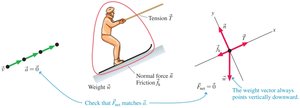
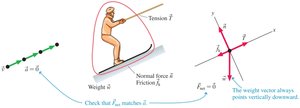
A free-body diagram is a visual tool used to show all the forces acting on a single object. It helps in analyzing the forces and solving dynamics problems.
Steps:
Identify the object of interest.
Draw the object as a dot (particle model).
Draw and label all forces acting on the object as vectors.
Choose a coordinate system aligned with the motion or surface.
Newton’s Third Law of Motion
Action-Reaction Pairs
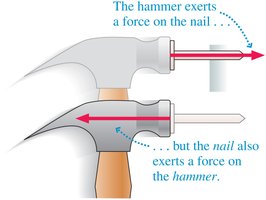
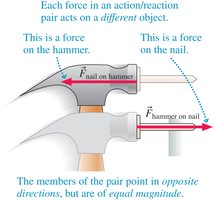
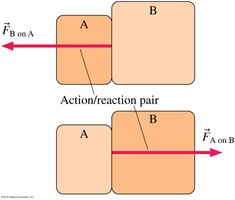
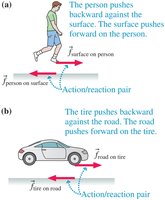
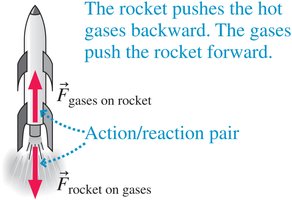
Newton’s Third Law states that for every action, there is an equal and opposite reaction. Forces always occur in pairs, acting on two different objects.
Action/Reaction Pair: If object A exerts a force on object B, then object B exerts an equal and opposite force on object A.
Examples: Hammer and nail, rocket and exhaust gases, foot and ground while running.
Equilibrium and Applying Newton’s Laws
Equilibrium Conditions
An object is in equilibrium if the net force acting on it is zero. This can be static equilibrium (at rest) or dynamic equilibrium (moving at constant velocity).
Mathematical Condition: and
Example: Finding the Forces on an Orangutan
An orangutan weighing 500 N hangs from a rope. The tension in the rope equals the weight of the orangutan if it is at rest (static equilibrium).
Solution:
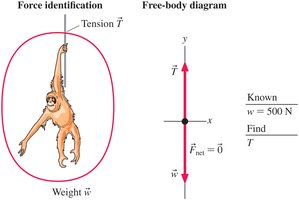
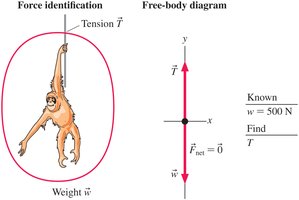
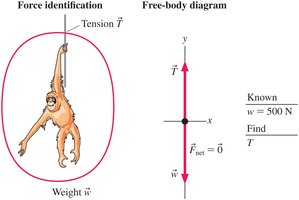
Conceptual Example: Forces in Static Equilibrium
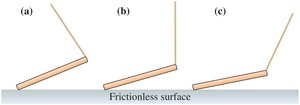
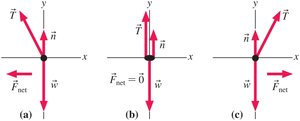
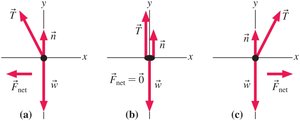
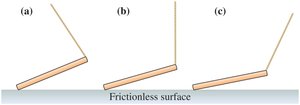
A rod on frictionless ice is held by a string. Only when the string is vertical can the net force be zero, as frictionless ice cannot exert a horizontal force.
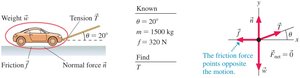
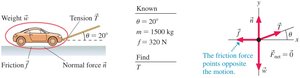
Example: Finding the Tension in a Rope While Towing a Car
A car is towed at a steady speed by a rope at an angle. The tension in the rope must balance both the friction force and the vertical component of the car’s weight.
Dynamics and Problem-Solving Strategies
General Approach to Dynamics Problems
Sketch a visual overview, including knowns and unknowns.
Draw a force identification diagram and a free-body diagram.
Write Newton’s second law in component form and solve for the unknowns.
Use kinematics as needed to relate acceleration, velocity, and position.
Example: Putting a Golf Ball
A golf ball is putted with an initial speed and slowed by friction. Newton’s second law is used to find the acceleration, and kinematics determines if the ball reaches the hole.
Example: Towing a Car with Acceleration
When a car is towed and accelerates, the tension in the rope must overcome both friction and provide the necessary net force for acceleration.
Summary Table: Common Forces and Notation
Force | Notation |
|---|---|
General force | \( \vec{F} \) |
Weight | \( \vec{w} \) |
Spring force | \( \vec{F}_{\text{spring}} \) |
Tension | \( \vec{T} \) |
Normal force | \( \vec{n} \) |
Static friction | \( \vec{f}_s \) |
Kinetic friction | \( \vec{f}_k \) |
Drag | \( \vec{D} \) |
Thrust | \( \vec{F}_{\text{thrust}} \) |
Additional info: These notes cover the core concepts of Newton’s Laws, types of forces, equilibrium, and problem-solving strategies in algebra-based physics. All images included are directly relevant to the explanations provided and reinforce the associated concepts.
