 뒤로
뒤로Applying Newton’s Laws: Statics, Dynamics, Friction, and Circular Motion
스터디 가이드 - 스마트 노트
 자료에 맞춘 맞춤형 노트, 핵심 정의, 예시, 맥락을 확장해 제공합니다.
Applying Newton’s Laws
Overview
This chapter focuses on the application of Newton’s laws of motion to a variety of physical situations, including equilibrium (statics), accelerating bodies (dynamics), frictional forces, fluid resistance, and circular motion. Mastery of these concepts is essential for solving real-world physics problems involving forces and motion.
Statics: Newton’s First Law and Equilibrium
Conditions for Equilibrium
Equilibrium occurs when a body is at rest or moves with constant velocity in an inertial frame of reference.
All forces acting on the body must sum to zero: .
Common forces include: normal force, friction, tension, contact forces, and weight (gravity).
Steps for Solving Equilibrium Problems
Visualize the situation and choose a coordinate system.
Draw a free-body diagram (FBD) showing all forces acting on the object.
Break forces into components along the chosen axes.
Apply Newton’s laws to each component: , .
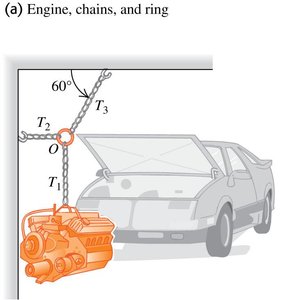
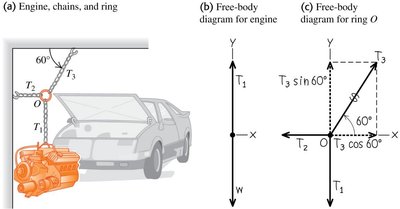
Worked Example: Engine Suspended by Chains
Given: Engine weight suspended by three chains at angles.
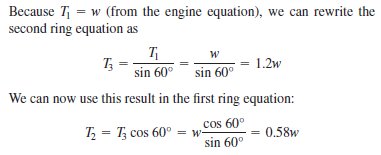
Solution involves resolving tensions and applying equilibrium conditions.
Worked Example: Car on a Ramp
Forces: weight , normal force , tension .
Weight is resolved into components parallel and perpendicular to the ramp.
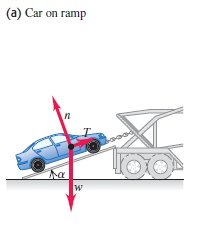
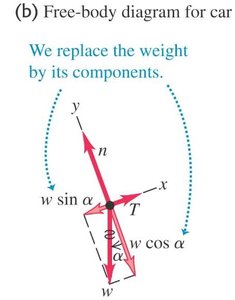
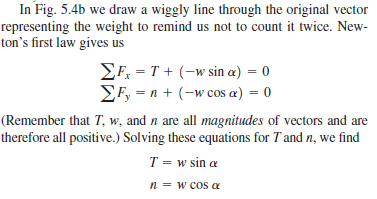
Equilibrium equations:
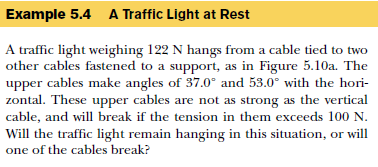
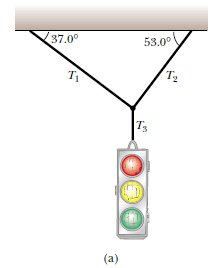
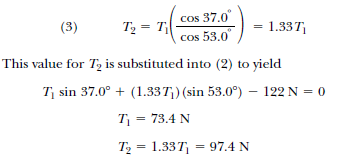
Worked Example: Traffic Light at Rest
Traffic light suspended by cables at angles; find tensions and check if cables will break.
Dynamics: Newton’s Second Law
Newton’s Second Law for Accelerating Bodies
When the net force on a body is not zero, it accelerates: .
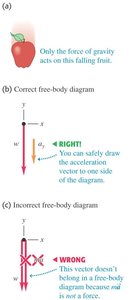
Free-body diagrams should include only real forces, not (which is the result of the net force).
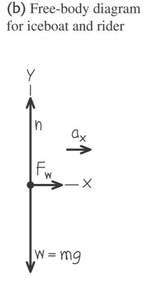
Worked Example: Iceboat on Frictionless Surface
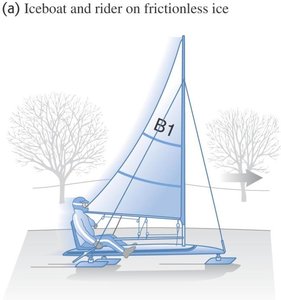
Given: Iceboat of mass 200 kg, wind force, and acceleration over time.
Find the force exerted by the wind.
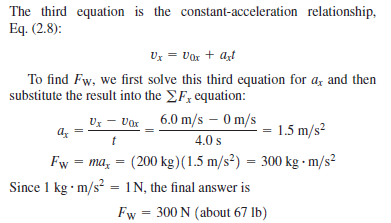
Use to find acceleration, then .
Result:
Worked Example: Iceboat with Friction
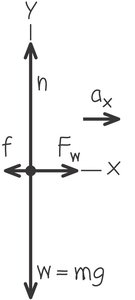
Now include a friction force opposing motion.
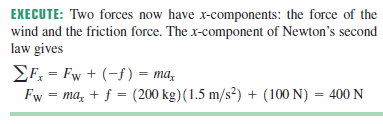
Apply Newton’s second law:
Result:
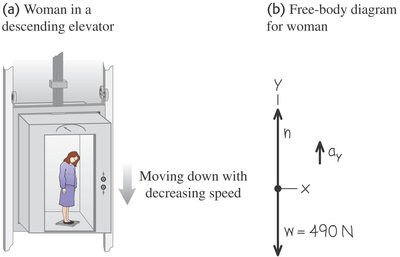
Worked Example: Apparent Weight in an Elevator
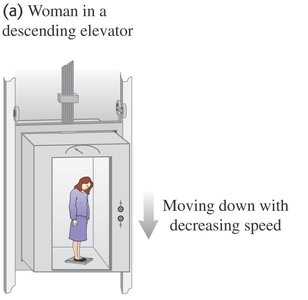
When an elevator accelerates, the normal force (apparent weight) changes.
Apply
For upward acceleration:
For downward acceleration:
Frictional Forces
Types of Friction
Static friction (): Acts when there is no relative motion; .
Kinetic friction (): Acts when a body slides; .
Friction always acts parallel to the surface and opposes relative motion.
Fluid Resistance and Terminal Speed
Fluid Resistance
A fluid is a gas or liquid that can flow.
Fluid resistance (drag) acts opposite to the velocity of a body moving through a fluid.
Drag force can depend on speed () or speed squared ():
(linear drag)
(quadratic drag)
Terminal speed is reached when drag force equals weight:
For :
For :
Circular Motion
Dynamics of Circular Motion
For uniform circular motion, the net force and acceleration are directed toward the center of the circle (centripetal).
Magnitude of net force:
If the inward force ceases (e.g., string breaks), the object moves tangentially to the circle.
There is no real “centrifugal force” in an inertial frame; it is a fictitious force.
Summary Table: Types of Forces in Newtonian Mechanics
Force Type | Symbol | Direction | Formula |
|---|---|---|---|
Weight | Downward (toward Earth) | ||
Normal Force | Perpendicular to surface | Varies | |
Tension | Along string/rope | Varies | |
Friction (kinetic) | Parallel to surface, opposes motion | ||
Friction (static) | Parallel to surface, opposes motion | ||
Drag (fluid resistance) | Opposite to velocity | or | |
Centripetal Force | Toward center of circle |
Key Equations
Newton’s First Law (Equilibrium):
Newton’s Second Law:
Kinetic Friction:
Static Friction:
Drag Force (linear):
Drag Force (quadratic):
Centripetal Force:
Applications and Examples
Free-body diagrams are essential for analyzing forces in all problems.
Friction and drag must be considered in real-world applications such as vehicles, sports, and engineering.
Apparent weight changes in accelerating systems (e.g., elevators).
Circular motion analysis is crucial for understanding orbits, amusement park rides, and rotating machinery.
