 뒤로
뒤로Capacitors and Dielectrics: Principles, Calculations, and Applications
스터디 가이드 - 스마트 노트
 자료에 맞춘 맞춤형 노트, 핵심 정의, 예시, 맥락을 확장해 제공합니다.
Capacitors and Dielectrics
Introduction to Capacitors
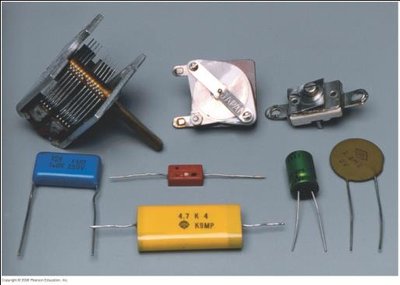
Capacitors are fundamental electrical components that store electric charge and energy. They consist of two conductive plates separated by an insulating material. Capacitors are widely used in electronic circuits for energy storage, filtering, and timing applications.
Definition: A capacitor is a device that stores electrical energy in an electric field, created by a separation of charges on two conductive plates.
Unit of Capacitance: The capacitance (C) is measured in farads (F), where 1 F = 1 coulomb/volt.
Basic Formula: The charge (Q) stored is proportional to the potential difference (V) across the plates:
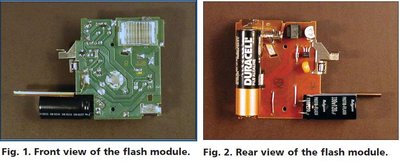
Applications: Capacitors are used in devices such as DRAM memory, camera flashes, and touchpads.
Capacitance and Its Calculation
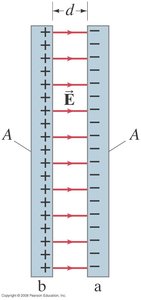
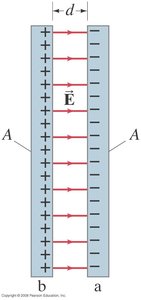
The capacitance of a capacitor depends on its geometry and the material between its plates. For a parallel-plate capacitor, the capacitance is given by:
Parallel-Plate Capacitor: , where A is the plate area, d is the separation, and is the vacuum permittivity.
Electric Field: The electric field between the plates is .
Potential Difference: for a uniform field.
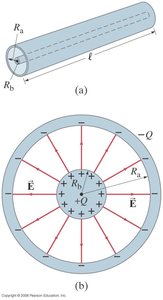
Cylindrical Capacitor: For coaxial cylinders, where and are the radii and is the length.
Capacitors in Circuits: Series and Parallel
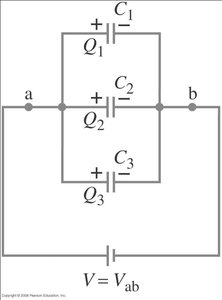
Capacitors can be combined in series or parallel to achieve desired capacitance values in circuits.
Parallel Connection: The total capacitance is the sum of individual capacitances:
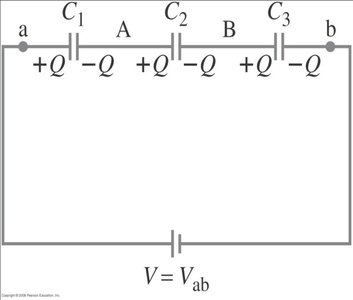
Series Connection: The reciprocal of the total capacitance is the sum of reciprocals:
Key Point: In parallel, voltage is the same across all capacitors; in series, charge is the same on all capacitors.
Energy Stored in a Capacitor
Capacitors store energy in the electric field between their plates. The energy stored is given by:
Energy Formula:
Energy Density: For a parallel-plate capacitor, the energy per unit volume (energy density) is
Dielectrics and Their Effect on Capacitance
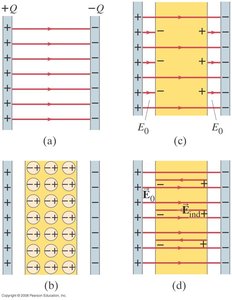
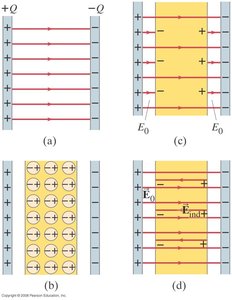
A dielectric is an insulating material placed between the plates of a capacitor. It increases the capacitance by reducing the effective electric field and allowing more charge to be stored for the same voltage.
Dielectric Constant: The factor by which the capacitance increases is called the dielectric constant ():
Permittivity:
Effect on Electric Field: The electric field inside a dielectric is
Physical Explanation: Dielectrics are made of polar molecules that align in the field, reducing the net field inside the capacitor.
Applications of Capacitors and Dielectrics
Capacitors and dielectrics are essential in modern electronics, including memory devices, camera flashes, and advanced transistors.
Camera Flash: Capacitors store energy and release it rapidly to power a camera's flash.
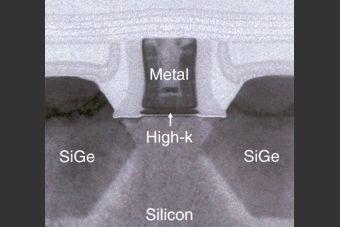
MOS Transistors: The gate dielectric in MOSFETs is crucial for device performance. High- dielectrics (e.g., HfO2) are used to increase capacitance without reducing thickness.
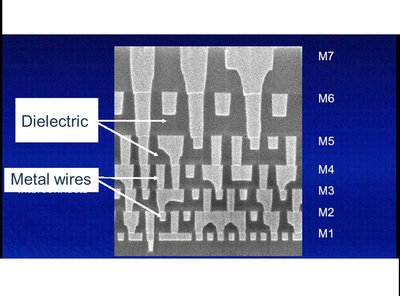
Interconnects: Low- dielectrics reduce capacitance between metal wires, minimizing signal delay in integrated circuits.
Summary Table: Dielectric Constants and Strengths
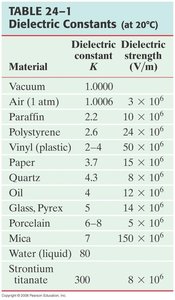
The following table summarizes the dielectric constants and strengths of common materials used in capacitors:
Material | Dielectric Constant (K) | Dielectric Strength (V/m) |
|---|---|---|
Vacuum | 1.0000 | 3 × 10⁶ |
Air (1 atm) | 1.0006 | 3 × 10⁶ |
Paraffin | 2.2 | 10 × 106 |
Polystyrene | 2.6 | 24 × 106 |
Vinyl (plastic) | 2.6 | 40 × 106 |
Paper | 3.7 | 15 × 106 |
Quartz | 4.3 | 8 × 10⁶ |
Oil | 4.5 | 12 × 106 |
Glass, Pyrex | 5 | 14 × 106 |
Porcelain | 6–8 | 10 × 106 |
Mica | 7 | 150 × 106 |
Water (liquid) | 80 | 8 × 10⁶ |
Strontium titanate | 300 | 8 × 10⁶ |
Key Equations
(parallel plates)
(with dielectric)
(energy density)
Series:
Parallel:
Additional info: The notes include advanced applications such as MOS transistors and interconnects, which are relevant for understanding the role of dielectrics in modern electronics. The molecular description of dielectrics and their effect on the electric field is also provided for deeper conceptual understanding.
