 뒤로
뒤로Chapter 17: Superposition and Interference of Waves
스터디 가이드 - 스마트 노트
 자료에 맞춘 맞춤형 노트, 핵심 정의, 예시, 맥락을 확장해 제공합니다.
Superposition of Waves
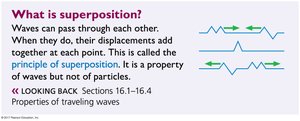
Principle of Superposition
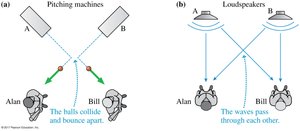
The principle of superposition states that when two or more waves are simultaneously present at a single point in space, the displacement of the medium at that point is the sum of the displacements due to each individual wave. This property is unique to waves and does not apply to particles, which interact differently.
Definition: The net displacement is the algebraic sum of individual displacements.
Example: If wave 1 displaces a particle by D1 and wave 2 by D2, the total displacement is D1 + D2.

Superposition in Action
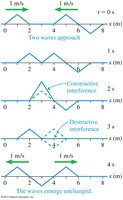
When two wave pulses approach each other, they can interfere constructively or destructively, but after passing through each other, they emerge unchanged. This is illustrated in the time sequence of two pulses on a string.
Constructive Interference: When the pulses overlap and their displacements add.
Destructive Interference: When the pulses overlap and their displacements subtract.
Standing Waves
Formation and Properties
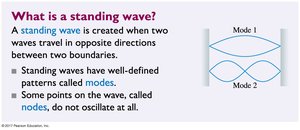
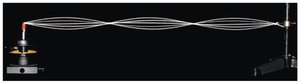
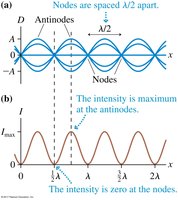
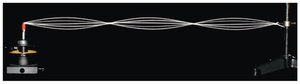
A standing wave is created when two waves of equal frequency and amplitude travel in opposite directions between two boundaries. Standing waves have well-defined patterns called modes, and some points, called nodes, do not oscillate at all.
Nodes: Points of zero displacement, spaced λ/2 apart.
Antinodes: Points of maximum displacement, located halfway between nodes.
Mathematical Description
The displacement of a standing wave can be written as:
where is the amplitude function, and is the angular frequency. The amplitude varies with position, reaching a maximum at antinodes and zero at nodes.

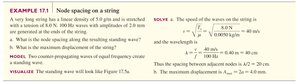
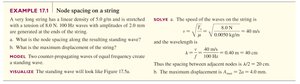
Node Spacing Example
For a string with given linear density and tension, the speed of the wave and the spacing between nodes can be calculated:
Standing Waves in Physical Systems
Standing waves are important in musical instruments, bridges, and lasers. The frequency and wavelength of standing waves depend on the boundary conditions and the length of the medium.
Fundamental frequency: The lowest allowed frequency, for a string of length L.
Normal modes: Higher harmonics with frequencies ,

Standing Electromagnetic Waves
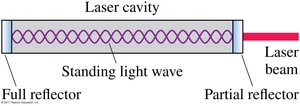
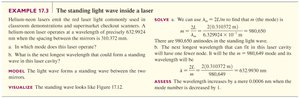
Standing electromagnetic waves can be established in laser cavities, where the mode number is extremely high due to the small wavelength of light.
Standing Sound Waves
Sound Waves in Tubes
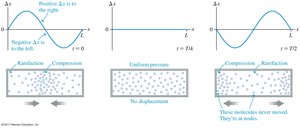
Longitudinal standing sound waves can be supported in tubes. The boundary conditions determine the node and antinode locations for both displacement and pressure.
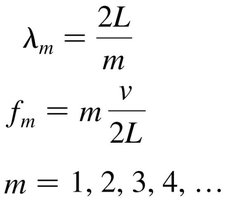
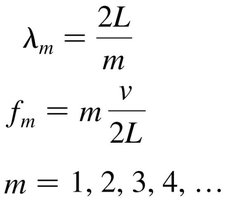
Closed-closed tube: Nodes at both ends.
Open-open tube: Antinodes at both ends.
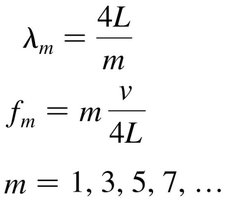
Open-closed tube: Node at closed end, antinode at open end.
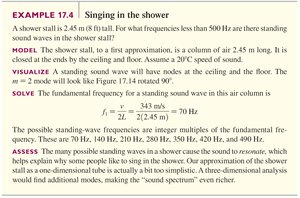
Example: Singing in the Shower
Standing waves in a shower stall can be analyzed to find the possible frequencies below 500 Hz:
Interference of Waves
Interference Patterns
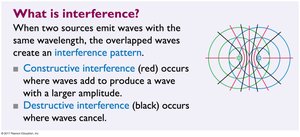
When two sources emit waves with the same wavelength, the overlapped waves create an interference pattern. Constructive interference occurs where waves add to produce a larger amplitude, while destructive interference occurs where waves cancel.
Mathematics of Interference
The net displacement of two waves traveling together can be written as:
For maximum constructive interference:
For perfect destructive interference:
Interference in Two and Three Dimensions
Interference patterns can also occur in two or three dimensions, such as overlapping water waves or sound waves from two loudspeakers. The path-length difference determines the type of interference at a given point.
Beats
Beat Frequency
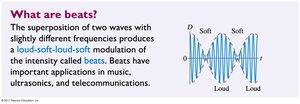
The superposition of two waves with slightly different frequencies produces a modulation of intensity called beats. The beat frequency is the difference between the two individual frequencies:
Applications: Beats are important in music, ultrasonics, and telecommunications.
Importance and Applications of Superposition
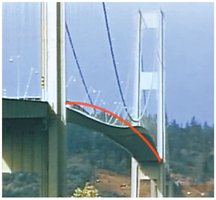
Superposition and standing waves are fundamental in many physical systems, including musical instruments, microwave systems, lasers, and large structures like bridges. Interference of light waves is used in precision measuring techniques and electro-optic devices.
Summary Table: Standing Wave Boundary Conditions
Tube Type | Node/Antinode Locations | Allowed Modes | Wavelength Formula | Frequency Formula |
|---|---|---|---|---|
Closed-closed | Nodes at both ends | m = 1, 2, 3, ... | ||
Open-open | Antinodes at both ends | m = 1, 2, 3, ... | ||
Open-closed | Node at closed end, antinode at open end | m = 1, 3, 5, ... |
Additional info: Mathematical derivations, boundary conditions, and physical examples have been expanded for clarity and completeness.
