 뒤로
뒤로Chapter 19: Electric Charges, Forces, and Fields – Study Notes
스터디 가이드 - 스마트 노트
 자료에 맞춘 맞춤형 노트, 핵심 정의, 예시, 맥락을 확장해 제공합니다.
Electric Charge
Nature and Properties of Electric Charge
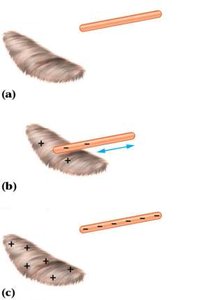
Electric charge is a fundamental property of matter responsible for electric phenomena. The effects of electric charge were first observed as static electricity, such as when an amber rod rubbed with fur acquires a charge and attracts small objects.
Two Types of Charge: There are two types of electric charge: positive and negative. Like charges repel, and opposite charges attract.
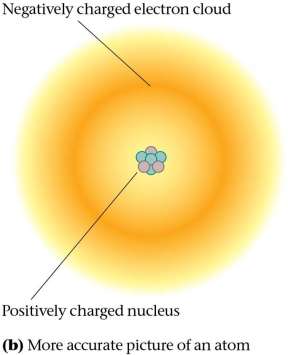
Elementary Charge: All electrons have the same charge, and protons have the same magnitude but opposite sign. The magnitude of the elementary charge is $e = 1.60 \times 10^{-19}\ \text{C}$.
SI Unit: The SI unit of charge is the coulomb (C).
Charge Conservation: The total electric charge of the universe is constant; charge is conserved.
Charge Quantization: Electric charge is quantized in units of $e$.
Ions: Atoms that lose electrons become positive ions; those that gain electrons become negative ions.
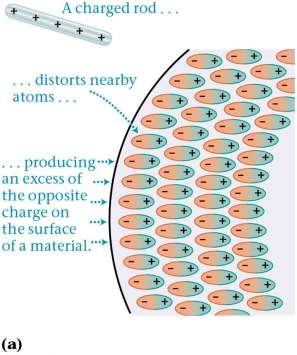
Polarization: Some materials can become polarized, meaning their atoms rotate in response to an external charge, allowing a charged object to attract a neutral one.
Insulators and Conductors
Classification of Materials
Materials are classified based on their ability to allow electrons to move:
Conductors: Materials whose conduction electrons are free to move throughout. Most metals are conductors.
Insulators: Materials whose electrons seldom move from atom to atom. Most insulators are nonmetals.
Semiconductors: Materials with properties intermediate between conductors and insulators; their properties change with chemical composition.
Photoconductors: Materials that become conductive when exposed to light.
Charge Distribution: Excess charge on a conductor is distributed over its surface.
Coulomb’s Law
Force Between Point Charges
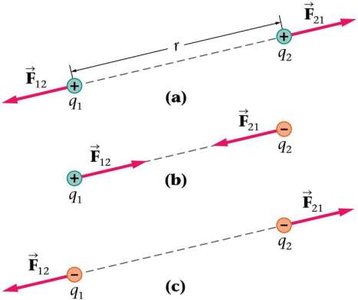
Coulomb’s law describes the force between two point charges:
Formula: $F = k \frac{q_1 q_2}{r^2}$
Constant: $k = 8.99 \times 10^9\ \text{N}\cdot\text{m}^2/\text{C}^2$
Direction: The force acts along the line connecting the charges. It is attractive if the charges are opposite, repulsive if they are alike.
Action-Reaction: The forces on the two charges are equal and opposite (Newton’s third law).
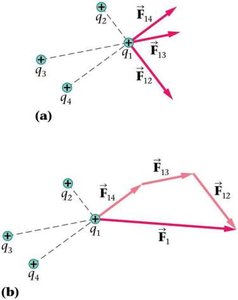
Superposition Principle: For multiple point charges, the forces add vectorially.
Spherical Distributions: Coulomb’s law applies to spherically symmetric charge distributions, analogous to gravitational forces.
The Electric Field
Definition and Properties
The electric field is a region around a charged object where electric forces are exerted on other charges.
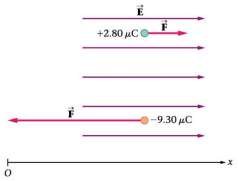
Definition: $E = \frac{F}{q_0}$, where $q_0$ is a test charge.
SI Unit: Newton per coulomb (N/C).
Force Calculation: $F = qE$
Direction: The force is in the direction of the field for positive charges, opposite for negative charges.
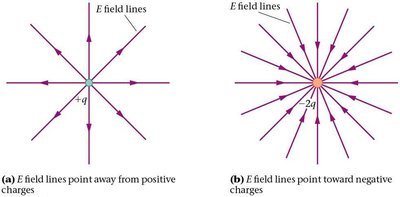
Field of Point Charge: Points radially away from positive, toward negative charges.
Superposition: Electric fields from multiple charges add vectorially.
Electric Field Lines
Visualization of Electric Fields
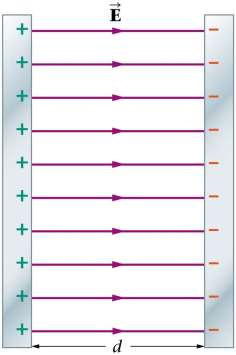
Electric field lines are a graphical tool to visualize the direction and strength of electric fields.
Field lines point in the direction of the field vector at every point.
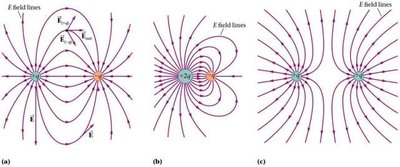
Start at positive charges or infinity; end at negative charges or infinity.
Are denser where the field is stronger.
Combinations of charges produce complex field line patterns; the field is not necessarily zero where there are no lines.
Shielding and Charging by Induction
Behavior of Conductors
Conductors exhibit unique behaviors in electric fields due to the mobility of their charges.
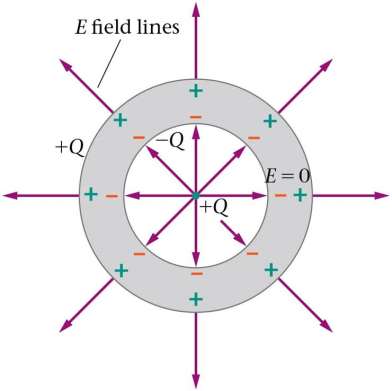
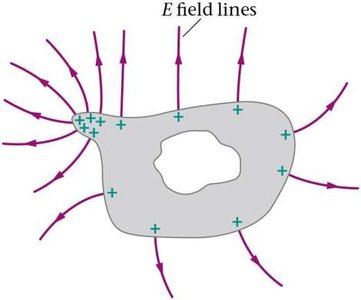
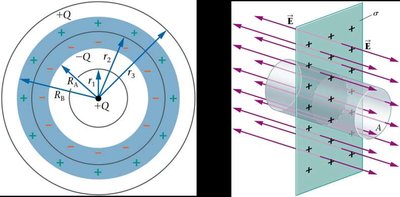
Excess charge on a conductor resides on its surface.
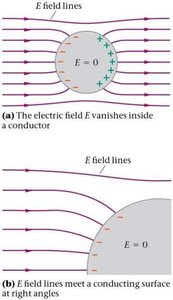
When charges are at rest, the electric field inside a conductor is zero.
The electric field is always perpendicular to the surface of a conductor.
The field is stronger where the surface is more sharply curved.
Conductors can be charged by induction if grounded, allowing like charges to leave the conductor.
Electric Flux and Gauss’s Law
Quantifying Electric Fields
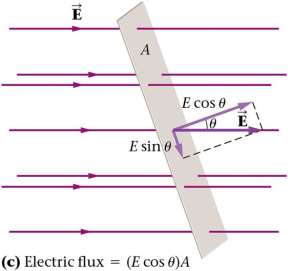
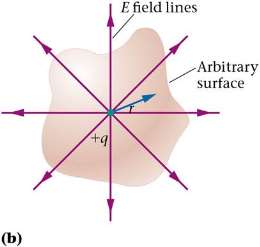
Electric flux measures the amount of electric field passing through a surface, and Gauss’s law relates flux to enclosed charge.
Electric Flux: $\Phi = EA \cos \theta$
SI Unit: $\text{N}\cdot\text{m}^2/\text{C}$
Gauss’s Law: $\Phi = \frac{q}{\varepsilon_0}$, where $\varepsilon_0 = 8.85 \times 10^{-12}\ \text{C}^2/\text{N}\cdot\text{m}^2$
Gauss’s law is useful for finding electric fields in systems with simple symmetry.
Summary Table: Key Concepts in Chapter 19
Concept | Definition/Formula | SI Unit |
|---|---|---|
Elementary Charge | $e = 1.60 \times 10^{-19}$ | Coulomb (C) |
Coulomb's Law | $F = k \frac{q_1 q_2}{r^2}$ | Newton (N) |
Electric Field | $E = \frac{F}{q}$ | N/C |
Electric Flux | $\Phi = EA \cos \theta$ | $\text{N}\cdot\text{m}^2/\text{C}$ |
Gauss's Law | $\Phi = \frac{q}{\varepsilon_0}$ | $\text{N}\cdot\text{m}^2/\text{C}$ |
