 뒤로
뒤로Chapter 25: The Electric Potential – Structured Study Notes
스터디 가이드 - 스마트 노트
 자료에 맞춘 맞춤형 노트, 핵심 정의, 예시, 맥락을 확장해 제공합니다.
Energy and Potential in Physics
Kinetic and Potential Energy
The concepts of kinetic and potential energy are fundamental to understanding energy conservation in physical systems.
Kinetic Energy (K): The energy of motion, given by for each particle in a system.
Potential Energy (U): The energy stored due to interactions between particles.
Change in Potential Energy: ; the change is minus the work done by interaction forces.
Conservative Forces: If all forces are conservative (e.g., gravity, electric force), total energy is conserved.
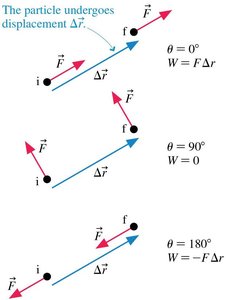
Work Done by a Constant Force
Work is a measure of energy transfer when a force acts over a displacement.
Formula:
The angle between force and displacement determines the amount of work done.
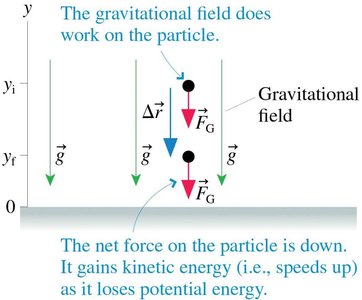
Gravitational Analogy
Gravitational Potential Energy
Gravity is a classic example of a conservative force, associated with potential energy.
Work Done by Gravity:
Change in Gravitational Potential Energy:
Gravitational Potential Energy:
Electric Potential Energy in a Uniform Field
Work and Potential Energy in an Electric Field
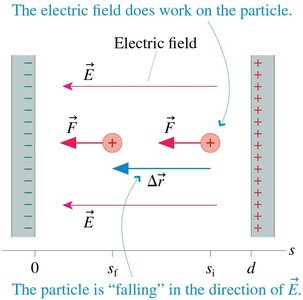
Charged particles in a uniform electric field experience forces analogous to gravity.
Force on Charge:
Work Done:
Change in Electric Potential Energy:
Electric Potential Energy:
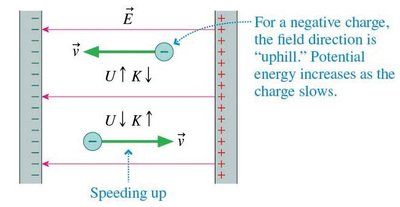
Behavior of Positive and Negative Charges
The change in potential and kinetic energy depends on the sign of the charge and its direction of motion relative to the field.
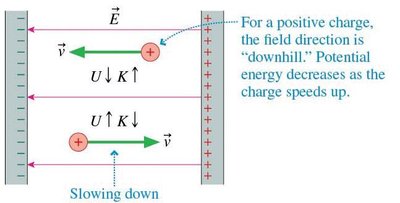
Positive charges lose potential energy and gain kinetic energy as they move toward the negative plate.
Negative charges gain potential energy (become less negative) as they move toward the negative plate.
Energy Diagrams in Uniform Fields
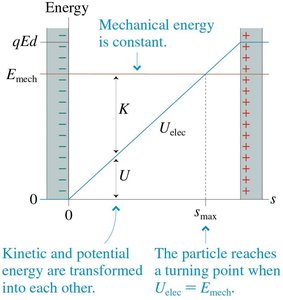
Energy diagrams illustrate the linear relationship between potential energy and distance in a uniform field, with total mechanical energy conserved.
Kinetic and potential energy transform into each other.
The turning point occurs when .
Potential Energy of Point Charges
Two Point Charges
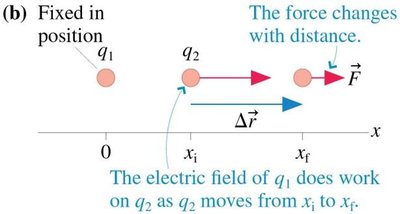
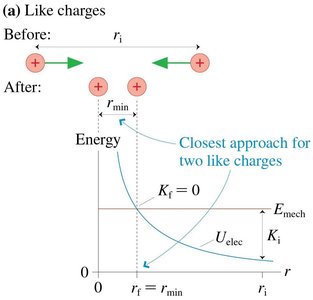
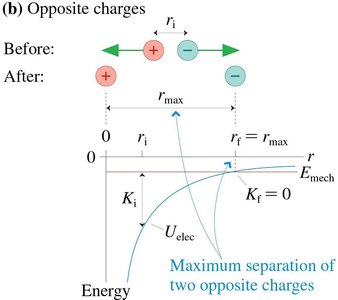
The potential energy of a system of two point charges depends on their separation and the nature of their charges.
Formula: , where
Potential energy approaches zero as .
For like charges, is positive; for opposite charges, it is negative.
Multiple Point Charges
The potential energy of a system with more than two charges is the sum of the potential energies for all pairs.
Formula: $U_{\text{elec}} = \sum_{i
Each pair is counted only once.
The Electric Potential
Definition and Units
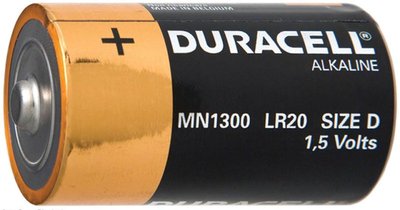
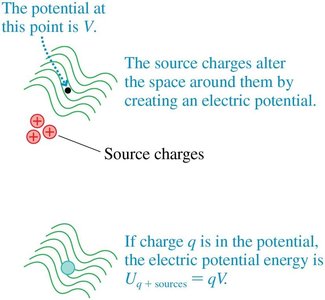
Electric potential is a scalar quantity representing the potential energy per unit charge at a point in space.
Formula:
Unit: 1 volt (V) = 1 joule/coulomb (J/C)
Electric potential is a property of the source charges, independent of the test charge.
Energy Conservation in Electric Potential
As a charged particle moves through a changing electric potential, energy is conserved.
Conservation Equation:
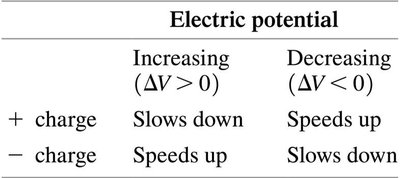
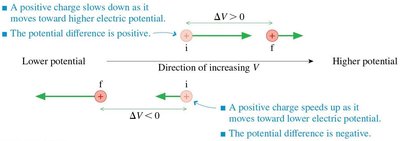
Changes in electric potential correspond to changes in kinetic energy.
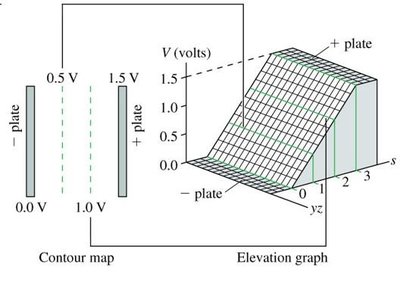
Electric Potential in a Parallel-Plate Capacitor
Electric Field and Potential
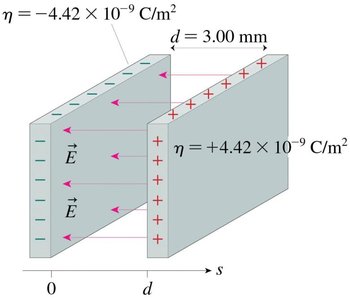
The electric field inside a parallel-plate capacitor is uniform and directed from the positive to the negative plate.
Electric Field:
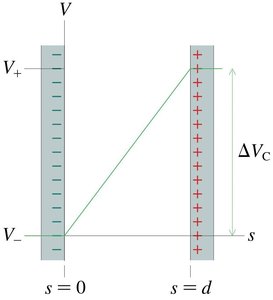
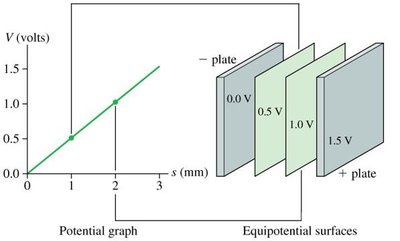
Electric Potential: (where is the distance from the negative electrode)
Potential Difference (Voltage):
Units: ; 1 N/C = 1 V/m
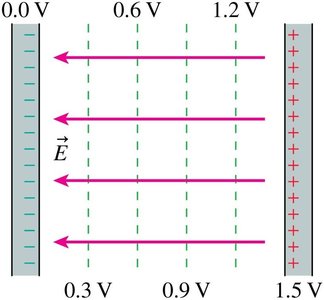
Equipotential Surfaces and Field Lines
Equipotential surfaces are perpendicular to electric field lines, and the field points in the direction of decreasing potential.
Electric Potential of Point Charges and Spheres
Point Charge
The electric potential due to a point charge decreases with distance.
Formula:
Potential is defined as zero at .
Charged Sphere
Outside a uniformly charged sphere, the electric potential is identical to that of a point charge at the center.
Formula: for
If is the potential at the surface, then for
Superposition Principle for Electric Potential
Many Charges
The electric potential at a point is the sum of the potentials due to each charge.
Formula:
Superposition applies to electric potential as it does to electric field.
Electric Potential of a Dipole and Applications
Electric Dipole
An electric dipole consists of two equal and opposite charges separated by a distance. The potential at a point depends on the positions relative to both charges.
Human Heart as an Electric Dipole
Electrical activity in the body, such as the heart, can be monitored by measuring equipotential lines, which resemble an electric dipole.
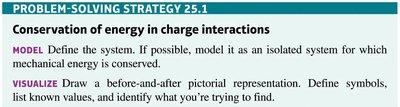
Problem-Solving Strategies
Conservation of Energy in Charge Interactions
To solve problems involving electric potential and energy:
Define the system and model it as isolated if possible.
Draw before-and-after diagrams, define symbols, and list known values.
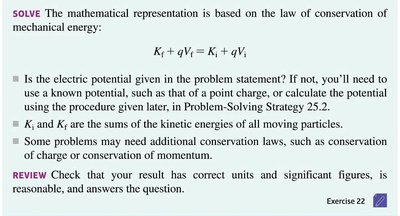
Use the conservation equation:
Check units, significant figures, and reasonableness of the result.
Summary Table: Electric Potential and Charge Motion
Electric potential | Increasing () | Decreasing () |
|---|---|---|
+ charge | Slows down | Speeds up |
- charge | Speeds up | Slows down |
Additional info:
All equations are written in LaTeX format for clarity and academic rigor.
Images included are directly relevant to the explanation and reinforce key concepts.
These notes are structured to provide a comprehensive yet concise review of Chapter 25: The Electric Potential, suitable for exam preparation.
