 뒤로
뒤로Chapter 27: Current and Resistance – Study Notes
스터디 가이드 - 스마트 노트
 자료에 맞춘 맞춤형 노트, 핵심 정의, 예시, 맥락을 확장해 제공합니다.
Current and Resistance
Introduction to Electric Current
Electric current is a fundamental concept in physics, describing the flow of electric charge through a conductor. Understanding current and resistance is essential for analyzing electric circuits and the behavior of materials under electric fields.

What is Current?
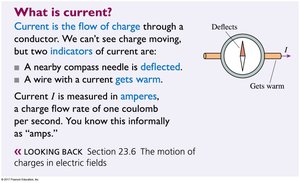
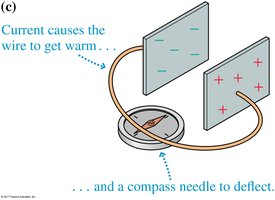
Current is the flow of electric charge through a conductor. It is measured in amperes (A), where 1 ampere equals 1 coulomb of charge passing a point per second. Indicators of current include the deflection of a nearby compass needle and the warming of a wire carrying current.
Definition: , where is current, is charge, and is time.
Unit: 1 ampere (A) = 1 coulomb/second (C/s).
Indicators: Magnetic effects (compass deflection), heating of the wire.
How Does Current Flow?
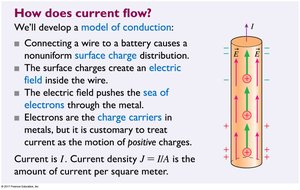
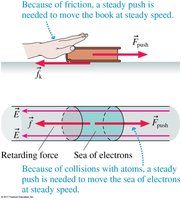
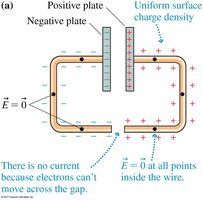
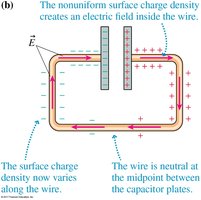
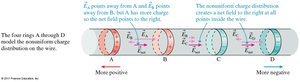
Current flows when a conductor is connected to a source of potential difference, such as a battery. This connection creates a nonuniform surface charge distribution, establishing an electric field inside the wire. The electric field pushes the sea of electrons (charge carriers) through the metal. Although electrons are the actual charge carriers in metals, conventional current is defined as the flow of positive charge.
Model of Conduction: Surface charges create an internal electric field .
Current Density: , where is current density and is cross-sectional area.
Kirchhoff’s Junction Law
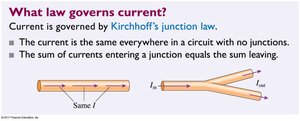
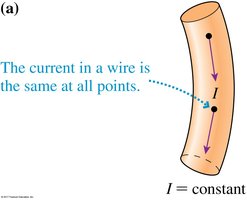
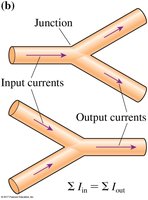
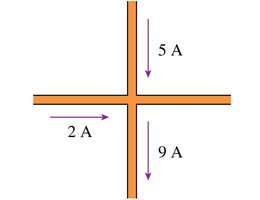
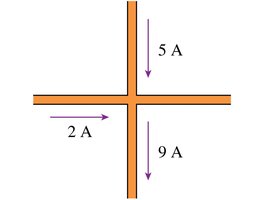
Current in a circuit is governed by Kirchhoff’s junction law, which states that the sum of currents entering a junction equals the sum of currents leaving. This law is a direct consequence of charge conservation and ensures that current is the same everywhere in a circuit with no branches.
Mathematical Statement:
Application: Used to analyze complex circuits with multiple branches.
Resistivity and Resistance
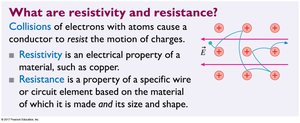
As electrons move through a conductor, they collide with atoms, causing the material to resist the motion of charges. Resistivity () is an intrinsic property of a material, while resistance () depends on both the material and the geometry of the conductor.
Resistivity (): Characterizes how strongly a material opposes current.
Resistance (): , where is length and is cross-sectional area.
Ohm’s Law
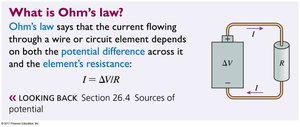
Ohm’s law relates the current through a conductor to the potential difference across it and the resistance of the conductor. It is valid for ohmic materials, where resistance remains constant as voltage changes.
Ohm’s Law:
Ohmic Materials: Materials for which is directly proportional to .
Microscopic View of Current
Discharging a Capacitor
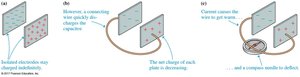
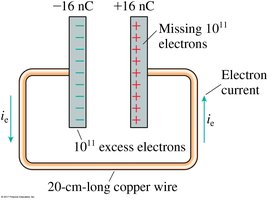
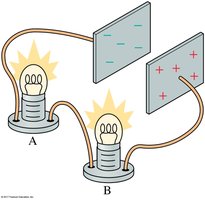
When a wire connects the plates of a charged capacitor, electrons flow from the negative to the positive plate, discharging the capacitor. The current can be detected by the warming of the wire and the deflection of a compass needle.
Charge Carriers in Metals
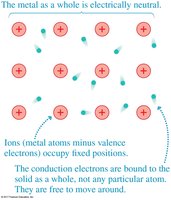
In metals, the outer electrons are only weakly bound and form a 'sea of electrons' that can move freely. These conduction electrons are responsible for carrying electric current.
Ions: Fixed positions in the lattice.
Conduction Electrons: Free to move throughout the solid.
Electron Current and Drift Speed
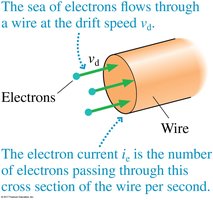
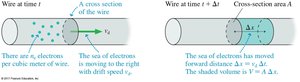
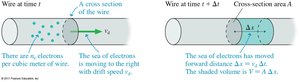
The electron current () is the number of electrons passing through a cross-section of the wire per second. The electrons move with a very slow average drift speed (), even though the electric field propagates much faster.
Drift Speed: Typical values are on the order of m/s.
Electron Current: , where is the cross-sectional area.

Conduction-Electron Density in Metals
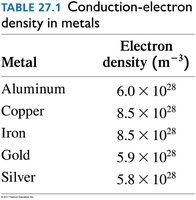
The number of conduction electrons per unit volume varies by material. This property is important for calculating current and conductivity.
Metal | Electron density (m-3) |
|---|---|
Aluminum | 6.0 × 1028 |
Copper | 8.5 × 1028 |
Iron | 8.5 × 1028 |
Gold | 5.9 × 1028 |
Silver | 5.8 × 1028 |
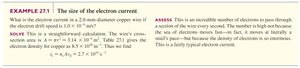
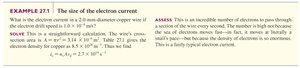
Example: The Size of the Electron Current
This example calculates the number of electrons passing through a wire per second, illustrating the immense scale of charge carrier movement even for small currents.
Discharging a Capacitor: The Role of the Electron Sea
Capacitors discharge rapidly because the wire is already full of electrons. Only a slight rearrangement of charges is needed, not the movement of individual electrons from one plate to the other.
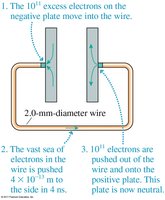
Establishing the Electric Field in a Wire
When a wire is connected between two points of different potential, surface charges rearrange rapidly, creating a nonuniform distribution. This establishes an internal electric field that drives the current.
Microscopic Model of Conduction
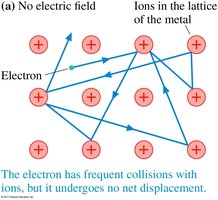
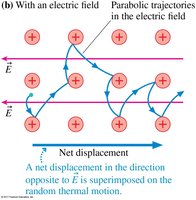
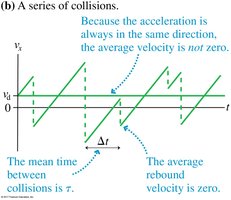
In the absence of an electric field, electrons move randomly and have no net displacement. When an electric field is present, electrons follow curved paths between collisions, resulting in a slow net drift opposite to the field direction.
Mean Free Path: Average distance between collisions.
Drift Velocity:

Current Density and Drift Speed
The current density is the current per unit area. It is related to the drift speed and the number density of electrons:
Formula:

Conservation of Current
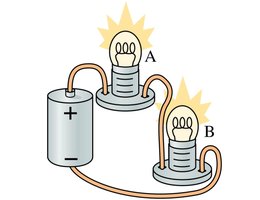
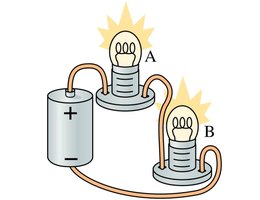
Current is conserved in a circuit: the rate at which charge enters any point is equal to the rate at which it leaves. This principle is crucial for analyzing circuits with multiple components.

Conductivity, Resistivity, and Ohm’s Law
Conductivity and Resistivity
Conductivity () measures how easily a material allows current to flow, while resistivity () measures how much it resists current. They are inversely related:
Conductivity:
Resistivity:


Resistance and Ohm’s Law
The resistance of a conductor depends on its resistivity, length, and cross-sectional area. Ohm’s law relates current, voltage, and resistance:
Resistance:
Ohm’s Law:
Summary Table: Key Quantities in Current and Resistance
Quantity | Symbol | Unit | Definition |
|---|---|---|---|
Current | I | A (ampere) | |
Current Density | J | A/m2 | |
Resistivity | ·m | ||
Conductivity | S/m | ||
Resistance | R | (ohm) |
Applications and Examples
Capacitor Discharge: Demonstrates rapid rearrangement of charges, not slow electron drift.
Light Bulbs in Series: Current is the same through both bulbs; brightness is equal if bulbs are identical.
Junctions in Circuits: Kirchhoff’s law ensures current conservation at every junction.
Summary
Current is the flow of charge, measured in amperes.
Current density, resistivity, and conductivity are key properties for understanding current flow in materials.
Ohm’s law relates current, voltage, and resistance for ohmic materials.
Kirchhoff’s junction law ensures conservation of current in circuits.
