 뒤로
뒤로Chapter 33: Wave Optics – Diffraction, Interference, and Applications
스터디 가이드 - 스마트 노트
 자료에 맞춘 맞춤형 노트, 핵심 정의, 예시, 맥락을 확장해 제공합니다.
Wave Optics: The Wave Nature of Light
Introduction to the Wave Model of Light
The wave model of light describes how light spreads out and how the superposition of multiple light waves causes interference. This chapter explores the phenomena that arise when light is treated as a wave, including diffraction and interference patterns.
Wave Model: Light behaves as a wave under many circumstances, exhibiting properties such as interference and diffraction.
Ray Model: Useful for understanding the behavior of light in mirrors and lenses, where light travels in straight lines.
Photon Model: In quantum physics, light is described as photons with both wave-like and particle-like properties.
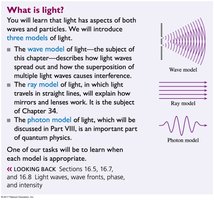
Additional info: The wave model is central to understanding phenomena such as diffraction and interference, which cannot be explained by the ray model alone.
Diffraction: The Spreading of Waves
What is Diffraction?
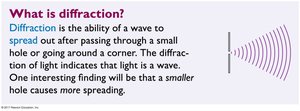
Diffraction is the ability of a wave to spread out after passing through a small hole or going around a corner. The observation of diffraction in light is strong evidence for its wave nature.
Smaller apertures cause more pronounced spreading of the wave.
Diffraction is more noticeable for waves with longer wavelengths.
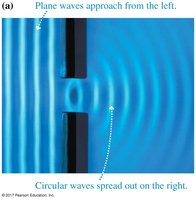
Diffraction of Water Waves and Light
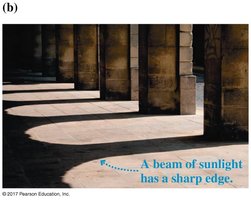
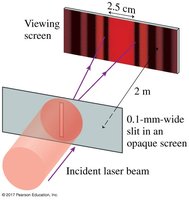
Water waves passing through an opening spread out to fill the space behind the opening, demonstrating diffraction. Light also exhibits diffraction, but due to its very short wavelength, noticeable spreading occurs only for very small apertures.
Interference: Superposition of Light Waves
Does Light Exhibit Interference?
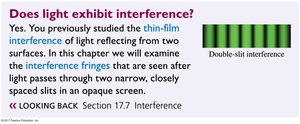
When two or more light waves overlap, they can interfere constructively (bright regions) or destructively (dark regions). This is observed as interference fringes in experiments such as the double-slit experiment.
Thin-film interference: Previously studied with light reflecting from two surfaces.
Double-slit interference: Examined in this chapter, where light passes through two closely spaced slits.
Young’s Double-Slit Experiment
Experimental Setup and Observations
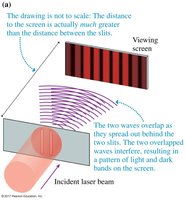
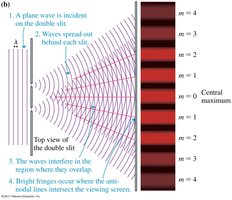
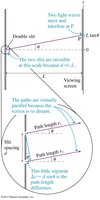
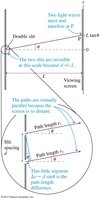
Young’s double-slit experiment was the first to demonstrate the wave nature of light. When coherent light passes through two closely spaced slits, an interference pattern of bright and dark fringes appears on a screen.
Constructive interference (bright fringes) occurs where the path difference between the two waves is an integer multiple of the wavelength.
Destructive interference (dark fringes) occurs where the path difference is a half-integer multiple of the wavelength.
Mathematical Analysis of Double-Slit Interference
The positions and angles of the bright fringes are given by:
Angle of bright fringes: , where
Position on the screen: , where is the distance to the screen and is the slit separation.


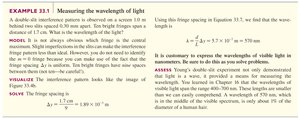
Example: Measuring the Wavelength of Light
By measuring the spacing between interference fringes, the wavelength of light can be determined using the double-slit formula.
Diffraction Gratings
What is a Diffraction Grating?
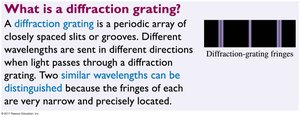
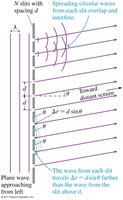
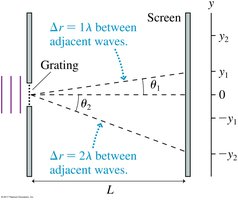
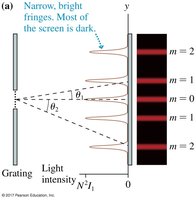
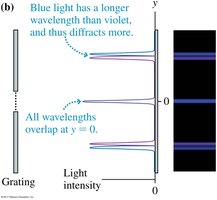
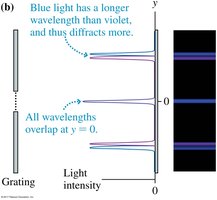
A diffraction grating is a periodic array of closely spaced slits or grooves. When light passes through a grating, different wavelengths are sent in different directions, producing sharp, well-defined interference fringes.
Diffraction gratings are used to distinguish between similar wavelengths due to their narrow and precisely located fringes.
Mathematical Description of Grating Interference
The condition for constructive interference (bright fringes) in a diffraction grating is:
, where is the slit spacing and is the order of the fringe.
The intensity of the bright fringes increases with the number of slits, , as .




Example: Measuring Wavelengths Emitted by Sodium Atoms
Diffraction gratings can be used to measure the wavelengths of light emitted by different atoms, such as sodium, by analyzing the positions of the bright fringes.
Applications of Interference and Diffraction
Uses of Interference
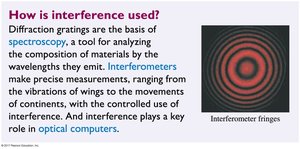
Diffraction gratings are fundamental in spectroscopy, which analyzes the composition of materials by the wavelengths they emit. Interferometers are used for precise measurements, and interference is also important in optical computing.
Natural Diffraction Gratings
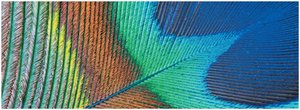
Some colors in nature, such as those in peacock feathers, are produced by natural reflection gratings—structures that act like diffraction gratings to separate light into its component colors.
Summary Table: Key Equations in Wave Optics
Phenomenon | Equation | Description |
|---|---|---|
Double-slit interference (angles) | Angles of bright fringes | |
Double-slit interference (positions) | Positions of bright fringes on screen | |
Diffraction grating | Angles of bright fringes for N slits | |
Grating intensity | Maximum intensity for N slits |
Conclusion
Wave optics reveals the wave nature of light through phenomena such as diffraction and interference. These effects are not only fundamental to our understanding of light but also have important practical applications in spectroscopy, measurement, and technology.
