 뒤로
뒤로Conservation of Energy in Physics: Concepts, Applications, and Problem Solving
스터디 가이드 - 스마트 노트
 자료에 맞춘 맞춤형 노트, 핵심 정의, 예시, 맥락을 확장해 제공합니다.
Conservation of Energy
Overview of Energy Types
Energy exists in various forms and is continually transformed from one type to another. In physics, energy is broadly classified into mechanical and non-mechanical types.
Mechanical Energy (M.E.): The sum of kinetic and potential energies in a system.
Non-Mechanical Energy (N.M.E.): Includes thermal, electrical, nuclear, light, sound, and other forms.
Kinetic Energy (K): Energy due to motion, given by .
Potential Energy (U): "Stored" energy due to position or configuration. Main types include gravitational and elastic (spring) potential energy.
Thermal Energy: Associated with friction, heat, and other dissipative processes.
Example: When a ball is dropped, gravitational potential energy is converted into kinetic energy as it falls.
Gravitational Potential Energy
As objects fall, gravity does work, increasing their speed and kinetic energy. This energy comes from gravitational potential energy (Ug), which is the energy due to an object's position in a gravitational field.
Formula:
Change in Gravitational Potential Energy:
Work Done by Gravity:
Key Points:
When objects fall: is positive, increases, decreases.
When objects rise: is negative, decreases, increases.
Potential energy is always calculated relative to a chosen reference point (often the lowest point in the problem).
Example: Dropping a 5.1 kg box from 10 m to 4 m: Calculate initial and final , and the change .
Conservation of Mechanical Energy
Mechanical energy (ME) is the sum of kinetic and potential energies in a system. If only conservative forces (like gravity and springs) do work, the total mechanical energy is conserved.
Mechanical Energy:
Conservation Equation:
Example: Dropping a 2 kg ball from a 100 m building: Calculate total mechanical energy at the top and just before hitting the ground.
Steps for Solving Energy Problems:
Draw a diagram.
Write the conservation of energy equation.
Expand and eliminate terms as needed.
Solve for the unknown.
Conservation of Total Energy and Isolated Systems
The total energy of a system is conserved if the system is isolated (no external forces do work; only internal forces act). The definition of the system is crucial in determining whether energy is conserved.
Isolated System: No net external force acts on the system.
Internal Forces: Forces between objects within the system.
External Forces: Forces from outside the system.
Example: A spring pushes a box. If the system is defined as only the box, energy is not conserved due to the external force from the spring. If the system is box + spring, energy is conserved.

Conservative vs. Non-Conservative Forces
Mechanical energy is conserved only if all forces doing work are conservative. Conservative forces (like gravity and springs) can store and recover energy, while non-conservative forces (like friction and applied forces) dissipate energy as heat or other forms.
Conservative Forces | Non-Conservative Forces |
|---|---|
Gravity (Weight) | Applied Forces |
Spring (Hooke's Law) | Friction |
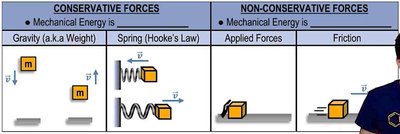
Example:
Block falls without air resistance: Energy conserved (gravity only).
Block compresses a spring: Energy conserved (spring force).
Block pushed by hand: Energy not conserved (applied force).
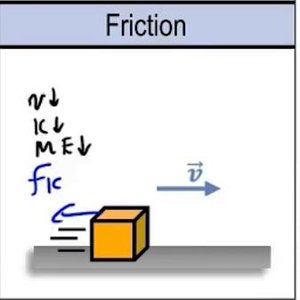
Block slows due to friction: Energy not conserved (friction).
Conservation of Energy with Non-Conservative Forces
If non-conservative forces do work (), mechanical energy is not conserved, but the total energy (including work done by non-conservative forces) is still accounted for.
General Energy Equation:
Work by Non-Conservative Forces: is the sum of work done by applied forces and friction.
Example: A hockey puck is pushed with a stick (applied force) on ice. Calculate the final speed using the energy equation.
Elastic (Spring) Potential Energy
Springs store energy when compressed or stretched. This energy is called elastic potential energy and is given by Hooke's Law.
Elastic Potential Energy:
Work by Spring:
Example: A block compresses a spring and is released. Use conservation of energy to find the block's speed after release.
Projectile Motion and Curved Path Problems with Energy Conservation
Energy conservation can simplify projectile and curved path problems, especially when solving for speed or height. For objects moving in curved paths (like rollercoasters or pendulums), energy methods are often the only practical approach.
Conservation Equation:
For rollercoasters, the minimum speed at the top of a loop and the required starting height can be found using energy conservation and centripetal force requirements.
Potential Energy Graphs and Equilibrium
Potential energy graphs plot potential energy versus position. The total mechanical energy is constant (if ), and kinetic energy at any point is the difference between total energy and $U(x)$.
Turning Points: Where , the object changes direction.
Force from Potential Energy:
Equilibrium Points: Where the slope of is zero ().
Stable Equilibrium: Local minimum of ; object returns if nudged.
Unstable Equilibrium: Local maximum of ; object does not return if nudged.
Example: Analyzing a marble's motion on a graph to determine kinetic energy, speed, and reachable positions.
Summary Table: Conservative vs. Non-Conservative Forces
Type of Force | Examples | Energy Conserved? |
|---|---|---|
Conservative | Gravity, Springs | Yes |
Non-Conservative | Friction, Applied Forces | No (mechanical energy not conserved) |
Additional info: In all energy conservation problems, clearly define the system, identify all forces, and choose appropriate reference points for potential energy. For systems with multiple objects, sum the energies of all objects and account for connections (e.g., pulleys, strings).
