 뒤로
뒤로Conservation of Mechanical Energy and Potential Energy in Physics
스터디 가이드 - 스마트 노트
 자료에 맞춘 맞춤형 노트, 핵심 정의, 예시, 맥락을 확장해 제공합니다.
Ch 10: Interactions and Potential Energy
Concept: Conservation of Mechanical Energy
The mechanical energy (ME) of a system is the sum of its kinetic energy (K) and potential energy (U). Mechanical energy is conserved in a system when energy is transferred between kinetic and potential forms without loss to other types (such as heat or sound).
Mechanical Energy Equation:
Kinetic Energy:
Gravitational Potential Energy:
Conservation of Mechanical Energy: (if no non-conservative work is done)
Example: Dropping a 2 kg ball from a 100 m building: Calculate total mechanical energy at the top and just before hitting the ground. Use at each point.
Solving Energy Conservation Problems
To solve problems using conservation of energy:
Draw a diagram of the system.
Write the conservation of energy equation.
Expand and eliminate terms as needed.
Solve for the unknown.
Example: Launching a 4 kg object upward with 40 m/s: Use energy conservation to find the maximum height.
Concept: Conservation of Total Energy and Isolated Systems
The total energy of a system is conserved if the system is isolated (no external forces do work; only internal forces act). A system is a chosen collection of objects. If any net force is external, the system is not isolated and total energy is not conserved.
Internal Forces: Forces between objects within the system.
External Forces: Forces from outside the system.
Example: A spring pushes a box. If the system is only the box, external forces (spring) act. If the system is box + spring, all forces are internal and energy is conserved.

Concept: Conservative vs. Non-Conservative Forces
Conservative forces (e.g., gravity, springs) allow mechanical energy to be conserved. Non-conservative forces (e.g., friction, applied forces) cause mechanical energy to change, usually converting it to other forms like heat.
Conservative Forces: Gravity, spring force (Hooke's Law)
Non-Conservative Forces: Friction, applied forces
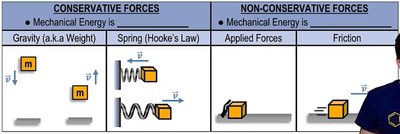
Example Situations:
Situation | Energy Conserved? | Energy Transfers |
|---|---|---|
Block falls without air resistance | Yes | Potential to kinetic |
Block hits spring and rebounds | Yes | Kinetic to elastic potential and back |
Block pushed by hand | No | Work done by applied force |
Block slows due to friction | No | Kinetic to thermal (friction) |
Conservative forces are reversible; energy lost can be recovered by reversing the process.
Concept: Conservation of Energy Equation with Non-Conservative Forces
If non-conservative forces do work (), mechanical energy is not conserved, but the total energy is still accounted for using the work-energy principle:
is the sum of work done by applied forces and friction.
Work by a force:
Work by friction:
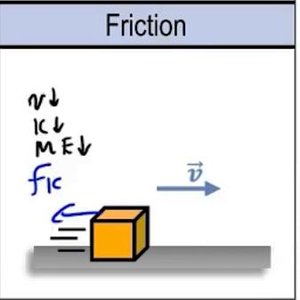
Example: A hockey puck is pushed with a stick; calculate final speed using work and energy.
Concept: Elastic (Spring) Potential Energy
Springs store elastic potential energy when compressed or stretched. This energy is combined with gravitational potential energy in conservation equations.
Elastic Potential Energy:
Work by Spring:
Example: A block compresses a spring; calculate compression distance and launch speed using energy conservation.
Concept: Potential Energy Graphs
Potential energy graphs plot versus position . The total mechanical energy is constant (if ), and kinetic energy at any point is the difference between total mechanical energy and .
Kinetic Energy from Graph:
Objects remain between turning points where if no energy is added.
Example: A marble moves according to a graph; calculate total energy, kinetic energy at a point, speed, and whether it can reach a certain position.
Concept: Forces and Equilibrium in Potential Energy Graphs
The sign of the force at any point is the opposite of the slope of . Equilibrium points occur where the slope is zero:
Stable Equilibrium: Local minimum of ; object returns if nudged.
Unstable Equilibrium: Local maximum of ; object does not return if nudged.
Example: Identify force direction and equilibrium points from a graph.
Summary Table: Conservative vs. Non-Conservative Forces
Type | Examples | Mechanical Energy |
|---|---|---|
Conservative | Gravity, Spring | Conserved |
Non-Conservative | Friction, Applied Forces | Not Conserved |
Additional info: The notes also include step-by-step problem-solving strategies, emphasizing the importance of identifying the system, drawing diagrams, and carefully applying the conservation of energy principle to both simple and complex systems, including those with multiple objects, resistive forces, and springs.
