 뒤로
뒤로Continuous Charge Distributions and Electric Flux: Study Notes
스터디 가이드 - 스마트 노트
 자료에 맞춘 맞춤형 노트, 핵심 정의, 예시, 맥락을 확장해 제공합니다.
Motion of Charged Particles in Electric Fields
Charged Particle Dynamics
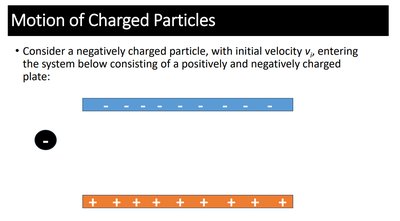
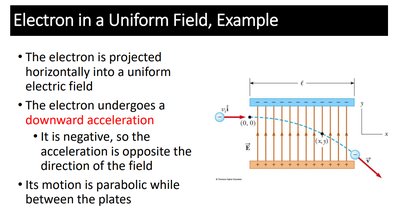
When a charged particle enters an electric field, it experiences a force due to the field. The direction and magnitude of this force depend on the sign and magnitude of the charge and the electric field strength.
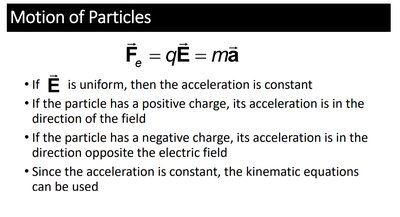
Electric Force: The force on a charge q in an electric field E is given by .
Newton's Second Law: The resulting acceleration is , where m is the mass of the particle.
Direction of Acceleration: For a positive charge, acceleration is in the direction of E; for a negative charge, it is opposite.
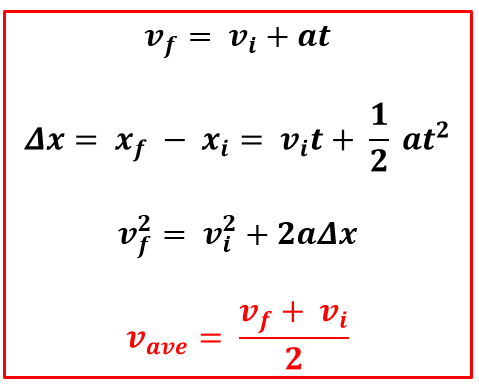
Kinematics: If E is uniform, acceleration is constant and kinematic equations apply.
Continuous Charge Distributions
Concept of Continuous Charge
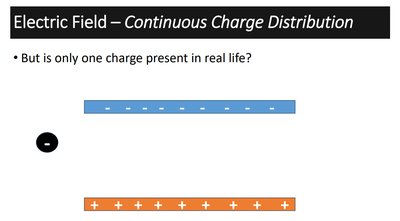
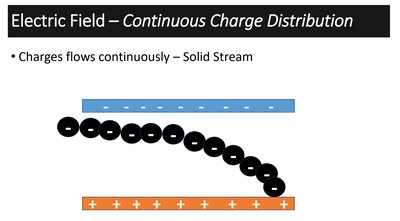
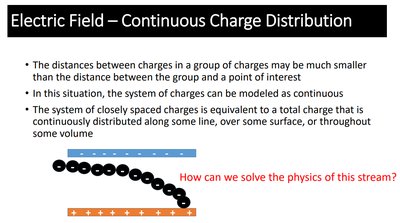
In real systems, charges are often distributed over regions of space rather than existing as isolated points. When the spacing between charges is much smaller than the distance to the observation point, the distribution can be treated as continuous.
Continuous Distribution: Closely spaced charges are modeled as a continuous charge distribution.
Types of Distributions: Charge can be distributed along a line (linear), over a surface (surface), or throughout a volume (volume).
Mathematical Tools: Calculus Review
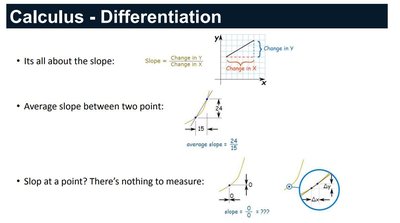
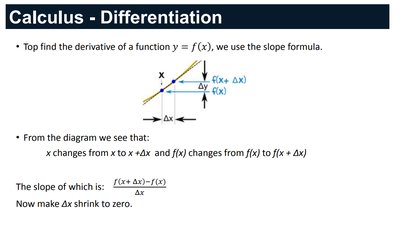
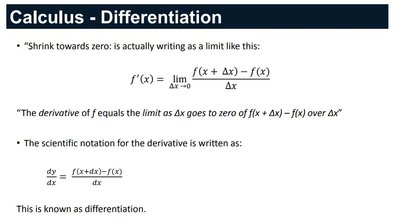
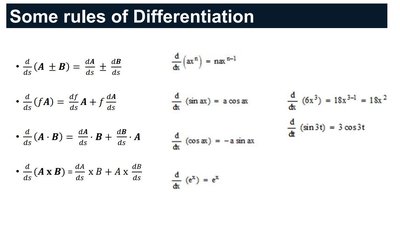
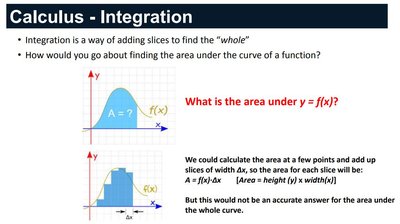
Calculus is essential for analyzing continuous charge distributions. Differentiation finds rates of change, while integration sums contributions over a region.
Differentiation: Measures the rate of change (slope) of a function. The derivative is defined as .
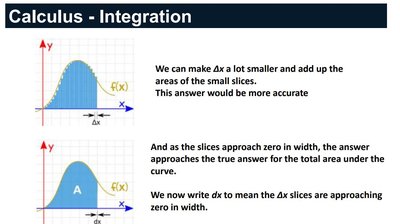
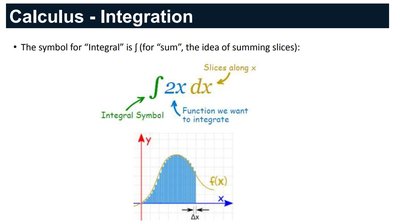
Integration: Sums infinitesimal contributions to find totals, such as total charge or electric field. The integral is written as .
Electric Field from Continuous Charge Distributions
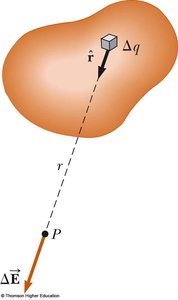
The electric field at a point due to a continuous charge distribution is found by dividing the distribution into small elements, calculating the field from each, and integrating over the entire distribution.
Field from Element: , where is the charge element and is the distance to the point of interest.
Total Field:
Charge and Mass Densities
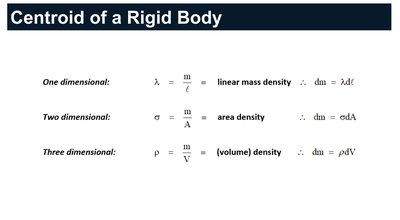
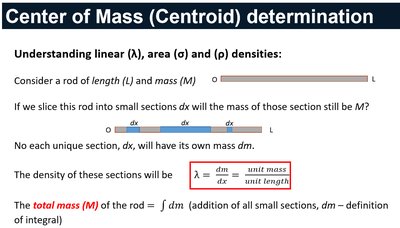
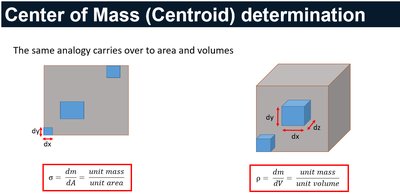
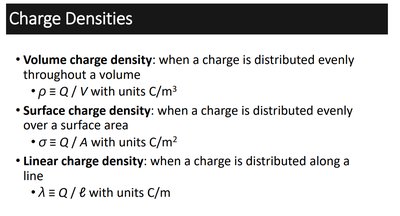
Charge and mass densities describe how charge or mass is distributed in space.
Linear density: (C/m or kg/m)
Surface density: (C/m2 or kg/m2)
Volume density: (C/m3 or kg/m3)
Amount of Charge in a Small Volume
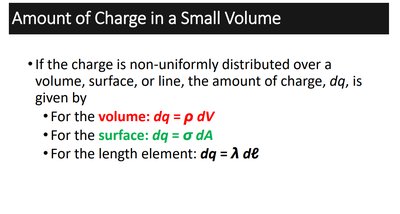
If the charge is non-uniformly distributed, the infinitesimal charge element is:
For volume:
For surface:
For line:
Example: Electric Field of a Uniformly Charged Rod
To find the electric field at a point along the axis of a uniformly charged rod:
Divide the rod into small segments of length with charge .
Each segment contributes to the field at point P.
Integrate over the length of the rod to find the total field.
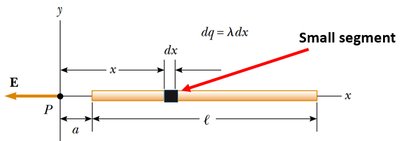
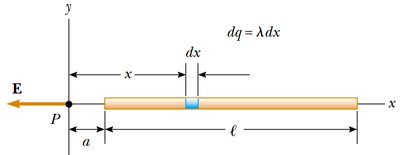
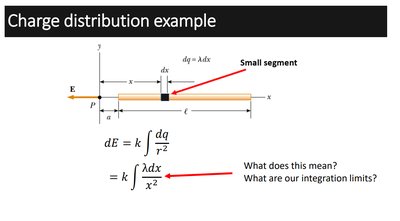
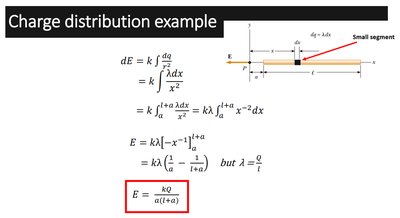
The result for a rod of length and total charge at a distance from one end is:

Dot Product, Cross Product, and Flux
Dot Product
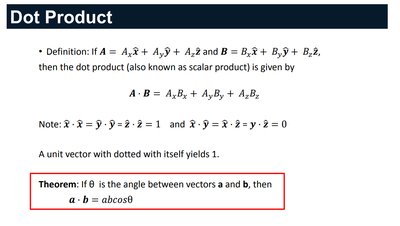
The dot product (scalar product) of two vectors a and b is:
It measures the component of one vector along the direction of another.

Cross Product
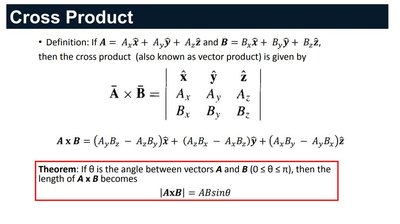
The cross product (vector product) of two vectors a and b is:
It gives a vector perpendicular to both a and b.
Electric Flux
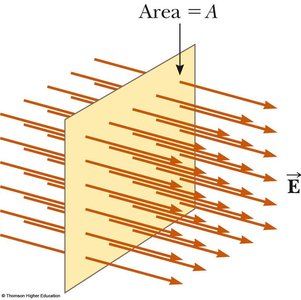
Electric flux quantifies the number of electric field lines passing through a surface. For a uniform field perpendicular to a flat surface:
If the field makes an angle with the normal to the surface:
For a non-uniform field or curved surface, the flux is found by integrating:
Units: The SI unit of electric flux is N·m2/C.
*Additional info: The notes above include expanded explanations and context for calculus and vector operations as they are foundational for understanding continuous charge distributions and electric flux in physics.*
