 뒤로
뒤로Current and Resistance: Study Notes for Physics Students
스터디 가이드 - 스마트 노트
 자료에 맞춘 맞춤형 노트, 핵심 정의, 예시, 맥락을 확장해 제공합니다.
Current and Resistance
Charge Carriers in Metals
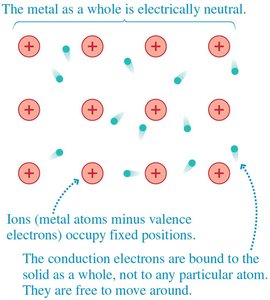
In metallic conductors, the outer electrons of atoms are only weakly bound to their nuclei. These electrons become detached and form a 'sea' of conduction electrons, which are free to move throughout the solid. The movement of these electrons underlies the concept of electric current in metals.
Conduction electrons are responsible for carrying charge in metals.
The metal as a whole remains electrically neutral, with positive ions fixed in place and electrons free to move.
The Electron Current
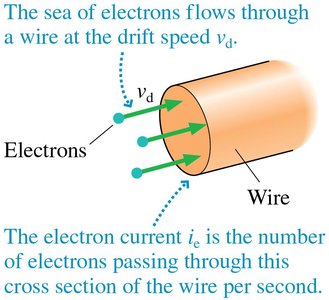
The electron current () is defined as the number of electrons passing through a cross-section of a conductor per second. If electrons pass through in a time interval , then:
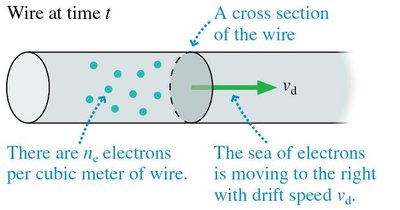
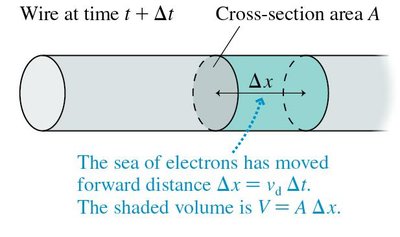
If the number density of conduction electrons is , the total number of electrons in a segment of wire of cross-sectional area and length is .
Since (where is the drift speed), .
Thus,
Electron Density in Metals
Each atom in a metal typically contributes one conduction electron. The number density is thus approximately equal to the number of atoms per cubic meter. Typical values for common metals are:
Metal | Electron Density ( m) |
|---|---|
Aluminum | 18 |
Iron | 17 |
Copper | 8.5 |
Gold | 5.9 |
Silver | 5.8 |
Example: Calculating Electron Current
For a 2.0-mm-diameter copper wire with electron drift speed m/s and m:
Cross-sectional area: m
Electron current: electrons/s
Discharging a Capacitor
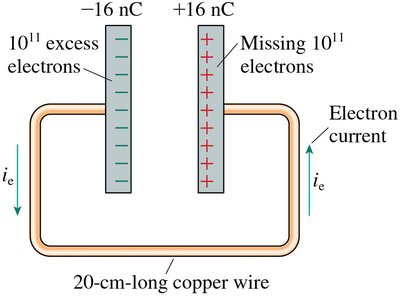
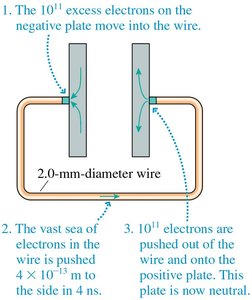
Although the drift speed of electrons is slow, capacitors discharge almost instantaneously because the wire is already full of electrons. Discharging involves only a slight rearrangement of charges, not the movement of individual electrons from one plate to another.
Creating and Sustaining a Current
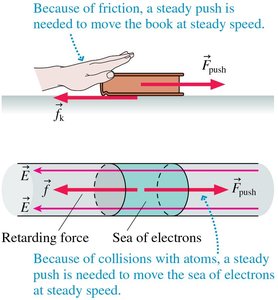
To maintain a steady current, a continuous 'push' is needed, analogous to pushing a book across a table against friction. In conductors, this push is provided by an electric field.
Establishing the Electric Field in a Wire
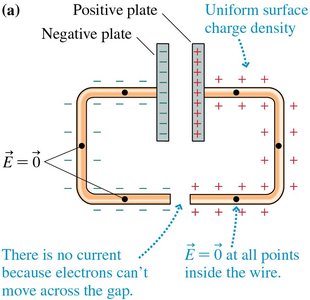
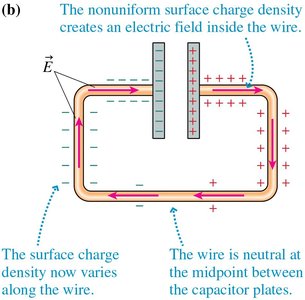
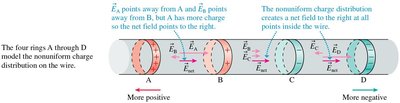
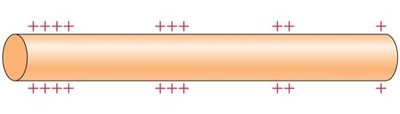
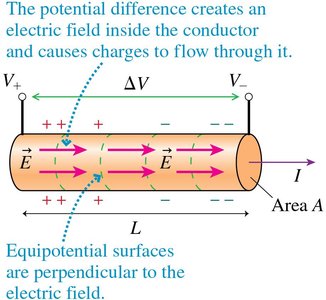
When two wires are connected to the plates of a charged capacitor, surface charges rearrange almost instantly, creating a nonuniform distribution. This distribution establishes an internal electric field that drives the electron current.
Direction of Electron Drift
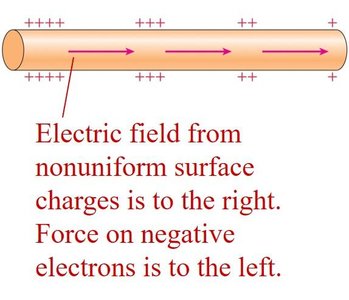
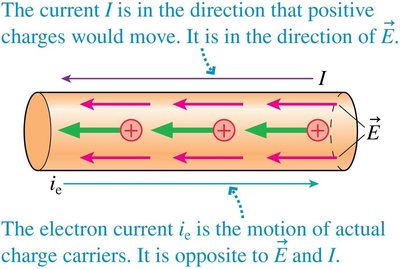
The internal electric field points from the more positive to the more negative end of the wire, causing electrons (negative charge carriers) to drift in the opposite direction.
A Model of Conduction
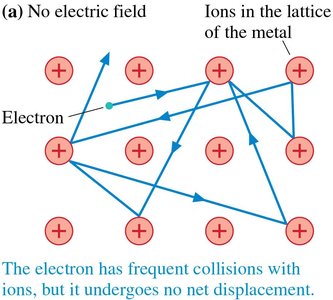
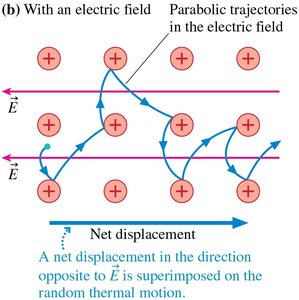
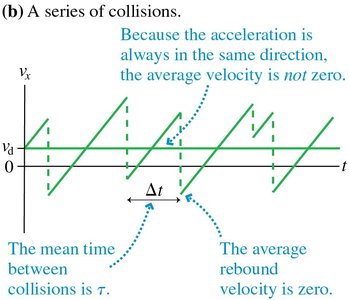
In electrostatic equilibrium (no electric field), electrons move randomly and have zero average velocity. When an electric field is present, electrons follow curved paths between collisions, resulting in a slow net drift opposite to the field.
Electron Current and Electric Field
The electric field in a wire of cross-section causes an electron current:
Here, is the mean time between collisions, and is the electron mass.
The electron current is directly proportional to the electric field strength.
Current and Conventional Current
The total current is the rate at which charge flows through a wire:
SI unit: ampere (A), where
The direction of conventional current is opposite to the direction of electron flow in metals.
Current Density
The current density is the current per unit area:
Units: A/m
Resistance and Ohm's Law
The resistance of a conductor is defined as:
, where is the resistivity, is the length, and is the cross-sectional area.
The current through a conductor is proportional to the potential difference across it: (Ohm's Law).
Unit of resistance: ohm (), where
Ohmic and Nonohmic Materials
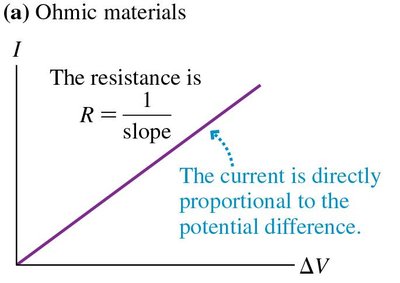
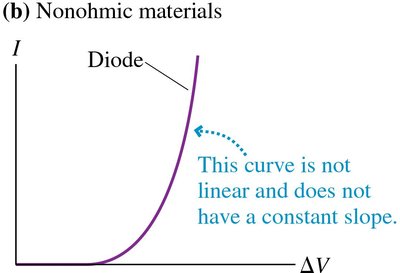
Materials that obey Ohm's law (constant ) are called ohmic. For these materials, the current is directly proportional to the potential difference. Nonohmic materials (e.g., diodes, batteries, capacitors) do not have a constant resistance, and their - relationship is nonlinear.
Batteries and Circuits
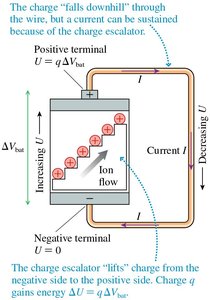
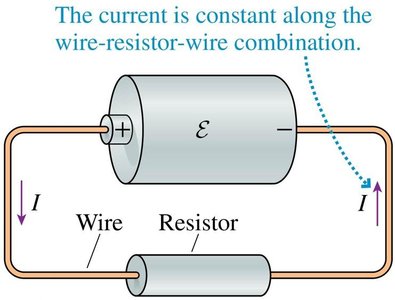
A battery provides a potential difference that drives current through a circuit. The current in a simple battery-wire-resistor circuit is the same at all points, and is given by .
Summary Table: Key Equations
Quantity | Equation | Units |
|---|---|---|
Electron current | electrons/s | |
Current | A (C/s) | |
Current density | A/m | |
Resistance | ||
Ohm's Law | A |
Additional info: These notes cover the fundamental concepts of electric current, electron flow, current density, resistance, Ohm's law, and the behavior of ohmic and nonohmic materials, as well as the role of batteries in circuits. The included images reinforce the physical models and equations described.
